Category Archives: Online News

British Journalists Chastened on Ethics

newsofworld

Ethics violations close Britain’s News of the World. itv.com photo.

“Let not England forget her precedence of teaching nations how to live.” —Milton

By Casey Bukro

British journalists are more likely to pay sources for information than American journalists, but journalists in both countries agree that providing reliable information is their chief goal.

These are among the conclusions of a survey of 700 of the United Kingdom’s almost 64,000 professional journalists, by the Reuters Institute for the Study of Journalism at the University of Oxford.

On ethics and standards, said the report:

“There is a close correspondence between U.K. journalists’ views on ethics and their professional codes of practice. However, they are more likely to find justification for ethically contentious practices, such as paying sources, than journalists in the United States.

“Rank and file journalists in the U.K. push ethical boundaries more than their managers, and 25 percent of all journalists believe it is justified, on occasion, to publish unverified information.”

As for misrepresentation and subterfuge, U.K. journalists expressed mixed views about whether claiming to be somebody else is acceptable. Fifty-four percent believe it is never justified and 46 percent think it is justified on occasion. U.S. journalists, according to the study, are more disapproving, with only 7 percent agreeing that misrepresentation is justified on occasion.

Continue reading British Journalists Chastened on Ethics

Photo of Halloween Display Challenges Editor’s Ethics

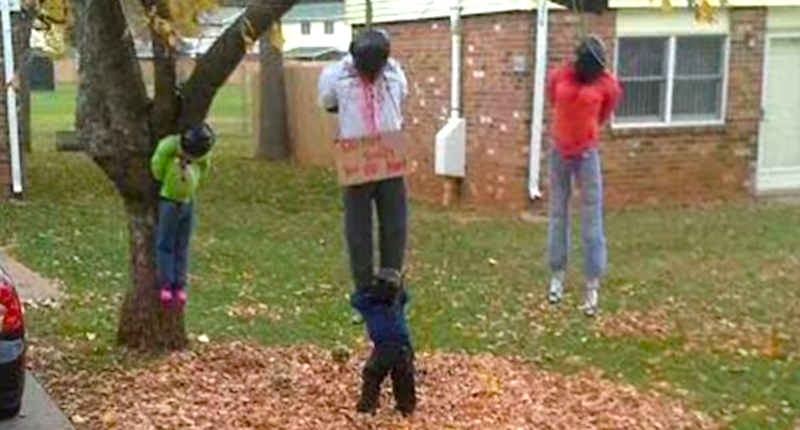
Halloween display at Fort Campbell taken down after complaints.
Halloween display at Fort Campbell taken down after complaints. Contributed photo from clarksvillenow.com.

By Casey Bukro

Lynching is no joking matter in the United States. News manager Robert Selkow found himself in the middle of a controversy over a Halloween display featuring three figures hanging from a tree.

“I got a photo on a smartphone,” recalled Selkow, who is site manager and news director of clarksvillenow.com, an online hyperlocal website affiliated with six radio stations serving Middle Tennessee and southern Kentucky.  “It looked like a scene out of (the movie) ‘Mississippi Burning,’ black figures being hanged.”

He said it turned out to be “the most powerful image we ever published.”

Selkow contacted Ethics AdviceLine for Journalists in facing this sensitive issue, and agreed to discuss details of the case publicly.

The offensive Halloween display was in the residential area of the Fort Campbell military base on the Kentucky-Tennessee border near Clarksville.

Continue reading Photo of Halloween Display Challenges Editor’s Ethics

Police Video: Searching for the Limit to Gruesome

By Casey Bukro

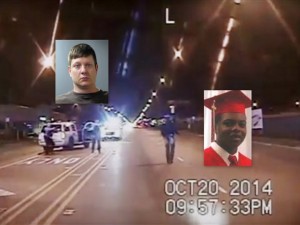
Chicago Police Officer Jason Van Dyke shot 17-year-old Laquan McDonald 16 times, and every second of that fatal shooting was recorded by a police car dashboard camera in the middle of a Chicago street.

That video has been broadcast countless times, showing every twitch of the body and what appear to be puffs rising from McDonald’s body as bullets strike.

Chicago police officer Jason Van Dyke and Laquan McDonald.

It’s gruesome, but it shows exactly what happened. The video is compelling evidence to disprove early police accounts that McDonald, who was black, was walking toward police with a knife in his hand and menacing police.

The video indicates that McDonald was walking away from police when Van Dyke, who is white, opened fire with a barrage that caused McDonald to twirl around, drop on his backside and roll to his right. Van Dyke kept shooting as McDonald lay in the street Oct. 20, 2014.

An autopsy confirmed that McDonald was shot 16 times. Van Dyke was indicted on six counts of first-degree murder and one count of official misconduct.

Police misconduct in shooting deaths in the United States is a major story propelled by television, a visual medium.

The use of phone video or dashboard cameras are recent developments that make it possible to show what happened, rather than rely on police or witness accounts. Technology is playing a bigger role in proving guilt or innocence.

But how many times is it necessary to show McDonald striding toward police, then falling to the ground as Van Dyke shoots him? Sometimes the whole scene is broadcast, sometimes it is edited so that it shows McDonald walking toward police.

Continue reading Police Video: Searching for the Limit to Gruesome

A Second Look at the Mizzou Uproar, Pros and Cons


thefederalist.com photo


By Casey Bukro

Since all the Ethics AdviceLine for Journalists consultants teach on campuses across the country, it seemed logical to ask them how they and their students reacted to events that played out at the University of Missouri over press freedoms and protests over racial tensions.

An earlier AdviceLine blog post focused on what appeared to be an attack on First Amendment press freedoms when faculty member Melissa Click attempted to banish two student photographers from the protest scene, for which she later apologized.

Hugh Miller, assistant professor of philosophy at Loyola University Chicago, took what he called a contrarian view.

“I disagree,” said Miller, citing a lawyer friend who pointed out that the First Amendment of the U.S. Constitution “is a restriction imposed upon the state, not upon individuals…. It imposes no restrictions on individuals.

“Reporters are perfectly free to jam a microphone in my face – no government authority can prevent them from doing so. And I am perfectly free to tell such reporters to get stuffed if I don’t want to talk or have them around. In so doing I do not violate the First Amendment. The First Amendment is not, IMHO [in my humble opinion], a license for journalists to demand, and get, access to coverage.

“Whether the contested access is on public property makes little difference to the First Amendment issue (though it may be important in a property rights sense). Nor does the First Amendment impose duties or obligations upon individuals to afford journalists the opportunity to cover them.

Continue reading A Second Look at the Mizzou Uproar, Pros and Cons

A Code of Ethics All Your Own

By Casey Bukro

Everyone is in favor of ethics, until you get into the details. That’s when the fights break out.

This is something the Online News Association is likely to learn as it makes its way through a project called the Build Your Own Ethics Code. Journalists are invited to crowdsource and document their ethical practices.

Code of Ethics
Can Stock Photo

I have some personal experience in this realm. Back in 1972, I was national professional development committee chairman for Sigma Delta Chi, later named the Society of Professional Journalists.

The public, then as now, tended to have a low opinion of journalists. A public opinion poll in 1972 showed only 19 percent of the public had confidence in the press. Garbage collectors ranked higher.

Hoping to counteract that, delegates at the 1972 convention in Dallas adopted a resolution asking the group to do something about that low image of American journalists. That resolution was sent to my committee.

We decided to write a code of ethics reflecting SDX values and standards, acting on a constitutional mandate to inform the public as part of journalism’s role in a democracy. We wanted to show that journalists do have standards, and can act in an ethical manner.

Continue reading A Code of Ethics All Your Own

Killing the Messenger, Live: Journalists Killed on Video

By Casey Bukro

Killing the messenger takes new meaning when you see it live, in living color, as happened in the deaths of a Virginia television news reporter and her cameraman.

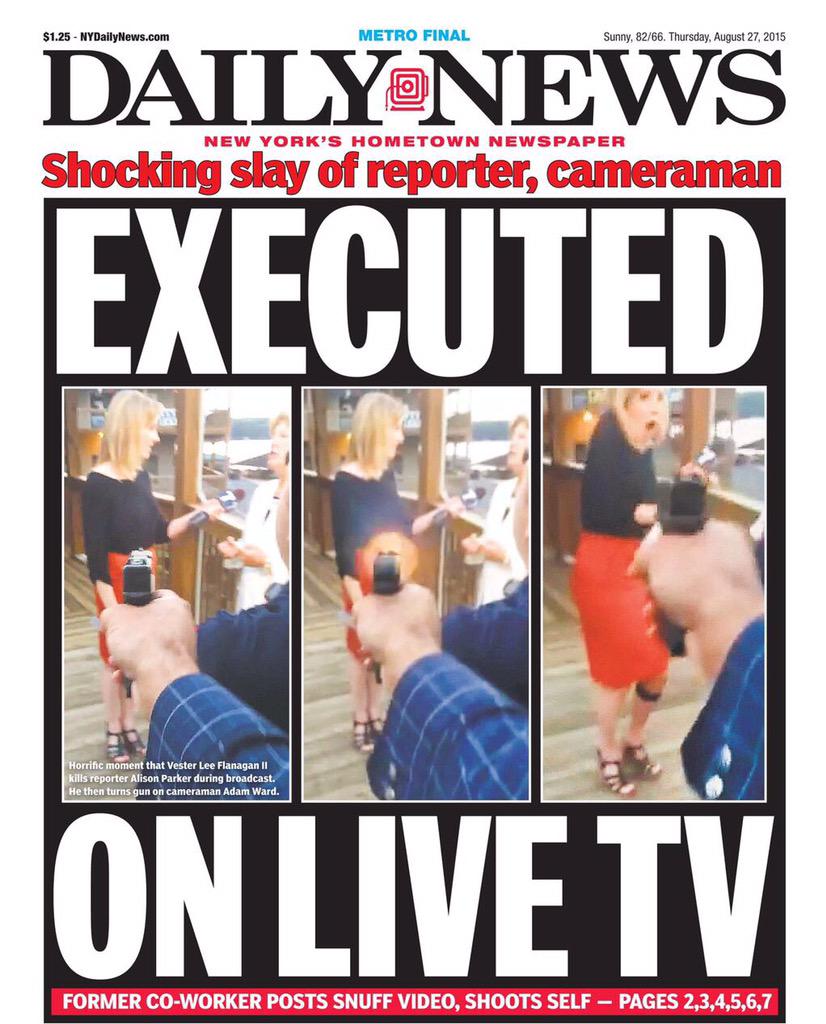
WDBJ correspondent Alison Parker was conducting an on-air interview in a Moneta, Va., shopping center when she and the photographer, Adam Ward, were shot and killed by a disgruntled former colleague who also videotaped the attack and put it on social media.

The New York Daily News gave the murders front-page display, in very graphic detail than some TV outlets shunned.

Embedded image permalink

Killings on video are increasingly common these days. Journalists are among those targeted now, becoming victims and not just reporters of  events. Parker and Ward’s names are now added to a list that included James Foley and Daniel Pearl.

Tech-savvy killers use social media and the internet these days to show their crimes.

The Islamic State group released a video in 2014 showing Foley, clad in an orange gown, kneeling on the ground next to a man dressed in black holding a knife. Foley makes a short statement and then is decapitated.

In 2002, Pearl, a correspondent for The Wall Street Journal, disappeared while on assignment in Karachi, Pakistan. Video shown around the world via the Internet showed Arab extremists cutting his throat, then decapitating the reporter.

In this world of social media, terrorists don’t need reporters to tell their message. Terrorists can do that themselves now, and one way of doing that is killing reporters.

Continue reading Killing the Messenger, Live: Journalists Killed on Video

Bomb Threats Tilt GamerGate Event

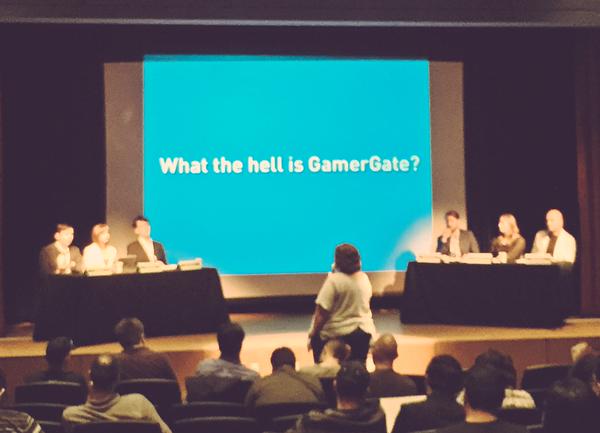
SPJ AirPlay panel
SPJ AirPlay panel (SPJ Florida photo)

By Casey Bukro

GamerGate from its beginning a year ago seemed touched by lunacy, and that was borne out when bomb threats forced the abrupt closure of a video-game program in Miami.

The Society of Professional Journalists event AirPlay aimed to pin down the social-media campaign GamerGate – whether it’s about journalism ethics and accurate reporting about the video-game industry, attacks on women in the male-dominated industry, or resistance to political correctness and censorship. Or something else.

The conference goal was to “make a good gaming press better, or a bad gaming press good,” said Michael Koretzky, an SPJ regional director who organized and moderated. The conference “concocted some novel yet practical ideas for achieving that,” he said, such as an SPJ award for games journalism or recruiting games media critics.

A Twitter feed and hashtag and a YouTube channel suggest the event provoked lively discussion. SPJ secretary/treasurer Lynn Walsh said “if mainstream media jumps on this, it should be done well and ethically.”

Topics included plagiarism, fabrication, anonymity, fair reporting and the performance of Gamer writers. Koretzky asked about a “troll patrol,” how to vet or write about their social-media statements, and how to expose anonymous digital mischief-makers.

Then it all ground to a halt.

Miami police cleared the building after a series of bomb threats, UPI reported. Breitbart.com reported that the event got 10 bomb threats before police stopped the program and moved participants out of the building and into the streets.

Koretsky said two separate conferences in the building drew about 135 participants, of which about 60 attended the AirPlay event.

AirPlay was supposed to teach us something about GamerGate. AdviceLine asked Koretzky what the abbreviated conference taught him.

“I learned I was right about one thing,” Koretsky responded in an email. “Face-to-face opens minds. As for the bomb threat, it was awesome. It happened only 30 minutes before we ended, and it made @SPJAirPlay trend worldwide.”

Such threats are not new to GamerGate. Earlier this year a bomb threat cleared 300 people from a Washington, D.C., event aimed at GamerGate supporters. And Anita Sarkeesian, creator of a video series of pop-culture critiques, canceled an appearance at Utah State University last year because of the threat of a mass shooting.

AdviceLine asked Koretzky if continued threats of violence prove that some of those GamerGate folks really are nuts.

“I knew some GGers were nuts from the get-go,” he said. “But I learned just how many aren’t. I’d say it’s 50-50 &ndash which might offend both sides. But really, that’s a ringing GG endorsement, since so many folks told me the stat was 100 percent.”

And what else did he learn from the event?

“I’ve been talking to some gaming journalists post-AirPlay about why it wasn’t covered. Interestingly, the reporters are cool, editors are not. So once again, it’s age more than philosophy.”

As for his next move, Koretzky said he’s considering hosting a feminism-and-media debate.

Mark Samenfink, a lifelong gamer, wrote that he was frustrated by the way the Miami GamerGate event ended.

“This feels like a hollow victory,” Samenfink wrote. “But since at least half of the event took place (and was streamed live, worldwide), it’s not completely hollow. I was excited all day, my hype was real, I sat down to watch the debates and was overjoyed by them, but this … it just killed the mood.”

Did the gaming press cover the event?

“No,” said Koretzky, “just the bomb threats, and some not even that. It says more in defense of GG than anything else to date.”


GamerGate Revisited: Is It Really About Journalism Ethics?

AirPlay

By Casey Bukro

Is GamerGate about ethical violations in video-game journalism?

Or is GamerGate just a smokescreen for harassing women who want to work in the male-dominated gaming industry?

Or is it something else?

A live-streamed debate will sort it out Aug. 15 in Miami.

Elements in the controversy include the $15 billion video game industry, the video game press, game reviewers, developers, commentators and those who sell advertising in gaming magazines. It’s a volatile mixture.

Michael Koretzky, a regional director for the Society of Professional Journalists, organized the conference and will moderate. His region covers Alabama, Georgia, Florida and South Carolina. Sponsors are the region and SPJ Florida.

AdviceLine questioned Koretzky on the key issues:

Continue reading GamerGate Revisited: Is It Really About Journalism Ethics?

Ethics of Purging Negative Stories From News Archives

From the Ethics AdviceLine for Journalists archives

By Casey Bukro

Back in 2005, the executive editor of a California chain of community newspapers called AdviceLine with a newly emerging problem: People wanted old stories about them removed from the web archives, or blocked from Google searches.

Would that be ethical, the news executive asked?

It was a small problem then, in its infancy. Today, it’s a hot topic. A French court order holds that search engines must consider requests to remove dated links, including news stories.

In the U.S., search engines entertain appeals to remove links for issues from piracy to “revenge porn” to copyright violations. Editors continue to field requests to “unpublish” stories. “Stay on the phone until you solve the issue,” one company advises aggrieved news subjects.

“There are a number of companies out there in the business of helping people scour themselves out of online archive data,” said the digital news editor of the California media organization from which the AdviceLine question originated 10 years ago. The executive editor who posed the question retired, and a lot more has changed in the news world.

Because the deletion issue is so controversial now, the digital news editor preferred that his identity remain confidential, along with the identity of his news organization.

“It’s been an issue for years,” said the digital news editor, “since Google started indexing news content and since people began to realize that as part of a standard for employers, many look at what you do on social media and what you do on the web.”

Here’s the organization’s policy today:  “What we’ve posted online is part of our record online for publication. Our general rule is we do not remove that. If there is an error in fact, we will correct it. Or if it needs an update, we will update.”

The editor pointed out that policies change, and that could change in the future.

For that California executive editor, here’s how it started 10 years ago. One person, now divorced, wanted mention of the marriage removed from the website. A person convicted of a felony five years ago wanted the story removed, and was threatening to sue. A beauty shop owner wanted the name of a beautician removed from a story about the beauty shop because the beautician doesn’t work there anymore.

The editor asked: Is there anything unethical in keeping electronic archives? Is there any ethical requirement to honor requests for deletion? If it’s expensive to do so, would it still be ethically required? Is there an ethical requirement that a newspaper contact Google about selective removal of items from their search engines?

The AdviceLine ethics consultant at the time, David Ozar, professor of Social and Professional Ethics at Loyola University Chicago,  said, “this is an issue of benefit/harm and the first issue is what benefit the archives offer the community. The answer is the benefit of an historical record.”

The ethicist and the editor discussed whether there is any significant ethical difference between a paper archive and an electronic archive. They decided an electronic archive is more useful to the community because it is more easily accessed and searched. Therefore, the electronic archive is of greater benefit to the community than a paper archive.

Both archives, however, might contain old information that some individuals might prefer was not easily accessible.

Ozar decided after that discussion that there was no ethical difference between written or digital archives.

The newspaper should not help people remove information from the historical record, the ethicist decided. The paper may choose to see if Google will assist those people, but the paper has no obligation to bear great expense to help these people block access to information about them.

“All of this assumes, of course, that the paper has taken the usual care in publishing only news that is supported by the evidence and has taken care also to correct any errors in its publishing,” said the AdviceLine ethicist.

Although today’s digital news editor at the California publication was not aware of that long-ago exchange, he is following that advice given by the AdviceLine ethicist.

Florida Student Blows Whistle on Boca Raton Plagiarist

By Casey Bukro

Journalism student Emily Bloch thought she saw something familiar while reading a story in the Boca Raton Tribune. It looked like something she had written, exactly the way she had written it.

Turned out it was a case of plagiarism, for which the Tribune writer was fired. He had copied material Bloch had written for the Florida Atlantic University student newspaper, the University Press, about an alleged campus rape.

Students sometimes are accused of copying material written by professional journalists, but in this case the professional journalist copied material written by a student. The case was reported by New Times Broward-Palm Beach.

Plagiarism often is a career-killing offense in journalism, although not always.

A Columbia Journalism Review report found that punishment for plagiarism falls in an grey area “ranging from severe to virtually nothing even for major offenses.”

It’s an editor’s decision, one that takes a writer’s talents and past performance into consideration. In other words, how badly does an editor need that writer or how easily could that writer be replaced? And, it is no secret that editors sometimes have favorites, known among staffers as “friends of the editor’s” or FOEs.

Editors might look for a pattern of plagiarism before taking disciplinary steps.

In these days of the Internet, much is made of the ease with which text can be stolen or copied and pasted. Cut-and-paste is a dangerous practice. The only good case for it is for citing a direct quote accurately. It is commonly used in the drafting stage, but a writer might forget to recast the material.

Equally easy is finding online plagiarism checkers, or reports that list the latest examples of plagiarism, or plagiarism “hit lists” of famous journalists gone wrong. Where are they now? For the most part, out of journalism.

At The New York Times a reporter, Jayson Blair, lost his job for plagiarism, and another, Maureen Dowd, didn’t.

They were named in a Plagiarism Today report by Jonathan Bailey called “5 Famous Plagiarists: Where Are They Now?”

The so-called “celebrity plagiarists,” for the most part, “seemed to land on their feet,” according to Bailey.

In its report on top 10 cases of plagiarism and attribution, Media Ethics in 2012 named Jonah Lehrer, formerly of The New Yorker, as its No. 1 plagiarist for plagiarizing himself.

“We’re putting him on our top plagiarist list since being busted for self-plagiarism led to his downfall,” said writer Sydney Smith. How do you plagiarize yourself, you might ask?

Lehrer’s blogs duplicated content he previously published for other outlets. He also made up quotes attributed to Bob Dylan.

The Poynter Institute also published a roundup of plagiarism and fabrication cases, by Mallary Jean Tenore, showing “the range of actions news organizations have taken and some of the factors they’ve considered when making these decisions.”

Plagiarism is a slippery slope. One might argue that plagiarism could be committed by accident. But the profiles of serial plagiarists show that it’s usually not a one-time mistake. It’s a choice.

In most cases, it becomes a pattern or a bad habit, perhaps because it seems so easy. And because some get away with it for some time, they might think they can get away with it indefinitely.

It’s an illusion. One of the benefits of the Internet are the millions of eyes on our words, including print editions. Many people are voracious readers of news reports, foreign and domestic. They recognize when identical paragraphs appear in two or more publications, and don’t hesitate telling editors.

A reader once notified the Chicago Tribune that one of its stories bore an uncanny resemblance to a story in the Jerusalem Post. An investigation proved that he was right. A Tribune reporter had taken text from the Post, a publication half a world away from Chicago.

Astute readers are unpaid “copy cops,” and anyone who works for a publication knows what I mean. They are really good at catching errors, among other things, and enjoy playing “gotcha.”

I think it’s fair to say the industry standard is zero tolerance for plagiarism. Penalties can be harsh even for a single infraction.

The Society of Professional Journalists code of ethics flatly says: “Never plagiarize. Always attribute.”

I suppose I fall into the zero tolerance camp for plagiarism, because zero means zero. Otherwise, journalists can argue over how much is allowed and how much is not.

My intolerance dates from my earliest days of writing the 1973 version of the SPJ code of ethics. Some ethics committee members argued for a little of this, and a little of that. It was hard to define how much is a little, or too much.

So I decided that it’s best to draw a bright line. No means no, and there is no quibble room to haggle over.

Journalists are terrible hagglers and nit-pickers. The result is a long, drawn-out process that sometimes does not reach a conclusion or a consensus. Get a room full of journalists and they will argue over all the possibilities and change the punctuation. There is a point at which that is not productive. Best to draw bright lines.

Plagiarism is theft. It can’t be allowed.