Category Archives: Attribution

Ethics Collaboration

http://www.linkedin.com image

By Casey Bukro

Ethics AdviceLine for Journalists

Faced with a serious ethics problem, a journalist should talk to someone who knows something about ethics. Get some advice.

Too often, a sweat-drenched journalist might hunker down in fear or panic, trying to decide alone what to do about a story involving children, identifying rape victims or when told by an editor to do something the reporter knows is ethically wrong.

Reaching out and talking to someone about the dilemma is good ethics strategy. Collaboration doesn’t need to involve a terrible dilemma. It could be a matter of looking for another point of view.

A lawyer calls

That’s what AdviceLine advisor Hugh Miller did when he was contacted by a lawyer who was writing an article for a law review. Typically, AdviceLine answers ethics questions from professional journalists. But the lawyer was making an honest effort to be ethical, and he was asking a question that some journalists also might ask:

“Does a reporter/journalist have a duty to inform an interviewee that his answers to questions may be set forth in an article? Is the duty, if any, heightened if the interviewee’s name and title is placed in the article?”

It was an important question about identifying sources in articles, and whether they are aware that they will be identified.

Academic ethics

Hugh Miller answered this way: “This turned out to be not so much a journalism ethics question as an academic ethics one.” The lawyer has been interviewing people for the law review he is writing.

“It occurred to him that, although he wanted to quote his interlocutors by name and title, he had not informed them that he would be quoting them in his piece, and wondered whether it was ethical to do so without seeking their permission.

“I reviewed academic plagiarism with him and told him that he was certainly doing the right thing by citing his sources by name if he had not himself come up with the idea or phrase in question. In academic practice permission is not usually required, but certainly it would be professionally courteous to do so.”

Research ethics

In some academic situations, Miller cautioned, the Institutional Review Board guidelines might apply. The IRB is a research ethics committee that reviews and approves research involving human subjects. Its primary responsibility is to protect the rights and safety of research participants.

But here’s where Miller took a step to reach out to another member of the AdviceLine team, the author of this article, Casey Bukro.

The AdviceLine team consists of four ethics experts, including Miller, who taught or are teaching ethics at the university level. It also consists of two members with experience as professional journalists, Bukro and Howard Dubin.

Critique sessions

The ethics experts write reports on each call for advice to AdviceLine. Periodically, the team meets to review and critique those reports on whether the advice given to journalists could have been better. The role of the professional journalists is to consider whether the advice is consistent with newsroom practices and how journalism operates on a practical level.

That’s why Miller reached out to Bukro, to ask how a professional journalist might answer the lawyer’s question about naming sources.

“Yes,” said Bukro, “an interviewee should be informed that the reason for the interview is to place his comments in an article. The reporter could say something like, ‘I intend to identify you and use your comments in a story.’”

Sophistication

This is especially important “when dealing with people who are not accustomed to talking to reporters,” said Bukro. Public officials, for example, understand why reporters are interviewing them. “So it also is a matter of sophistication.”

“If somebody gets a call from a reporter asking questions, it should be assumed the reason for the call is that the information is likely to be published or distributed,” said Bukro. That might seem obvious, but people who are not accustomed to being interviewed might not think so. Handle members of the public with special care. Miller said he informed the lawyer about the sophistication angle after collaborating with Bukro.

Bukro pointed out that the lawyer wanted to know if journalists have “a duty” to act a certain way, as though they are governed by law.

Code of ethics

Many journalists use the Society of Professional Journalists code of ethics as guidelines for ethical conduct. They are standards of fairness and accuracy.

“Probably a lawyer wants to think of the code as mandatory,” said Bukro. “It is not.”

SPJ leaders have long insisted that adherence to the ethics code is voluntary.

“Not everyone is familiar with the code or how it should be applied,” Bukro told Miller, “which is one of the reasons AdviceLine exists.”

***************************

The Ethics AdviceLine for Journalists was founded in 2001 by the Chicago Headline Club (Chicago professional chapter of the Society of Professional Journalists) and Loyola University Chicago Center for Ethics and Social Justice. It partnered with the Medill School of Journalism at Northwestern University in 2013. It is a free service.

Professional journalists are invited to contact the Ethics AdviceLine for Journalists for guidance on ethics. Call 866-DILEMMA or ethicsadvicelineforjournalists.org.

Stop Cringe Worthy Clichès

Messiahnetwork.org image


By Casey Bukro

Ethics AdviceLine for Journalists


“Thanks for having me!”

You hear that over and over again, on radio and television. People express their gratitude for being invited to speak or appear as guests. They are trying to be polite, but they are trite. And look so proud of themselves.

Over and over again, you hear it. “Thanks for having me.” I cringe every time I hear it. And I’ve been cringing a lot lately. It’s getting on my nerves. It’s a linguistic epidemic during the covid-19 pandemic.

“Thanks for having me!” Okay, I think. You’ve been had, and you liked it. It sounds indecent. Shame on you. Not only for appearing to talk dirty, but also because you can’t think of something more original to say. Make something up, rather than repeating something you hear other people say, like sheep following sheep.

                                   Dignified expressions

How about something more dignified, like, “Thanks for inviting me.” Or, “Thanks for your invitation.” Or, “Thanks for your interest.” Or, “Glad to be here.” Or “What would you like to know?” Or, “How can I help you?” Or, “What can I do for you?” Or, “Glad to be with you.” Or, “Thanks for asking me to participate today.”

Anything, anything but that tired cliché heard dozens of times every day ad nauseam  across the country because everyone else is doing it. Stop!

Why do people resort to clichés? They are the mark of lazy thinking and lazy writing. But they survive, even when their original meanings are sometimes lost or used incorrectly.

By definition, a cliché is an expression, idea, an element of an artistic work that has become overused to the point of losing its original meaning or effect, even to the point of being trite or irritating (see that!), when at some earlier time it was considered meaningful or novel.

The French poet Gerard de Nerval once said: “The first man who compared a woman to a rose was a poet. The second, an imbecile.”

And that’s the point. Saying something over and over again because others are saying it doesn’t make you look smart. You look like an imbecile.

But, unfortunately, we are not all poets or original thinkers.

                                   Expressing commonalities

Scholars say people use clichés and repeat tired phrases because they are expressing a commonality, showing that they share certain values with others, even though they sound like parrots.

Psychologists say clichés serve a purpose, as stale and tiresome as they might be. They can be seen as life’s sign-posts.

“Clichés are not simply tired bromides,” writes Dr. Steven Mintz in Psychology Today. “They are instruments through which a ‘common-sense ‘ view of life is disseminated. Pithy aphorisms play a central role in the transmission of beliefs. They serve as conduits through which psychological concepts flow into the broader culture.”

Clichés shift over time, writes Dr. Mintz. Fortitude, stoicism and reticence once were regarded as admired virtues. A person facing adversity was encouraged to “suck it up” or “tough it out” in earlier times. Today, emotional expressiveness is more highly valued. We’re told to “express your anger” and “don’t hold it in.” Otherwise, we’re seen as uncommunicative and emotionally numb.

“Nuture your inner child,” we’re told. “Pursue your passion” and “never lose hope.” These are concepts of positive thinking.

“Though often misused,” writes Dr. Mintz, “clichés serve as guides to life that reflect assumptions deeply embedded in popular culture. Yet much as writers need to steer clear of clichés and invent images that are fresh and original, so, too, in our personal lives we need to break free from shopworn banalities and truisms and recognize that life does not conform to simplistic formulas.”

                                               Fresh, new clichés

And, as one of my journalism professors once said, stop using boring, old clichés. Give me some fresh, new clichés.

There is an abundance of old and tired clichés, and thinking people should avoid them. Author Robert Jay Lifton calls clichés “The language of non-thought.” It’s thought on automatic pilot.

HuffPost listed 13 clichés “you shouldn’t be caught dead using.” And they make you “unbearably boring.” Among them:

“Don’t cry over spilt milk.” It’s outdated and nonsensical. Who sheds tears over a toppled tumbler of milk?

“Selling like hotcakes.” Popular in the 19th century, they were made from cornmeal and fried in pork lard. They would be on no health-conscious shopper’s grocery list these days.

                                              History repeats itself

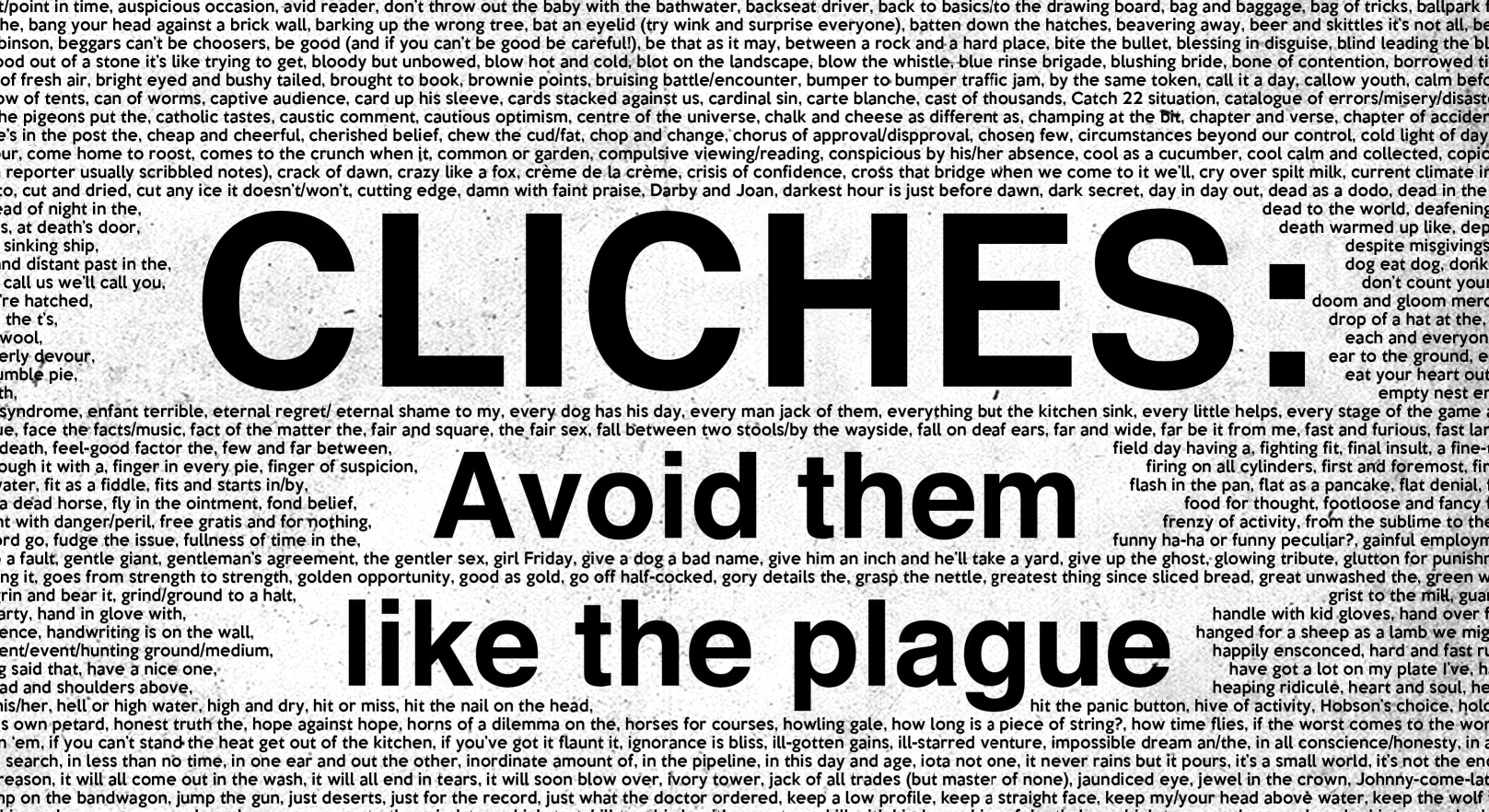
“Avoid like the plague.” Considered outdated and an unlikely expression only months ago. But then the coronavirus pandemic struck. This is more of a health warning now instead of a cliché, showing how history repeats itself.

“The rest is history.” A vapid way of wrapping up a well-known story, so why tell it?

“Every cloud has a silver lining.” The original source of this phrase is Milton’s “Comus,” in which the author is describing moonlight behind clouds at night, not every cloud. Aside from being trite, the cliché is incorrect.

“Beg the question.” Almost everyone uses this cliché incorrectly. It does not mean a question needs to be asked or raised. Aristotle around 350 BC coined the phrase, meaning a type of logical fallacy where a statement refers to its own assertion to prove the assertion, or circular reasoning. That’s what happens when you try to simplify Aristotle.

“When it rains it pours.”  Not always. Sometimes it drizzles.

“Cat got your tongue?” A benefit of a cliché is that it communicates an idea most people can relate to. But who can relate to having their tongue stolen by a cat? It’s a bizarre way to ask somebody to speak up.

“Dressed to kill.” Defined as dressing in extravagantly fancy or stylish clothing to impress others. But it makes no sense. It does not mean dressing in a way fit to kill someone. Taken literally, it could mean wearing something that sheds blood stains. Nothing attractive about that.

                                             Lost in translation

“Spitting image.” Derives from the phrase “spit and image,” meaning you are genetically similar to your kin and look like them. But it sounds gross and looks like something got lost in the translation.

“Go climb a tree.” Meant as a mild insult or rebuke. In these contentious times, a person considering to deliver an insult probably would be advised to make it soul-shattering. Or not at all.

“Don’t judge a book by its cover.” Advice likely given by someone who doesn’t read books. A book’s cover contains a lot of useful information, like its title and the name of the author. An illustrated cover jacket can dazzle you with beckoning details.

                                                Creative writing

Writers are advised to shun clichés, but I suspect some take pride in having a vocabulary full of them, as good as any other best-selling author.

“Editors may reject creative writing on the basis of too many clichés alone,” advises be-a-better-writer.com. “Reviewers will point them out unless it’s obvious that the writer used them for comic effect, such as to define an overly earnest or boring character.”

The creative writing site adds: “If clichés are frequent and easy to spot, you’re not doing your job as a writer, and you should spend more time weeding them out.”

That’s exactly what to do with “thanks for having me.” Weed it out, mercilessly. Remove it as an irritant to our ears and our intelligence.

We are judged by our words. Use them wisely to express ourselves and our individuality. Thanks for your courteous attention.

*************************************************

The Ethics AdviceLine for Journalists was founded in 2001 by the Chicago Headline Club (Chicago professional chapter of the Society of Professional Journalists) and Loyola University Chicago Center for Ethics and Social Justice. It partnered with the Medill School of Journalism at Northwestern University in 2013. It is a free service.

Professional journalists are invited to contact the Ethics AdviceLine for Journalists for guidance on ethics. Call 866-DILEMMA or ethicsadvicelineforjournalists.org.


Attribution And Plagiarism

Attribution and plagiarism: In the Ethics AdviceLine for Journalists archives, Stephen Rynkiewicz compares Renaissance artists with modern journalists.

“If the rules on fair play are shifting, the Renaissance atelier may be where to look for direction,” he writes.

“When they knew enough to transform their material, apprentices became journeymen and started their own studios. When journalists bring craft and intelligence to their work, they too become artists,” he writes.


Using Twitter Ethically

Using Twitter ethically: Twitter evolved from an oddity to a key tool for gathering and reporting news, writes David Craig.

Ethical pressure points: Handling unverified information, navigating between personal and professional boundaries and providing context and narrative structure. From the Ethics AdviceLine for Journalists archives.