Tag Archives: Society of Professional Journalists

Conflict of Interest: The Perils of Journalists in Love

From the Ethics AdviceLine for Journalists archives.

By Casey Bukro

The managing editor of a California newspaper said one of his reporters has been having an affair with the mayor of one of the towns the paper covers.

The editor learned that she has sent her paramour at least two stories about his town prior to their publication. The editor intends to confront the reporter about this, but she is otherwise a fine reporter and writer and he doesn’t want to lose her.

A further complicating factor is the discovery that a competing newspaper has become aware of the relationship between the reporter and the mayor, and might run a story about it. The managing editor wanted to know the AdviceLine adviser’s take on this situation, for the reporter and for the editor.

The AdviceLine adviser pointed out that the reporter had violated two standards in the Society of Professional Journalists code of ethics – to “act independently” and “avoid conflicts of interests, real or perceived” – by concealing her relationship with the mayor from her editor, surreptitiously leaking stories in advance of their publication and then concealing that exchange.

“The other paper’s telling this story before you do anything about it might severely or even fatally impair your paper’s credibility and reputation. Imagine what a typical reader would think,” said the adviser.

The editor answered: “I can, alas.”

Here’s what the AdviceLine  adviser suggested:

“I think you should do something decisive, and promptly. Either reassign her to an utterly different beat or function, at the minimum. Or fire her. In either event, you might consider disclosing the matter in some form to the public before the competition gets a chance to do it for (or to) you.”

The editor answered: “That’s pretty much exactly what I thought was called for before I called you — I wanted confirmation of my instincts.”

Years after the editor called AdviceLine for guidance, AdviceLine called the editor to learn the outcome of this case.

“I wanted to fire her outright,” said the editor, who left the newspaper after 22 years in the news business. “She eventually got fired,” he added, but not for her affair with the mayor.

The case was brought before the newspaper’s human resources department for review. The HR managers decided that an employee could have a relationship with whomever she wanted.

“With regard to the conflict of interest (of sex with the mayor), HR was not interested in that,” said the former editor.

“There also was an issue of the same female reporter sending her copy to the mayor for review before she filed it to the editor,” he said. “If we had not found out that she was sending copy to the mayor in advance, I don’t think HR would have signed off on firing her.”

Though journalists are guided by ethics codes like the one adopted by the Society of Professional Journalists, HR departments are guided by a different set of standards.

There were “worries about litigation in a highly litigious state,” said the former editor. That was a deciding factor.

Ethics of Promoting Advertisers

From the Ethics AdviceLine for Journalists archives

By Casey Bukro

An assignment editor for a New York television station said that management is directing the news staff to give favorable “news” coverage to local advertisers.

The AdviceLine adviser said management’s mandate clearly is unethical, and the assignment editor recognizes that. But what to do about it?

The assignment editor was hoping to contact “some sort of ethics police.”

AdviceLine is not in the ethics policing business, but wanted to help the editor decide where to go next.

The assignment editor clarified his question by explaining that, while the station’s advertising sales department does not actually write “news” stories about advertisers, they pressure editorial staffers into creating stories about advertisers. The sales department has veto power over anything said on the air about an advertiser.

The Society of Professional Journalists code of ethics supports the assignment editor’s concerns, the adviser observed. The code says journalists should “deny favored treatment to advertisers.”

As for his next steps, the assignment editor was encouraged to contact the SPJ professional chapter in New York, which might be willing to pressure the caller’s superiors to stop promoting advertisers, or at least raise questions about it.

The assignment editor also wondered if there was any legal recourse. The adviser gave him the contact number for the Reporters Committee for Freedom of the Press, to check if they know of any legal recourse. The adviser also suggested checking Federal Communications Commission regulations.

“After this conversation about resources, we talked a little about his just leaving the job and about the ethical and practical issues related to whistle-blowing to competing TV stations,” said the AdviseLine adviser. The assignment editor “had begun to think about both of these things, even though he was hoping we could provide him with help in finding a less drastic way to address the matter.”

When Media Are the News: Brian Williams’ Mistake


  • Brian Williams under fire: Cartoons of the day
            Bob Englehart, Hartford Journal


By Casey Bukro

The news has been the news in recent weeks, starting with Rolling Stone, then Charlie Hebdo and now NBC’s Nightly News anchor Brian Williams.

Usually, journalists try to avoid being the story, although Williams demonstrated that television celebrities might see no harm in a little self-promoting embellishment even if it’s  untrue.

After challenges from military witnesses, Williams now admits he was mistaken or had “gone crazy” when he said that he was in a helicopter that was shot down in 2003 while he was covering the Iraq war. Williams often repeated that scenario, making himself look intrepid.

Whoops. It was another helicopter that was forced down by a rocket hit, not the one Williams was riding. Williams and military witnesses give different accounts of the incident.

Williams apologized.

Caught in a fabrication that was widely mocked on the internet, Williams said he was stepping down for a few days from his post as managing editor and anchor of Nightly News, a post which ethics expert Kelly McBride of the Poynter Institute described as “the primary arbiter of the facts.”

Let’s get one thing straight: Williams was in a helicopter in a war zone, which was dangerous and laudable. Witnesses vouch for that. So I give the guy credit for doing a reporter’s job.

But he went a step too far and landed in the shoals of fabrication and deceit, which ended the careers of Jayson Blair of the New York Times, Janet Cooke of the Washington Post and Stephen Glass of The New Republic. Their careers crashed and burned.

Dan Rather left CBS News after 44 years for “a mistake in judgment.”

NBC management said they were considering “the best next steps.” They should consider the Society of Professional Journalists code of ethics. It says “journalists should be honest….” They also should not cast doubt on the credibility of other journalists working to gain the trust and respect of the public.

NBC suspended Williams for six months without pay.

For some people, Williams will be living proof that “reporters make it all up.”

Williams told the false story of his heroics often, and one unanswered question is whether NBC knew the story was fake and did nothing about it. Where were the editors? Or was Williams so untouchable that nothing he said could be challenged? Television crew members with Williams also witnessed the event. Did anyone bother to question them?

To complicate matters, Williams’ 2005 coverage of Hurricane Katrina also is being challenged since he reported seeing a body floating past his hotel room in the French Quarter of New Orleans.

A local newspaper reported that flood waters did surround the Ritz-Carlton where Williams was staying. And a former sheriff’s sergeant working with the anchor during the Katrina floods says he believes Williams.

Charlie Hebdo was a far more tragic story, in which two gunmen killed 12 people in or near the offices of the satirical magazine, which had published cartoons of the Prophet Mohammed.

Two philosophers who are staff members of the Ethics AdviceLine for Journalists wrote blogs about the event. You can read their comments at http://www.ethicsadvicelineforjournalists.org.

David Ozar and Hugh Miller agreed that no religion condones killing people over religious or philosophical differences.  But they saw the Charlie Hebdo massacre turning on the issue of offense, and what should be done to avoid offending the beliefs of others.

A step in that direction came when al-Jezeera English banned the use of certain words that could be offensive in other cultures, such as “terrorists,” “Islamists” or “jihad.”

Nancy Matchett, also an AdviceLine staff member, had this to say about Charlie Hebdo:

” I too think the most interesting and difficult issues raised by satire have to do with the concept of ‘offense.’  One thing I might emphasize a bit more (and here I would be paraphrasing Eleanor Roosevelt’s famous line) is that no one can offend another person without that other person’s consent.

“That does not, of course, obviate the point that a person can, through deliberate malice or carelessness or even cluelessness, say or do things that are extremely likely to be taken offensively by specific others (and here again, I agree with both Dave and Hugh that such sayings and doings constitute ethical failings).

“It is just to note that the mere fact that one person ‘took offense’ does not, by itself, show that the purportedly offensive action was the result of a clearly blameworthy motive like malice, etc. Applied very briefly to Charlie Hebdo, it’s my sense that the magazine was trying to deliberately provoke (if not outright offend) in ways that make the taking of offense by various communities justified. But of course a murderous response to even the most highly offensive speech act is inexcusable in any context.”

And I would add one more thought about Charlie Hebdo. And that is to be true to your standards about giving offense. Think hard about it, and decide on your standards. Then stick to them. Charlie Hebdo intentionally offended. It was their standard. Journalists should decide where they draw the line.

Enough time has passed to show that Rolling Stone magazine clearly shot itself in the foot by reporting a story based on a single source, with no attempt at in-depth investigation, about an unnamed woman who said she had been gang raped by seven men at a fraternity party on the University of Virginia campus in 2012.

The story began unraveling almost immediately after it was printed as times, dates, places and people mentioned in the story did not match reality.

The author, Sabrina Rubin Erdely,  said she had agreed with a request from the alleged rape victim to avoid interviewing anyone else who might have been involved, thereby violating a standard journalism practice to seek as many viewpoints as possible to check the validity of the allegations.

Erdely and Brian Williams have this in common: They should have checked their facts.

Rolling Stone editors later issued a statement saying that in light of new information, “there now appear to be discrepancies,” and the editors concluded their trust in the young woman’s story “was misplaced.”

“The truth would have been better served by getting the other side of the story,” tweeted Rolling Stone managing editor Will Dana.

The university and the fraternity mentioned in the story were seriously smeared by the allegations, and the legitimate cause of campus rape prevention was damaged.

Charlie Hebdo represented an assault on freedom of expression.

Brian Williams and Rolling Stone represent an assault on professional standards in journalism, and a subversion of simply telling the truth.


The Steve Kroft Affair


By Casey Bukro

We here at Ethics AdviceLine for Journalists sometimes clash over what is ethical or not.

The Steve Kroft affair is the latest example.

The veteran “60 Minutes” correspondent admits he had a three-year fling with a New York City lawyer, though both are married.

“I had an extramarital affair that was a serious lapse of personal judgment and extremely hurtful to my wife and family, and for that I have nothing but regret,” Kroft said in a statement to the New York Post. Both the Post and the National Enquirer published salacious text messages between Kroft and his lover, proving once again that anything on the internet is not private.

A CBS spokesperson said “It’s a private matter.”

Soon after the scandal broke, an AdviceLine colleague wrote: “Are personal values/ matters the same as professional matters? Should I teach my students that I don’t care what they do in their personal lives as long as they make good ethical choices in their professional ones? Personally, this Kroft story does not interest me. His professional work does.”

Kroft is one of the most high-profile journalists in America. He has been a CBS newsman for 31 years, 26 of them as a correspondent with “60 Minutes,” which specializes in asking the high and mighty tough questions about their personal lives, their entanglements, their dalliances and the quality of their professional judgment.

Here’s what I say to my AdviceLine colleague: What people do in their personal lives reflects on their credibility and integrity. I don’t think you can separate personal and work lives that easily.

By your reasoning, we should have ignored Bill Clinton’s affair with Monica Lewinsky, as we did with JFK and his affairs. Looking back on JFK, journalists are criticized now for turning a blind eye to his dalliances. Now we’re more inclined to think about accountability.

Kroft is a very public figure by virtue of his role on “60 Minutes.” Part of his job is exposing the conduct of public officials. I would buy your argument if he were not a public figure. That is why, in ethics, we draw the distinction between public and private individuals.

Also, there is the issue of blackmail. Anyone involved in something he or she does not want the public to know is subject to the possibility of blackmail and manipulation.

Tell your students that they have to be smart enough to recognize that ethical values apply to all facets of people’s lives, especially to public figures, and that they, themselves, become public figures when they become very visible journalists. Think Woodward and Bernstein.

That’s why, these days, we encourage publishers and editors to avoid becoming involved in civic organizations, a practice that once was common, and to a degree still is. There is the public perception that if a publisher is an official on the board of a civic organization, he will favor that organization and give it favorable publicity. He also is seen likely to keep bad information about the organization out of the news.

The Society of Professional Journalists code of ethics warns journalists to avoid conflicts or interest, real or perceived.

All of this is in the realm of accountability, an issue we take more seriously these days. People with ethics issues should not be pointing fingers at others with ethics issues. “60 Minutes” sets very high standards and its correspondents should measure up to them.

Personally, I always thought my role as a journalist meant that I was forbidden from doing things others could do. When I covered finance, I avoided buying stock in companies I covered. I did not join organizations I covered. I did not take part in political campaigns.

You can argue that any American citizen is entitled to do those things, and you would be right. But I always believed that anything I did should be above reproach. Being a journalist was paramount. It is an honor, a privilege and a duty to be smart enough to avoid any activity that could tarnish my reputation, and the reputation of the journalism organization I worked for.

Too often, the public complains that the media gleefully write about the transgressions of politicians and others, while keeping silent about the transgressions of journalists. The “old boy” syndrome. They say we cover up for each other. It’s a double standard. We should report on the transgressions of journalists as vigorously as we do about the transgressions of others. It’s only fair.

Comments are welcome.

Rape, Cosby and UVA

A story in Rolling Stone featured the alleged gang rape of a University of Virginia student, launching calls for reform and more attention to the issue of sexual assaults on campus. Recent reporting by the Washington Post, however, has raised doubts about the veracity of the story.
Fraternity house named in alleged rapes (Ryan M. Kelly, The Daily Progress/AP file)

How aggressively did journalists pursue the facts?

By Casey Bukro

Rape became big news with allegations against Comedian Bill Cosby and an explosive Rolling Stone story describing a gang rape of a co-ed at a fraternity house on the University of Virginia campus, for which editors later apologized for “discrepancies.”

Both rape stories raised questions about how journalism works in America and whether it can be trusted.

Where were the editors while these stories were being covered? Tough editors ask tough questions, and demand answers from their own reporters about how they got the story and whether it’s supported by hard investigation.

Media are accused of failing to dig into serial rape accusations over decades against Cosby, who was seen as a popular father figure as he was portrayed on his television show.

About 20 women have accused Cosby of drugging them, and often raping them. But he has not answered to what he calls “innuendos.” Some of the accusers have been challenged. Cosby’s most recent comment is that his wife is dealing well with the controversy.

Pushing back, Cosby’s lawyer accuses a reporter of deception, and his wife, Camille, contends the media failed to take a close look at her husband’s accusers.

The Rolling Stone gang rape story by Sabrina Rubin Erdely is based on a single source, a woman identified only as “Jackie,” who claimed she was lured to a 2012 fraternity party by a man named “Drew,” and raped by seven men. The Washington Post described the story.

Good reporting usually involves getting all sides of the story. Erdely admitted that she made a deal with Jackie that no attempt would be made to find and interview anyone else involved in the alleged rape, or knew about it.  And her editors allowed her to get away with a violation of a basic tenet of good reporting – getting multiple sources to verify the accuracy of the story

The editors allowed this unusual dispensation from careful reporting because the story was “sensitive.” Yes, rape is a sensitive issue, but not a reason to suspend professional standards in reporting. Sensitive stories require more careful reporting, not less.

The Society of Professional Journalists code of ethics urges caution in reporting sex crimes.

The story was widely reported and put a spotlight on campus rape. Then came questions about its accuracy. The accused fraternity had no party on the night the rape allegedly happened, and issued a statement saying that sexual assault was not “part of our pledging or initiation process.” It appeared to be fabricated and continues to be called into question from many sources.

Media followed the story as a lesson in journalism and ethics. A defamation suit against Rolling Stone is a possibility.

Rolling Stone’s managing editor, Will Dana, issued a statement:  “In the face of new information, there now appear to be discrepancies in Jackie’s account, and we have come to the conclusion that our trust in her was misplaced.”

Other media noticed the discrepancies. Pittsburgh Post-Gazette Columnist Jack Kelly calls the story “an unforgivable breach of journalism ethics” and thinks the fraternity house should sue Erdely and Rolling Stone for libel.

Rolling Stone editors believed Jackie was credible, according to Leslie Loftis in the Columbia Journalism Review,  because of a bias – a willingness to believe Jackie because “everyone knows that there is an epidemic of rape on campuses around the country….”

It’s what you know, or want to believe, that can set a trap.

The editors at the Washington Post wanted to believe one of their bright and upcoming reporters, Janet Cooke. She wrote “Jimmy’s World,” a story about an 8-year-old heroin addict in a family of addicts. Narcotics addiction was a big issue in 1980.

That story was so good, it won a Pulitzer Prize in 1981.

Then came the questions. A Washington Post editor asked Cooke to get in a car and go with him to identify where Jimmy lived. They drove around and could find no Jimmy. Cooke eventually admitted she invented Jimmy.

Cooke said the Post’s high-pressure newsroom corrupted her judgement. She said she had heard about somebody like Jimmy. She decided to write the story, based on anonymous sources, to satisfy her editors, she said.

The Post’s ombudsman wrote a long critique on the “Jimmy’s World” story, and found that the editors bore heavy responsibility, adding that “everybody who touched this journalistic felony was wrong.”

Good editors are supposed to do the hard work of keeping stories honest.

“Don’t tell me what you think, chum. Tell me what you know!” said a fabled, crusty editor at the former City News Bureau of Chicago, once called the Devils Island of Journalism. He grilled his reporters as vigorously as he expected his reporters to grill their sources.

GamerGate Ethics: It’s Not About Scoring Points

Grand Theft Auto 5
Off-the-rails video mayhem in Grand Theft Auto 5 (Rockstar Games)

What’s the point of video game debate? Consumer reviews pose valid ethical issues, but not this one.

By Stephen Rynkiewicz

Critics are prepared to justify their opinions, but shouldn’t be forced to defend their livelihoods, much less their lives. Yet that’s the challenge now facing video game reviewers, and it’s a struggle that tests the maturity of their industry.

Threats against cultural critic Anita Sarkeesian brought the issue mainstream attention. An anonymous email warned Utah State University administrators of a shooting massacre at her speech on women in video games. She canceled the appearance.

It’s hard not to identify with that dilemma. But when I circulated the New York Times report on Sarkeesian’s cancelation, the Twitter response was harsh. “Oh boo hoo,” one wrote, “those terrible, count them, ZERO, attacks on hated busybody con artists.” That suggests the level of the “GamerGate” debate.

No regrets from this editor if the mayhem stays at zero. I’m trained to keep writers safe. Mostly reporters want an editor to check their facts and their logic; reviewers need a sounding board. We may even disapprove of what our critics say. Yet editors defend their right to say it. Must we defend to the death?

Continue reading GamerGate Ethics: It’s Not About Scoring Points

Cited Out of Context: Reporting Data With Integrity

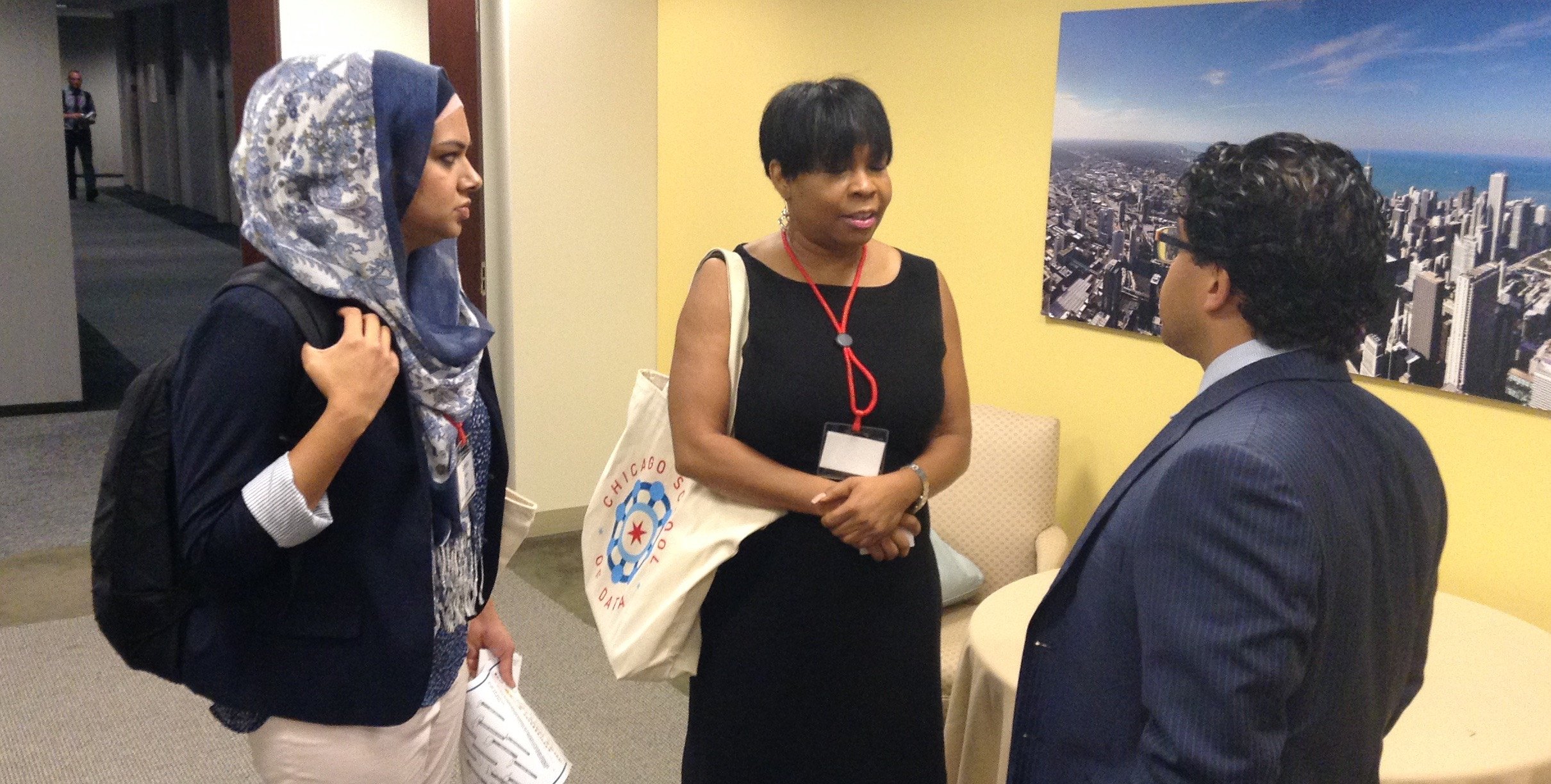
 Samia Malik (left) compares notes with technologists at the Chicago School of Data conference.

Samia Malik (left) compares notes with technologists at the Chicago School of Data conference.

A Medicare database, second-hand stats and social-science findings shed light on how to handle data with care.

By Stephen Rynkiewicz

Journalists look for reassurance in data, as a way to validate what their sources tell them. Scientists aren’t so sure – they joke about “data” being the plural of “anecdote.” Two sources are better than one, except when they’re both wrong.

“You can really jump to the wrong conclusions if you don’t have an understanding of the background of the data,” says Matthew Roberts, informatics manager for Chicago’s health department.

Researchers make a familiar complaint about their data: Getting quoted out of context. The issue’s playing out in a Medicare database of payments doctors took from medical suppliers. Both groups found errors in the data, and payments on research in progress were withheld.

Before the site launched, Roberts told the Chicago School of Data conference that news media inspecting the raw data were among the first to jump to conclusions.

“They just made some wrong guesses about what the data meant,” he said. The final Medicare database gives companies a chance to comment — to give details that could suggest a productive partnership rather than a conflict of interest.

Continue reading Cited Out of Context: Reporting Data With Integrity

An Ombudsman’s Dilemma

By Casey Bukro

See how the Toledo Blade’s ombudsman handles a reader’s complaint that the newspaper’s president and general manager also serves as chairman of the University of Toledo’s board of trustees.

The reader calls that a conflict of interest. The ombudsman says it’s not because the paper’s president operates on the business side of the newspaper, not the news side.

The reader correctly wondered how the newspaper can independently cover university activities when its president is head of the university’s board, especially when the university is in the process of selecting a new president.

AdviceLine periodically gets complaints about cases like this where top news officials serve on local civic organizations. The defense often is that the media official is performing a civic duty.

The Blade’s ombudsman cites the Society of Professional Journalists code of ethics in his president’s defense, but does not mention that the code warns against conflicts of interest, “real or perceived.”

Notice that in the Toledo case the reader is not convinced that the president’s involvement with the university is innocent and free of potential duplicity. That’s probably a typical reaction.

Civic organizations usually invite media officials to serve on their boards in hopes of publicity. The public knows that.

Given the threat to media credibility, this long-time practice should be abandoned. It’s from another era, before the changes now transforming journalism.

Especially lately, AdviceLine is getting more complaints from reporters about publishers and editors dictating news coverage favoring advertisers, in the pursuit of revenue.

In the real world, the argument that publishers or other top media managers operate strictly on the business side and do not influence the news side is a bit misleading. The boss, after all, is the boss, and he or she knows it. That can lead to a few “suggestions” from the top.

But it’s always interesting to see how an ombudsman defends the actions of his boss. You can decide how convincing he was.

New SPJ Code


By Casey Bukro

Some might argue that it takes a certain amount of hutzpah to adopt a set of principles intended to curb the worst  behavior of journalists, sometimes seen by the public as an unruly bunch of ruffians.

But that’s what the Society of Professional Journalists did at its annual convention in Nashville. Actually, it was an updated, boiled down, tweaked, massaged version of a code SPJ adopted in 1996.

The framers of the new version started the revision process by arguing that the 1996 version failed to take into account all the technological innovation that has transformed journalism. Others argued that the ethical foundations of journalism don’t change, regardless of technological changes.

A reading of the updated code suggests that the foundationalists won, since the new code does not mention technology.  It’s a smoother read in places, but most of the original principles are still there, with some added emphasis on transparency and accuracy.

The code does not “sing,” as some journalists had wished, hoping that journalists who pride themselves as wordsmiths might have produced a more inspiring document. It tends to plod from one “do” and “don’t” to another.

But it is the nature of journalists to quibble about how things are worded.

The Society of Professional Journalists introduced its first original code of ethics in 1973,  causing a wave of consternation and congratulation among journalists.  Some thought a code of conduct was contrary to First Amendment protection of Freedom of the Press.

The reaction to the 2014 version was more subdued.

Kevin Smith, outgoing SPJ ethics chair, said one of the goals of the revision was to address “the growing problems with transparency, including news outlets failing to disclose clear conflicts of interest.”

Al Tompkins of the Poynter Institute pointed out that, at the same joint convention, the Radio Television Digital News Association disclosed its own proposed code of ethics.

“The SPJ and RTDNA codes are similar,” said Tompkins, “both focusing on accuracy, accountability and independence.” He also pointed out that the SPJ code took aim at using anonymous sources in stories.

Public Relations practitioners also would benefit from taking note of the SPJ code because it addresses two key issues: Anonymous sources and a prohibition against paying for access to news.

“So if you’re ever talking to a journalist to give information,” writes Ellis Friedman, “think twice about requesting anonymity….”

Most people might think that adopting a code of ethics is not especially controversial, but they should think again. Such efforts always trigger powerful emotions for one reason or another. Journalists can be fractious.

Among those is Michael Koretzky, an SPJ regional director, who complained that the society was unethical in the manner in which the code was rewritten, charging that it was done in secrecy. SPJ leaders were not pleased with his remarks.

And he complained that the new code was adopted by an antiquated method through representatives attending a national convention.

“The code may have needed a tech update,” Koretzky wrote, but “SPJ leaders clung to a century-old system that featured less than 125 insiders making the decision for all its 7,500 members.” Voting should have been done electronically, he argued, giving all members of the society a chance to vote on the updated code.

Koretzky promises that’s not the last word on SPJ’s code of ethics.

“But from bad things, sometimes good things come,” he wrote. “Already, work is underway on an alternate SPJ code of ethics.”


Images of War


By Casey Bukro

James Foley was an American photojournalist who captured the gruesome images of savage warfare, until he became one of those images himself.

Foley, 40, dressed in prisoner orange with a shaved head, is seen kneeling next to a masked, black-clad man holding a knife. Kidnapped in Syria almost two years ago, Foley seems to grimace as the masked man clutches his shirt from behind.

A video posted on YouTube, then taken down, reportedly shows Foley decapitated, his bloody head detached from his body and resting on his back. Two U.S. officials said they believe the video is authentic.

Journalistically, one of the issues in reporting on Foley is whether the grim photo, which seems to show the journalist in the last moments of his life, should have been published.

The New York Post and the New York Daily News gave the photo front-page exposure, causing Washington Post reporter Abby Phillip to ask if the tabloids had gone “too far by printing gruesome images of James Foley’s execution.”

The Society of Professional Journalists code of ethics encourages sensitivity in the use of photographs involving those caught up by tragedy or grief, and “avoid pandering to lurid curiosity.”

For tabloids, that can be a challenge. The rule seems to be the more shocking, the better, and big images are best

This is not the first time the New York Post is seen as going “too far.” On Dec. 4, 2012, it published a cover photo of a man desperately trying to climb up on the platform of the New York City subway after a panhandler allegedly pushed him onto the tracks.

The man in the photo is moments from death as he looks at the train bearing down on him.

The photo appeared with the words, “this man is about to die,” and “doomed.” It caused outrage among those who thought it was heartless to publish such a photo. Some thought the photographer should have helped the doomed man, instead of taking his picture.

Shock value has always been a tool of the trade for tabloid journalism, and, to some extent its younger media relative, online journalism.

What does it mean these days to “go too far”? Is that idea passé?

There was a time when the personal lives of American presidents were off limits. Clearly, rules change.

What do you think?  Is shock value just a hangover from tabloid journalism and outmoded, or justified at a time when movies and television trade in sex and sensationalism? Are we just old-fashioned when we cringe from photos of men about to die?

Journalists from three organizations, including SPJ, are pondering writing or rewriting codes of ethics. What should they say about shock value in the news?