Category Archives: Online News

Donations Might Help to Define a Journalist

By Casey Bukro

One of the questions roiling journalism’s waters these days is, what defines a journalist?

One of the answers sometimes given is that a journalist is defined by what he or she does — committing acts of journalism like writing, reporting, editing or producing something that gives people information.

Usually standards exist for doing those activities, such as the Society of Professional Journalists code of ethics.

Lately, though, some broadcast journalists have shown that they might be confused about those standards, or simply ignored them. Or, are they leading the way toward a new era when broadcast opinion and partiality are overwhelmingly becoming the standards?

The most notorious case is Brian Williams, the NBC anchor who was suspended without pay for six months, for falsely reporting that he had been on a helicopter shot down in Iraq. Actually, another helicopter had been hit by a rocket-propelled grenade and forced down.

Williams apologized for the exaggeration, saying: “I don’t know what screwed up in my mind that caused me to conflate one aircraft with another.” The military publication Stars and Stripes had reported that Williams’ account of the incident was inaccurate.

“The episode has called into question not only the credibility of Mr. Williams but also the ethics and culture at NBC News,” The New York Times reported. NBC is investigating whether Williams exaggerated other reports, and will decide whether Williams returns to his post.

The SPJ ethics code says: Seek truth and report it.

Less prominent is the case of ABC News analyst and anchor George Stephanopoulis, who apologized for donating $75,000 to the Bill, Hillary and Chelsea Clinton Foundation without disclosing his donation to the network, as required. The donations were reported in the foundation’s public disclosure.

“We accept his apology,” ABC said in a statement. “It was an honest mistake.”

Stephanopoulos called the donations an “uncharacteristic lapse.”

His actions led to demands that Stephanopoulos recuse himself from all 2016 election coverage.

Critics recall that Stephanopoulos served President Bill Clinton as a political strategist before moving into broadcasting, despite allegations that he lacked journalistic objectivity.

“But with his acknowledgment that he had given a significant sum to the Clinton Foundation, he found himself facing accusations that he was effectively trying to buy favor with his former employers as Mrs. Clinton seeks the presidency for a second time,” reported the New York Times.

The Stephanopoulos disclosures prompted Judy Woodruff, PBS News Hour co-anchor, to make an on-air disclosure of her own: She said she gave $250 to the Clinton Foundation “for charitable purposes.”

The SPJ code says: Be accountable and transparent. It also says: Avoid conflicts of interest, real or perceived.

But are traditional standards and values still important, now that opinion or advocacy journalism are so widespread online? If those traditional standards were as entrenched as they seemed during Walter Cronkite’s day, when he was considered one of the most trusted men in journalism, perhaps Williams and Stephanopoulos would not have overlooked them so easily till they were caught.

Add to their stumbles the recent case of Rolling Stone, which apologized for reporting an alleged gang rape on the campus of the University of Virginia, a story based largely on one anonymous source. The story later was discredited by police and Rolling Stone was sued.

These cases, says Stephen J.A. Ward, a University of British Columbia ethicist, point to a “striking fragmentation” in journalism ethics and how they are applied, holding some anchors and reporters to the ideal of objectivity and independence while others are not.

“This only points to the utter breakdown of any consensus on journalism ethics,” said Ward.

The SPJ ethics code says: Boldly tell the story of the diversity and magnitude of the human experience.

With changing perspectives in journalism, it’s important for news organizations to adopt written standards, so employees understand the standards that govern their organization. As journalism changes, these standards might change depending on how news organizations define themselves.

Their audiences, too, benefit from knowing what to expect.

3 Ethical Pressure Points for Journalists on Twitter

Twitter shades of gray

Shades of gray: Rumor, intent and context in reporting on social media

By David Craig

This post is a condensed version of an article I wrote on the website Mediamorals.org.

For many journalists and news organizations, Twitter has shifted in a few years from being an oddity and add-on to a key tool for gathering and reporting news.

The thinking about ethics and best practices in journalistic use of Twitter has sharpened and evolved since the platform’s early days. But the ethical challenges persist, and the boundaries of best practices are difficult to nail down. Here, I will look at three continuing ethical pressure points for journalists using Twitter.

Handling unverified information

The continuous flow and immediate spread of information on social networks make this part of journalists’ work, which has always been challenging, more difficult. The consequences of incorrect information – whether about individuals, companies or governments – can be devastating and global. And with journalists occupying only a small space in the larger network of information flow, the pressure to pass on and amplify information prematurely becomes much greater.

My interactions with journalists, tracking of Twitter discussion, and reading suggest that journalists’ understanding of best practices with unverified information sits on a continuum from not tweeting until verified to acknowledging on Twitter while simultaneously checking. (For contrasting perspectives, see this AdviceLine post.)

The notion of reporting information in the process of being verified is in line with what City University of New York journalism professor and blogger Jeff Jarvis calls “process journalism,” which emphasizes being transparent about what one does and does not know, rather than waiting for a final finished product – which he argues is never perfect itself. I think the key challenge with this approach – and the lingering question for journalists – is how to be transparent in the midst of the larger network flow while maintaining truthfulness and minimizing harm.

What is the proper balance among these principles? Transparency alone doesn’t guarantee truthful information. Focus on minimizing harm alone can keep reports out of the public eye, even though members of the public might be able to help corroborate or dismiss them in an open network. Paying attention to the importance of the truth that is being reported alongside the extent of the harm that may result – a common balance in journalism ethics – helps in sorting out whether to transparently acknowledge unverified information on Twitter.

Beyond this, it’s important to use all available resources to verify content. As BBC News social media editor Chris Hamilton has told me, that means making the most of both technical tools such as Google Earth and reverse-image searches to check content shared through tweets and other means. But it also means using critical thinking to look for evidence of falsity and ask questions of human sources.

Navigating boundaries between personal and professional identities

The dual and overlapping uses of social media for personal and professional purposes create ambiguity about the identity of journalists using Twitter and other social platforms. One can signal intentions to some extent with a Twitter profile listing professional affiliations alongside some personal information, but not everyone will see the profile or the larger context of the kinds of things being tweeted.

I don’t think it’s necessary or helpful to agonize over whether journalists should offer routine tidbits about their personal lives in the same feeds they use for their journalism. As some journalists argue, doing that just shows they are human like their audiences. This may serve to increase rather than diminish their credibility. The bigger issue becomes how to handle opinion, especially opinion associated with what one is writing about.

Kelly Fincham, a professor at Hofstra University on Long Island, New York, studied a number of major news organizations’ social media policies for a chapter in Ethics for Digital Journalists, a book I co-edited. She found that although there were “some small signs” that “opposition to transparency about viewpoints is weakening,” overall the guidelines still warn against stating opinions on social media.

In the guidelines she studied, Fincham found that there has been a substantial shift since early days, from the expectation of separate Twitter profiles for personal and professional activity to a consensus that journalists should have single accounts. But single accounts do leave open the possibility that different people coming from one’s personal or professional worlds will assume different things about the intent of the account holder.

There is no foolproof way to navigate the challenges that come from the ambiguity of professional versus personal on Twitter. In ethical terms it’s important to be transparent by signaling the scope of the social world represented by including both professional and personal elements in the profile, or only professional elements if the focus will really be limited to those.

Providing context and narrative structure

From my own use of Twitter, I have seen how difficult it is to include structure and context. The character length limit makes it challenging to provide context for the meaning and significance of individual words. Other challenges involve connecting multiple tweets in a coherent way, especially given that many people get thousands of tweets a day and move in and out of the platform. It’s almost guaranteed that some followers will miss some tweets. From an ethical standpoint, this means that the truth users take away from these messages is fragmented and often missing some of the intended pieces.

Journalists have had several years of Twitter use to gain experience looking for ways to provide context and a coherent narrative. Jonathan Hewett, in another chapter in Ethics for Digital Journalists, notes the simple approach of numbering each segment of a series of related comments, in ways such as “1/3,” “2/3,” etc. (if the number is known). Parallel wording can also help, as he noted in an example of multiple tweets introduced by “Survivor of boat sinking:” or, in subsequent tweets, simply “Survivor.” He said BBC journalist Dominic Casciani has been trying “signposting” of tweets – “alerting users at the start of the day to what he’ll be covering later, for example, or providing a reminder of key points to add context and/or to help those who have not been following the story.”

Twitter hashtags also can help to provide context by keeping related tweets connected with one another.

On a larger scale, Storify has enabled journalists and others to combine tweets and other social posts in a single document and, if desired, add explanatory sentences of introduction and connection. But the tweets can end up in different contexts than the originals did by being selected for inclusion when related tweets were not.

All of these approaches using Twitter and related tools provide means to meet the ethical goal of truth telling to the greatest extent possible within the format.


GamerGate Ethics: It’s Not About Scoring Points

Grand Theft Auto 5
Off-the-rails video mayhem in Grand Theft Auto 5 (Rockstar Games)

What’s the point of video game debate? Consumer reviews pose valid ethical issues, but not this one.

By Stephen Rynkiewicz

Critics are prepared to justify their opinions, but shouldn’t be forced to defend their livelihoods, much less their lives. Yet that’s the challenge now facing video game reviewers, and it’s a struggle that tests the maturity of their industry.

Threats against cultural critic Anita Sarkeesian brought the issue mainstream attention. An anonymous email warned Utah State University administrators of a shooting massacre at her speech on women in video games. She canceled the appearance.

It’s hard not to identify with that dilemma. But when I circulated the New York Times report on Sarkeesian’s cancelation, the Twitter response was harsh. “Oh boo hoo,” one wrote, “those terrible, count them, ZERO, attacks on hated busybody con artists.” That suggests the level of the “GamerGate” debate.

No regrets from this editor if the mayhem stays at zero. I’m trained to keep writers safe. Mostly reporters want an editor to check their facts and their logic; reviewers need a sounding board. We may even disapprove of what our critics say. Yet editors defend their right to say it. Must we defend to the death?

Continue reading GamerGate Ethics: It’s Not About Scoring Points

Three Ethics Takeaways From ONA Conference

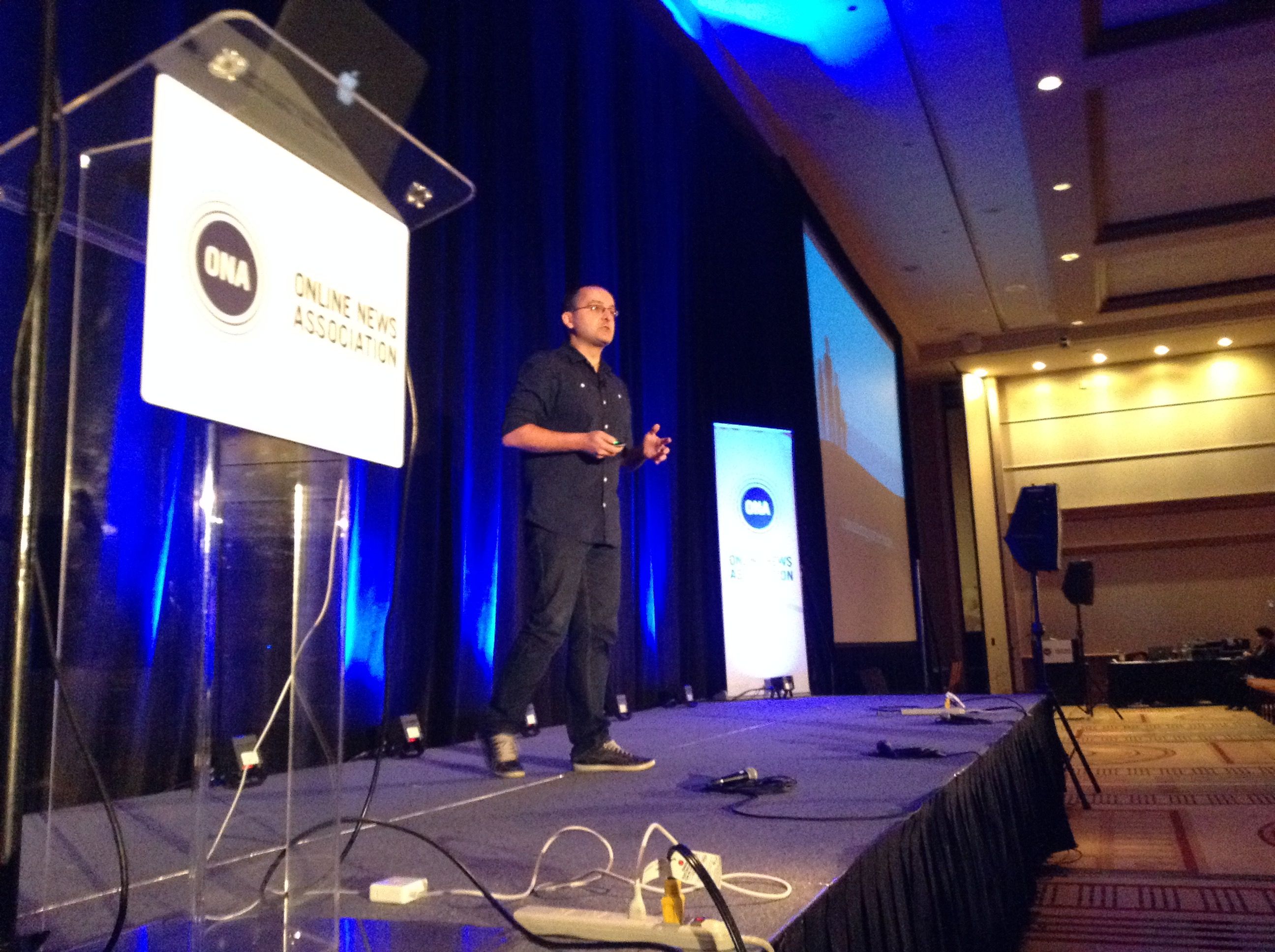
Alberto Cairo
Alberto Cairo of the University of Miami says ethics have not kept pace with data visualization techniques. (Stephen Rynkiewicz photo)

By David Craig

The Online News Association annual conference, which I attended September 24-27 in Chicago, always provides great updates on trends and issues in digital journalism. But it’s also a great place to hear about ethical challenges, both new and continuing.

Ethical issues were the focus of three sessions, including a challenge session in which audience members had to react quickly to ethical scenarios on topics such as use of user-generated content. But ethics also came up in sessions that were primarily about other topics.

Here are three ethics takeaways from the conference:

1. Content that disappears will create new ethical challenges. Amy Webb, founder of Webbmedia Group, delivered her annual talk on “10 Tech Trends for Journalists.” One of them was “ephemeral content,” an increasingly popular kind of social media communication.

Webb said Snapchat, an app developed to share photos that’s popular with young people, provided a way to send private content that users might not want to stay around, but “it’s also a way to clear up our cluttered social streams.” She said other companies are providing messaging services with content that disappears, appears anonymously or is even encrypted. She predicted that most messaging apps will have some kind of means of making content ephemeral in the next 24 months.

Ephemeral content is relevant to journalism because some news organizations including The Washington Post are experimenting with it. But Webb pointed to an ethical difficulty: “Ephemeral content can be used for publishing news. But it can’t be corrected, because no record is left.”

This kind of communication raises questions of accountability for the accuracy of content because once it’s gone, there’s no way to amend a false message or even verify what the message said.

“Talk internally about the implications,” Webb suggested to news organizations.

Even for journalists who don’t use this kind of content, the discussion points to ongoing questions about what it means to ethically handle incorrect content in social media messages.

2. Algorithms shape the truth that people learn about the world and point to new ethical obligations for journalists. Kelly McBride, vice president for academic programs at the Poynter Institute for Media Studies, and Nick Diakopoulos, a journalism professor at the University of Maryland and an expert in computational journalism, presented a session titled “Algorithms are the New Gatekeepers.”

McBride said algorithms, because they shape how news is distributed and to whom, have a powerful influence on what gets attention in the marketplace of ideas. As one of the presentation slides showed, they also affect a huge number of other areas of life including search rankings, online recommendations, advertising and relationships.

Diakopoulos talked about the power of algorithms in influencing the information we receive because of their ability to prioritize, classify, associate and filter it. He argued that the power they carry suggests new responsibilities – and opportunities – for journalists in reporting because they can help hold algorithms accountable. Stories might address issues including discrimination, mistakes that deny service, censorship, illegal activity or false predictions.

This kind of reporting isn’t easy. He pointed to several possible approaches to “auditing” algorithms – reviews of computer code, surveys of users about their experience, analysis of input and output, having users report data and (with ethical problems he acknowledged) impersonating users with programs.

Despite the difficulties, the social and economic impact of algorithms make it important for journalists to try new ways of reporting.

3. The power and availability of data visualization tools call for increasing attention to the ethics of visualization messages. Alberto Cairo, a professor at the University of Miami who teaches on informational graphics and data visualization, gave a session called “The Journalist, the Artist and the Engineer: The Ethics of Data Visualization.”

Cairo argued that the core goal of journalism ethics is to improve the public’s understanding of issues “relevant for their conducting good lives” while minimizing any potential harm. He said tools to create interactive charts, maps and other informational graphics are becoming more popular and widely available but that ethics is not keeping pace. He said that helping the public understand what good, ethical visualizations look like can help to better society and avoid the impact of misleading messages.

Even though great data visualizations are beautiful as well as functional, Cairo said, they must hold to a high standard of truthfulness that doesn’t oversimplify or distort the information being represented. Using the example of a graphic from the National Cable Television Association, he talked about going from showing things that are true but may leave out important information to showing a picture that’s more complicated but also truer and more accurate.

Cairo urged the audience not to hide complexity from the public or point to patterns that really aren’t there. In doing so, he is rightly pointing to a standard of care in visualization that is as high as the standards used in good investigative writing.

New SPJ Code


By Casey Bukro

Some might argue that it takes a certain amount of hutzpah to adopt a set of principles intended to curb the worst  behavior of journalists, sometimes seen by the public as an unruly bunch of ruffians.

But that’s what the Society of Professional Journalists did at its annual convention in Nashville. Actually, it was an updated, boiled down, tweaked, massaged version of a code SPJ adopted in 1996.

The framers of the new version started the revision process by arguing that the 1996 version failed to take into account all the technological innovation that has transformed journalism. Others argued that the ethical foundations of journalism don’t change, regardless of technological changes.

A reading of the updated code suggests that the foundationalists won, since the new code does not mention technology.  It’s a smoother read in places, but most of the original principles are still there, with some added emphasis on transparency and accuracy.

The code does not “sing,” as some journalists had wished, hoping that journalists who pride themselves as wordsmiths might have produced a more inspiring document. It tends to plod from one “do” and “don’t” to another.

But it is the nature of journalists to quibble about how things are worded.

The Society of Professional Journalists introduced its first original code of ethics in 1973,  causing a wave of consternation and congratulation among journalists.  Some thought a code of conduct was contrary to First Amendment protection of Freedom of the Press.

The reaction to the 2014 version was more subdued.

Kevin Smith, outgoing SPJ ethics chair, said one of the goals of the revision was to address “the growing problems with transparency, including news outlets failing to disclose clear conflicts of interest.”

Al Tompkins of the Poynter Institute pointed out that, at the same joint convention, the Radio Television Digital News Association disclosed its own proposed code of ethics.

“The SPJ and RTDNA codes are similar,” said Tompkins, “both focusing on accuracy, accountability and independence.” He also pointed out that the SPJ code took aim at using anonymous sources in stories.

Public Relations practitioners also would benefit from taking note of the SPJ code because it addresses two key issues: Anonymous sources and a prohibition against paying for access to news.

“So if you’re ever talking to a journalist to give information,” writes Ellis Friedman, “think twice about requesting anonymity….”

Most people might think that adopting a code of ethics is not especially controversial, but they should think again. Such efforts always trigger powerful emotions for one reason or another. Journalists can be fractious.

Among those is Michael Koretzky, an SPJ regional director, who complained that the society was unethical in the manner in which the code was rewritten, charging that it was done in secrecy. SPJ leaders were not pleased with his remarks.

And he complained that the new code was adopted by an antiquated method through representatives attending a national convention.

“The code may have needed a tech update,” Koretzky wrote, but “SPJ leaders clung to a century-old system that featured less than 125 insiders making the decision for all its 7,500 members.” Voting should have been done electronically, he argued, giving all members of the society a chance to vote on the updated code.

Koretzky promises that’s not the last word on SPJ’s code of ethics.

“But from bad things, sometimes good things come,” he wrote. “Already, work is underway on an alternate SPJ code of ethics.”


Plagiarism: A Renaissance for Attribution

he Young St. John the Baptist
Piero di Cosimo, “Young St. John the Baptist” (Metropolitan Museum of Art)

When New York Times critic Carol Vogel previewed an artist’s retrospective, readers were quick to question her report.

By Stephen Rynkiewicz

Renaissance artists might have struggled with the idea of plagiarism. Florentine salons respected tradition and uniformity, and apprentices in Piero di Cosimo’s studio learned by imitating the master. National Gallery of Art curator Gretchen Hirschauer told New York Times critic Carol Vogel that Piero’s work entered American collections partly by accident. It was attributed to other artists.

But the concept of plagiarism has evolved. When Vogel previewed Hirschauer’s retrospective of Piero’s work, a few readers were quick to question her report. It started with a list of Piero’s peculiarities, citing contemporary Giorgio Vasari, who’s still studied in paperback. But the wording was close to an even more common source, Wikipedia. The print passage is shortened online, and ombudsman Margaret Sullivan suggests Times editors might take further steps if a pattern emerges.

The word plagiarism first appears during the Reformation. The Random House Dictionary defines it as “to use the words or ideas of another person as if they were your own words or ideas.” Universities have moved beyond the Renaissance academy, with rules against copying and paraphrasing. The Society of Professional Journalists ethics code simply says, “Never plagiarize.

Yet the practice continues. Evidence of plagiarism in Sen. John Walsh’s Army War College research puts him under pressure to withdraw from the November election. Repeated instances on the website BuzzFeed got a producer fired last month. And delegates to SPJ’s 2014 convention will consider adding another ethics directive: “Always attribute.

Continue reading Plagiarism: A Renaissance for Attribution

Vanishing Facts, Finding Truth


By Casey Bukro

Looks like this new generation of online and social media writers don’t care much about fact-checking, favoring speed over accuracy.

Though that might be obvious from reading  the internet, a survey by the Dutch company ING seems to prove the point.

It found that only 20 percent of international journalists questioned bothered to check their facts before publishing.

Forty-five percent of them “publish as soon as possible and correct later,” according to the report.

This is further proof of online journalism’s faith in the self-correcting nature of the internet. Report it fast and report it first, they say. Corrections can come later.

This is a far cry from that old-school Chicago journalism motto: If your mother says she loves you, check it out. It was the ultimate in fact-checking, applied to anything and everything. The rule was to get it right the first time.

More in keeping with a different sort of saying: Never let the facts get in the way of a good story.

Another ING survey finding: Sixty percent of the international journalists said they felt less constrained by journalism standards when reporting in social media. Though they expressed low regard for the accuracy of social media, 50 percent said much of their news tips and information come from social media.

They agree social media is an informational trash bin, but dipping into that bin is addictive.

Angela Wascheck in “10,000 words” described the ING survey.

The ING report comes on the heels of a Columbia Journalism Review story on the values of modern-day newsrooms, entitled “Who Cares If It’s True?”

“In the newsrooms of this moment, with growing agreement that audiences want information that is true, journalists are coming together around the same basic questions: When is information sufficiently baked to be served up as accurate? Who decides? Should there be rules, or just ideals? Is it enough merely to try to be right eventually?”

The author, Marc Fisher, traces the shoot-from-the-hip history of some digital newsrooms, their differences with old-school journalism, and the growing recognition of the value of accuracy and credibility — even in social media.

It began with the digital journalists’ belief that truth would emerge through open trial and error. Transparency was the answer. If you don’t know, just say so.

But that could be changing.

Fisher cites one high-flying digital operation that is “embracing the ultimate symbol of the overstuffed print newsrooms of the pre-digital past.” It is hiring copy editors.

In another, Fisher finds a plan “to marry print traditions of completeness, verification and authority with the digital imperatives for speed and connection with the audience’s interest.”

Battles between the two camps still exist, but Fisher quotes a source who says conflicts diminish “as digital people have moved into leadership roles, and as everyone learned that aggregation can only take you so far, and as people from both backgrounds learn that it’s better to be second than wrong.”


Handling Rumors on Social Media

By David Craig

How should journalists deal with rumors on social media?

Answering this question in practice isn’t as simple as it might seem. A good discussion of the topic broke out Friday during the latest #EdShift Twitter chat on PBS MediaShift.

The biweekly chats draw in both journalists and journalism professors to talk about topics important to the future of journalism education. This one focused on ethical issues on social media. Excellent comments, including resources for good ethical practice, emerged on several topics. But the most intense debate centered on rumors.

Steve Fox, a journalism professor at the University of Massachusetts, took this view:

Fox said the approach used by Andy Carvin, formerly of NPR and well-known for his engagement with Twitter sources during Arab Spring, can’t be generalized to other reporting. But Carvin, who joined in the discussion, said that if journalists are just passing along unverified rumors, that’s the wrong way to work. He posted links to several tweets he wrote after the school shootings in Newtown, Connecticut, to show the approach he takes to verifying information:

With this approach, Carvin challenges assumptions and highlights the likelihood that early reports are wrong – whether they come from individuals or news media.

The research he’s been doing as a fellow at the Tow Center for Digital Journalism at Columbia University also provides a caution for journalists using law enforcement sources.

Where does all of this leave us on the question of how journalists should handle rumors on social media?

I share Fox’s caution on any communication by journalists about rumors. In ethical terms, minimizing harm – a mainstay of ethics including the Society of Professional Journalists code – calls for great care because of the potential of false information to do damage.

But in the social media sphere, where the public is immediately awash in good and bad information, journalists often best meet another duty – seeking truth – by aggressively questioning rumors openly in real time. (For another case study on this, see a 2011 blog post by Daniel Victor, now a social media editor at The New York Times, about two journalists on Twitter in the middle of a shooting scare in Philadelphia.)

In another tweet,  Carvin said that if a rumor spreads on social media, journalists’ duty is  “to acknowledge it, pick it apart, prove/debunk it.”

Well-said. That means being ethical on social media involves not just asking hard questions but asking them in the open.


Ethical Issues in Mobile Reporting

It was great to see ethical issues come up Friday in a Twitter chat about doing journalism with mobile devices.

Katy Culver, an assistant professor at the University of Wisconsin and visiting faculty member at the Poynter Institute for Media Studies, moderates biweekly #EdShift chats for PBS MediaShift on innovation in journalism education. Much of Friday’s chat, involving both journalists and journalism professors, focused on tips and tools for mobile reporting. But Culver, who is also associate director of the Center for Journalism Ethics at Wisconsin, included a question about ethical concerns.

The tweets in response addressed both specific challenges and broader points about navigating the ethics of mobile journalism.

A reporter from Appleton, Wisconsin, raised an issue in covering accidents that comes with the instant capability of mobile devices:

Steve Buttry, who does training for Digital First Media, pointed to challenges related to accuracy. They are connected both with size and features of mobile devices and the sense of urgency that goes with mobile reporting.

He also noted the need to identify oneself clearly as a journalist:

A journalism professor from Germany pointed out an issue related to photographic features that come with mobile phones.

In only a few words, these journalists highlighted a range of ethical challenges in mobile journalism. A radio reporter from Washington, D.C., noted the broader issue of the great power of these small tools and the responsibility that goes with it:

Another D.C. radio reporter did a good job of pointing out that the specifics of mobile journalism ethics are a work in progress:

I don’t think we’ve received any calls on the Ethics AdviceLine about issues in mobile journalism, but we’d love to be a sounding board for journalists thinking through decisions about reporting and editing on their phones.

Ethics Codes


By Casey Bukro

Codes of ethics sound like such noble things.

They can be inspirational and aspirational, statements of our highest moral and professional conduct.

Like any description of what is good, the devil is in the details.  And where journalists are involved, the effort can bring out the devil in them. Some seem to handle it better than others.

For instance, three journalism groups are considering revising or creating codes of ethics: The Society of Professional Journalists, the Radio Television Digital News Association and the Online News Association.

The SPJ effort stands out because of the degree of conflict that erupted over charges by one of SPJ’s regional directors, Michael Koretzky, that the organization’s national ethics committee has conducted the code revision process largely in secrecy. Koretzky is a member of SPJ’s national board.

“It’s been difficult to get answers,” Koretzky said in an e-mail to SPJ leaders. Koretzky  launched his attack against the national ethics committee by e-mailing his “journoterrorist” blog illustrated with 11 panels that graphically compares SPJ’s code revision efforts with ONA’s.

Kevin Smith, SPJ’s national ethics committee chair,  denied “this conspiracy theory of secrecy in revising the code,” adding “we have nothing to hide.”

Koretzky replied that he never said anything about a conspiracy, but “the fact remains that no one has explained to the SPJ board (or anyone else) how the first draft of the code revision was compiled” and who was involved.

David Cuillier, SPJ’s president, added this to the chain of e-mails: “You’re absolutely right, Michael, that we have not communicated the process, or engaged members and non-members, as effectively as ONA.” No conspiracy or secrecy, he added, “but the ultimate outcome is a much more low-key effort on our part. All true.”

SPJ adopted its present code in 1996.

The American Journalism Review described the struggles over SPJ’s proposed code revision.

The Online News Association is working on a novel approach, which it calls “Build Your Own Ethics Code,” a crowdsourced ethics code.

ONA describes it as a toolkit “to help news outlets, bloggers and journalists decide on ethical guidelines that match their own ideas about reporting and journalism.”

The ethics guide would be a constantly updated online document. Reporters will be encouraged to publish the ethics codes they create, and to hold themselves and their news outlets accountable to them, said ONA. In other words, it would be largely voluntary.

RTDNA’s ethics code was last updated in 2000, “and I don’t need to tell you how greatly our technology and our newsrooms have changed in 14 years!” said Mike Cavender, RTDNA”s executive director.

One of the central questions in revising or creating codes of ethics is whether they should reflect changing technology, or state undying principles that apply regardless of technological changes.

RTDNA asked its members to complete a survey. “The goal is to insure that a new code fits our business as it stands today, without straying from the principles that define outstanding journalism.”

All three code-writing efforts are in the round one stage, with more rounds to follow. SPJ’s national ethics committee is expected to report its findings at the organization’s annual convention in September.

All three are worth watching to see if they end in a win, or in a knockout.