Category Archives: Fairness

“Activist” A Dangerous Word

“Activist” is a loaded word, writes Tara Murtha.

“Certainly, there are occasions when ‘activist’ is an appropriate way to identify a participant in an article,” she writes. “Often, though, identifying someone as an ‘activist’ is a subtle but effective way to degrade the person you are quoting and their perspective by erasing credentials and professional expertise.”


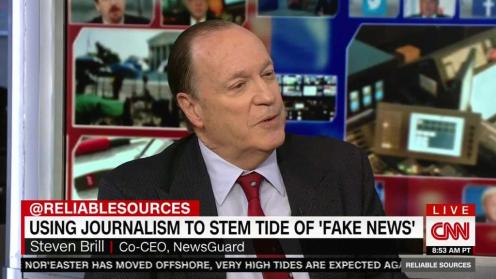
NewsGuard Fights Fake News


By Casey Bukro

NewsGuard Technologies is recruiting veteran journalists to fight fake news by color-coding 7,500 news and information websites and video channels in the United States green, yellow and red.

A red rating goes to purveyors of consistently and intentionally false information or propaganda.

Now in the process of recruiting and training qualified journalists to be NewsGuard analysts, the enterprise, based in New York and Chicago, will begin operating in time for the mid-term elections in November.

The 7,500 news sources targeted account for 98 percent of the news articles read and shared in the English language online in the United States. After launching in the U.S., NewsGuard will expand to serve billions of people globally who get news online.

“Our goal is to help solve this (fake news) problem now by using human beings – trained, experienced journalists – who will operate under a transparent, accountable process to apply basic common sense to a growing scourge that clearly cannot be solved by algorithms,” said co-founder Steven Brill, longtime journalist and media entrepreneur.

The founders raised $6 million to launch NewsGuard.

In addition to color-coding websites or online publications, NewsGuard plans to issue Nutrition Labels that will explain the history of the site, what it attempts to cover, who owns it and who edits it. The labels also will reveal financing, notable awards or mistakes, whether the publisher upholds transparency standards or repeatedly is found at fault.

Two NewsGuard analysts will independently review and rate each site or online publication. One will draft the Nutrition Label and the other will edit it. The public can access these reviews to see why publishers got the green, yellow or red ratings.

Any disagreement between the two analysts is resolved by NewGuard’s senior editorial officers, including Brill, cofounder Gordon Crovitz, former Wall Street Journal publisher, James Warren, former Chicago Tribune managing editor and Eric Effron, former Legal Times editor and publisher.

Warren is NewsGuard’s executive editor and Effron is managing editor.

The lead investor in NewsGuard, among 18 investors, is Publicis Groupe, based in Paris. It is a French multinational advertising and public relations company, and the oldest and one of the largest marketing and communications companies in the world, by revenue.
Who Rates An Obit?

Who rates an obit? The New York Times ponders why most obituaries are still of white men.

“So why not more women and people of color on the obituary pages?” asks its obituaries editor. “Why, for that matter, not more openly gay people, or transgender people?” Obits are among the most heavily read parts of media.


Archive Photo Ruled Okay

Using a 2005 photo of a young woman posing in a British strip club was not an invasion of privacy, ruled the Independent Press Standards Organization.

Sydney Smith writes that IPSO found a news outlet may consider a voluntary action in the past fair game in the future.

The newspaper volunteered to take down the photo as a goodwill gesture and said it “understood that when one is young, one can make choices which are later regretted.”


Interviewing Traumatized Women

The ethics of interviewing traumatized women: Zahera Harb says journalists often add to their suffering.

“Seeking informed consent in such cases is crucial,” she writes. “But before asking Yazidi women to give consent to these stories being recorded and disseminated, journalists should have informed them about how, where and when their stories would be published or broadcast.”


Embedding And Linking Challenged

Embedding and linking challenged: Eriq Gardner says a judge’s surprising decision on the use of a Tom Brady photo could disrupt the way news outlets use Twitter.

“Many of these cases involved some application of the so-called ‘server test,’ where the direct liability of a website publisher for copyright infringement turns on whether the image is hosted on the publisher’s own server or is embedded or linked from a third party server,” he writes.

Paying For Photojournalism

Paying for photojournalism: Visual journalists say the value of their work and legal rights to distribute their photos often are not recognized.

Brush up on the National Press Photographers Association code of ethics, they say, and use it as a guideline in your newsrooms.

The Internet’s Central Villain


The Internet’s central villain: Farhad Manjo asks what is the driving force behind much of the chaos and disrepute online?

“This isn’t that hard,” he writes. “You don’t need a crazy wall to figure it out, because the force to blame has been quietly shaping the contours of life online since just about the beginning of life online: It’s the advertising business, stupid.”