suindependent.com image
By Casey Bukro
Ethics AdviceLine for Journalists
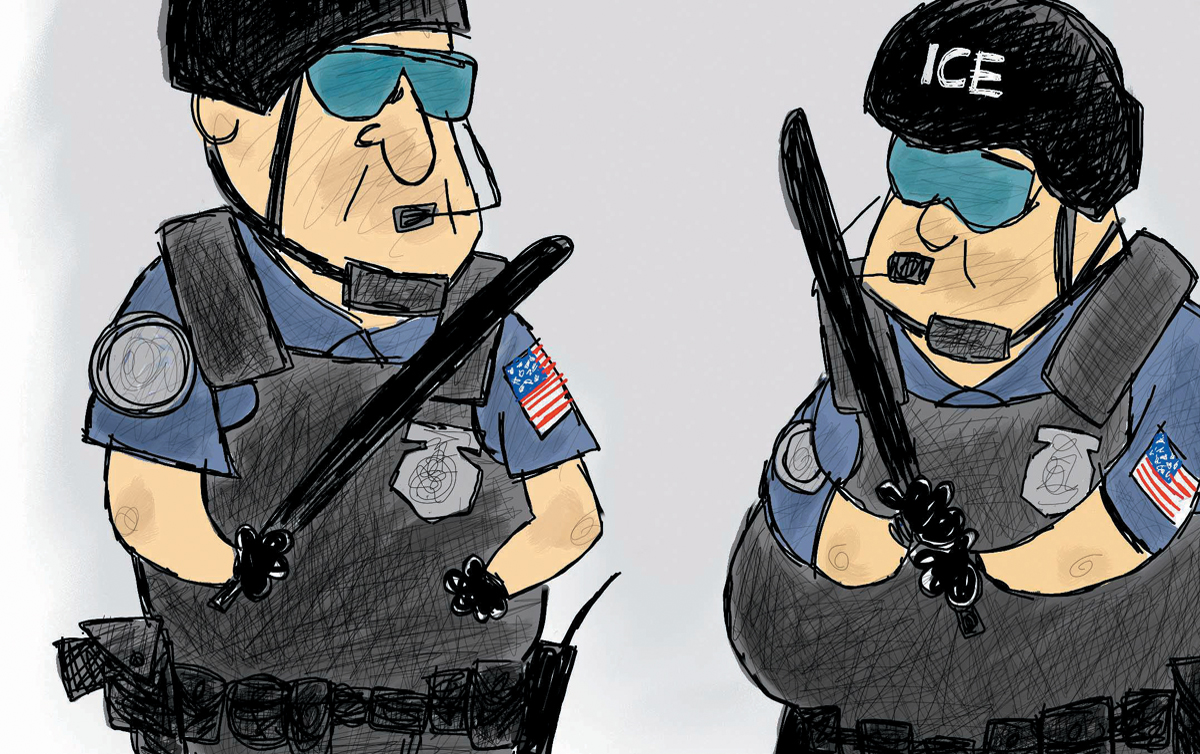
Immigrants in America, once a haven for such people, are now targets of federal crackdowns ordered by the Trump administration in sometime violent sweeps by masked and unidentified men.
The mass detention policy beginning on July 8 indiscriminately locked up immigrants who are contesting government attempts to deport them, which has been declared illegal by dozens of federal judges, according to Politico. Millions of immigrants are targeted.
In Los Angeles, Portland, Washington, D.C., Memphis and Chicago, federal troops and the National Guard were mobilized in the crackdown, which was highly controversial, unpopular, and in some cases challenged by shouting demonstrators.
How they look
“Dozens of federal agents took individuals into custody during a winding patrol Sunday through downtown Chicago,” the Chicago Sun-Times reported, “and a top U.S. Border Patrol official told WBEZ (broadcasting station) the agents were arresting people based on ‘how they look.’”
Passersby shouted at the agents, telling them to go home and “ICE sucks,” referring to U.S. Immigration and Customs Enforcement, one of the agencies in the deportation blitz. One person shouted “thank you!”, while another said sarcastically, “Real patriotic guys. Real patriotic.”
About two dozen protesters followed the agents, chanting “ICE go home!”
Illinois governor protests
On social media, Illinois Gov. JB Pritzker noted the agents were carrying large weapons in downtown Chicago while wearing camouflage and masks.
“This is not making anybody safer – it’s a show of intimidation, instilling fear in our communities and hurting our businesses,” said the Democratic governor.
Newsweek reported that ICE arrested more than 2,200 undocumented migrants in a single day.
Faced with increasing hostility, the U.S. Department of Homeland issued a statement saying: “Despite ongoing attacks and villainization of our brave U.S. Immigration and Customs Enforcement (ICE) officers, ICE continues to arrest the worst of the worst criminal illegal aliens across the country. Over the past two days, criminal Illegal aliens arrested by ICE have prior convictions for crimes including sexual conduct with a minor under 14, indecency with a child, criminally negligent DUI, homicide, drug charges, aggravated assault with a deadly weapon, theft, burglary and battery.”
Opposing politicians are comparing ICE to the Nazi Gestapo, secret police and slave patrols, said an agency official.
Collateral damage
In the first 50 days of the Trump administration, immigration officials arrested more than 32,000 migrants living in the United States without legal status. But these included 8,718 persons who were considered “collateral damage” and not immigration violators.
One of the most heated clashes with ICE agents came in Broadview, a village of 7,998 residents 12 miles west of downtown Chicago, where a federal deportation center is located. ICE agents used chemical irritants to fend off protesters at the processing center.
“We are experiencing an immediate health safety crisis,” Broadview Police Chief Thomas Mills said at a news conference. “The deployment of tear gas, pepper spray, mace and rubber bullets by ICE near the processing center in the Village of Broadview is creating a dangerous situation for the community and all first responders.”
Broadview Mayor Katrina Thompson said gas clouds released by the agents irritate people within 200 to 700 feet, but “the wind can carry it further.”
Three criminal investigations
Broadview officials asked ICE to stop using chemical sprays on protesters and said three criminal investigations were launched in the suburb against ICE agents.
Several federal officials, including two Illinois U.S. senators, sent a letter to the Department of Homeland Security asking for information about the fatal shooting of an alleged undocumented immigrant, Silverio Villegas-Gonzalez, by ICE officers during a Sept. 12 traffic stop in suburban Franklin Park.
This bulldozer approach to immigration management poses huge consequences for individual lives, torn families, the nation’s economy, labor force, health care, social services and housing.
It is still too early to fully assess the legal and ethical implications of the federal deportation blitz going on in the United States. It all boils down to deportation.
Individual lives
One of the most sensitive aspects is the impact on the lives of individuals, some fearful of what could become of them if they are identified as potential targets, rounded up legally or not, and deported to an uncertain fate in undisclosed places.
Years before the current vigilante-style manhunts for undocumented immigrants, one case came to the Ethics AdviceLine for Journalists that forecast the kind of questions facing journalists and undocumented migrants.
It involved a Rhode Island man who was severely injured on the job, possibly because of faulty equipment.
Undocumented immigrant
“The man is an undocumented immigrant from somewhere in Central America,” wrote David Ozar, an AdviceLine advisor who wrote a report on the query. “The result of the accident is that he lost one leg and part of his rectum, and now has a colostomy. He lives in an assisted living facility and has received some help from workers’ compensation, but nothing from the company.”
Pro Bono lawyers offered to bring suit against the company on behalf of the injured man because of alleged safety violations. The unidentified man wants to pursue that, even at the risk that his identity would become a matter of public record and could result in his deportation.
“He believes that the company was at fault and that other workers at the company are still at risk, as well as other undocumented workers whose safety is taken lightly by their employers because they will not sue if they are injured because of the risk of deportation,” wrote Ozar. If he won the case, the injured man might gain funds for medical treatment.
Second reason
But that is not entirely the reason this case was brought to AdviceLine’s attention.
A journalist called, encouraged by an editor, to ask about the newspaper’s ethical responsibilities in this case.
“My first question to the reporter was whether she had discussed all these risks with the man, risks that are obviously multiplied significantly if the story is published, and was she sure he understood them?” wrote Ozar.
The reporter went back to the injured man to make sure he understood the risks he was taking if the story were published.
Increased risk
“He was firm in his desire to have the story published,” Ozar wrote, “in spite of the increased risk of deportation and loss of needed health care, in order to call the public’s attention to the safety issues and the exploitation of undocumented workers by U.S. businesses.”
After further deliberation, the newspaper decided that the issues raised by the story and the human interest slant of a man willing to take risks to help others, a public benefit, “strongly supported a decision to publish if the harm to this man did not clearly outweigh it,” and the man approved.
Not discussed, said Ozar, but worth considering in such cases, was whether the newspaper’s editors should ethically decline to publish such a story because they believed the risks to the victim were too great, even if the injured man wanted it published.
Ethics is a balancing act, where the facts in each case have more or less weight that tips a decision one way or another.
The Society of Professional Journalists code of ethics encourages journalists to “minimize harm.”
**************************************************************************
The Ethics AdviceLine for Journalists was founded in 2001 by the Chicago Headline Club (Chicago professional chapter of the Society of Professional Journalists) and Loyola University Chicago Center for Ethics and Social Justice. It partnered with the Medill School of Journalism at Northwestern University in 2013. It is a free service.
Professional journalists are invited to contact the Ethics AdviceLine for Journalists for guidance on ethics. Call 866-DILEMMA or ethicsadvicelineforjournalists.org.
 Ethics AdviceLine for Journalists