Elections can be just as challenging for journalists as they are for the candidates.
The interviews, the allegations, the polls and the long nights of watching election results. And making sense of it all, including whether candidates are being ethical.
Nowhere is the watchdog nature of American journalism more critical than at election time, when the future of local communities, states and the nation often are decided by votes cast for candidates or for propositions or funding.
Acting ethically
Journalists themselves are expected to act ethically in reporting the facts without favoritism to advertisers or special interests, which is underscored by the Society of Professional Journalists code of ethics.
That became an issue for a public radio station during an election. The editor and producer told the Ethics AdviceLine for Journalists that the station runs a paid announcement from a local business owner whose name is the name of the firm. That business owner is a candidate for the United States Senate. In the past, the station pulled announcements naming a candidate for public office off the air, but that prompted listener complaints.
In the case brought to AdviceLine, only the name of the business is mentioned in the announcement, but not in connection with the election. To complicate matters, the radio station’s business office points out that that the business owned by the candidate has a contract for radio announcements, and pulling the announcements off the air would be a violation of the contract.
An ethics expert
This case went to David Ozar, one of AdviceLine ethics experts.
“There are two kinds of issues here,” Ozar wrote in a report on the case. “One is the question of whether the announcement constitutes improper endorsement of this candidate by the public radio station, or at a minimum the appearance of impropriety on the part of the station.
“The second is a fairness question, or rather two of them. First, if the announcement continues to run, is there an unfairness to other candidates? Second, the fairness issue associated with breaking a contract unilaterally (assuming that the contract does not include a clause permitting either party to terminate at will provided due notice is offered, or something like that.)”
A discussion
Ozar and the radio station executive discussed whether the public would consider the radio announcement a political endorsement. They agreed that most public radio listeners recognize the difference between paid announcements that support the station financially and endorsements of political candidates. So it was unlikely that a significant number of listeners would consider the announcements in question an endorsement of a political candidate.
But, Ozar observed, the announcements do give public recognition to one candidate and not to any others running for the senate seat, which raises a fairness issue. The case also raises “the appearance of endorsement issue,” he believes.
The contract
“And then there is the fact that there is a contract involved,” Ozar wrote. “So one option would be to contact the sponsoring candidate and explain the station’s concern about fairness and the appearance of impropriety, hoping he will agree to their delaying the rest of the contracted announcements until after the election.”
If that did not work, Ozar said another option is for the radio station managers to violate the contract if they believe airing those announcements might harm the station’s reputation.
For the future, Ozar suggested that the radio station adopt a new policy that would ban airing public announcements naming candidates running for public office until after the election.
AdviceLine does not know what course of action the radio station managers decided to take.
The Ethics AdviceLine for Journalists was founded in 2001 by the Chicago Headline Club (Chicago professional chapter of the Society of Professional Journalists) and Loyola University Chicago Center for Ethics and Social Justice. It partnered with the Medill School of Journalism at Northwestern University in 2013. It is a free service.
Professional journalists are invited to contact the Ethics AdviceLine for Journalists for guidance on ethics. Call 866-DILEMMA or ethicsadvicelineforjournalists.org.
Let’s call this a piggy-back story, one that rides on the back of another written earlier.
The subject is lifestyle changes caused by the Covid-19 pandemic, and changes that were predicted as people reacted globally to one of the worst health crises of the 21st century.
The topic is too vast to name every potential issue, but let’s look at some of the life-changing developments – those that were expected and others that were unexpected. At its roots, this exploration also is an exercise in examining how well the media and government provided reliable information to a public that was under extreme and deadly stresses.
It’s estimated the pandemic caused 7.1 million deaths worldwide, about 1.1 million of them in the United States.
Predictions
Click here for an AdviceLine post in 2020 on “Predicting a Future With Covid-19,” on which this post piggy-backs. Read the 2020 post now or later to see what some of the smartest people at the time predicted. We will discuss the two versions later.
An event like the pandemic calls upon the media and the government to do their best work to inform the public of the hazards they are facing and how to avoid risks. Covid-19 attacks your lungs and respiratory system, causing symptoms that feel much like a cold, the flu or pneumonia. In severe cases, it causes death.
The Centers for Disease Control and Prevention, a leading U.S. public health agency, became the main spokesman during the pandemic. As the pandemic intensified, the agency provided guidelines on prevention, testing and vaccination. However, critics accused Dr. Rochelle Walensky, CDC director, of confusing the public on issues like quarantine guidance, school reopening and mask-wearing.
Tarnished
NBC News said communication failures during covid “tarnished the agency.” Two years into the pandemic, in 2022, Dr. Walensky said her agency mishandled the pandemic and needed to be overhauled because it failed to respond quickly enough to the public health dilemma. She resigned in 2023.
The U.S. Government Accounting Office reported that the pandemic “caused catastrophic loss of life and damage to the economy.” The federal agency provided about $4.65 trillion in relief funds for response and recovery efforts.
In such times of a rapidly developing public health crisis, media outlets are expected to provide useful information to fend off risks of contamination. But the pandemic coincided with a time when the United States was losing local newspapers at an unprecedented rate, newspapers that would be expected to inform the public about the health hazard and ways to avoid it.
Lost newspapers
The country lost nearly 3,500 newspapers and more than 270,000 newspaper jobs over the past two decades, according to Northwestern University’s Medill School of Journalism 2025 State of Local News report. This left more than 50 million people in “news deserts,” areas where people have limited or no access to reliable local news sources.
The closures often involved small newspapers that were independently owned by families who lived in the communities the newspapers served and were trusted by readers to provide vital information.
That loss was described as “a massive splintering of the information environment” by the Pew Research Center in a 2024 survey of U.S. adults.
Trends boosted
It was one of three societal trends that were boosted by the pandemic, trends that were already advancing when the health crisis struck.
The pandemic also was seen as spurring political polarization. The Pew survey found 72 percent of those surveyed believed the pandemic “did more to drive the country apart,” accelerating a growing divide between the political left and right.
“Fundamental differences arose between Americans over what we expect from our government, how much tolerance we have for health risks and which groups and sectors to prioritize in a pandemic,” Pew reported. “Many of these divides continue to play out in the nation’s politics today.”
Decreasing trust
A third major societal trend quickened by the crisis, Pew found, was decreasing trust in many institutions.
The pandemic brought profound changes in the way we work, socialize and learn. It changed our dietary patterns and social interactions, forcing a major shift to remote work, with 42 percent of the U.S. workforce working from home full-time at the pandemic’s peak.
The shift to working at home emptied office buildings at commercial centers across the country, leaving a surplus of office space that still plagues some cities.
Vacancy rates
Downtown Chicago’s office vacancy rate reached an all-time high 28.6 percent by early 2026. The suburban Chicago office vacancy rate hit 32.9 percent.
As the effects of the pandemic wore off and workers returned to offices, other forces kept office vacancy rates high. People were leaving Chicago because of high housing costs, an unfriendly job market and high taxes.
Overall, the pandemic was the start of a massive experiment in full-time remote work for most workers and firms.
Serious jolt
The pandemic was a serious jolt to the way we live.
“For a short time,” reported the Stanford Center on Longevity, “before new routines and practices replace familiar old ones, we can see with great clarity the positive and negative aspects of our former lives. The suddenness and starkness of this transformation allows us to examine daily practices, social norms and institutions from perspectives rarely allowed.”
Here are some examples:
Dietary changes – Many reported eating more energy-dense “comfort” foods, more snacking, irregular meal patterns and less access to fruit and vegetables. Some experienced rapid weight gain. Others resorted to home cooking and healthier diets. Therefore, the pandemic forced people in directions that were good and bad. It also forced a recognition of the importance of food in health care and that “food is medicine.”
Good and bad
Physical activity – Again, people responded in ways both good and bad. The pandemic disrupted exercise routines and health habits. With gyms and fitness centers closed, people had to find ways to stay active through home workouts, online classes and solo outdoor outings. Some regarded covid as a teachable moment, while others simply became less active.
Social connections – Regular social interactions dropped off during the pandemic and shifted toward online, leading to more digital communication and feelings of isolation. The upside is that covid might have helped to reveal your most valuable relationship, people you missed most.
Impact on education – The Brookings Institution reports that the pandemic had “devastating impacts on learning.” It disrupted educational systems worldwide, leading to prolonged school closures and a rapid shift to remote learning, which affected millions of students and their readiness for higher education and the workforce. More than 50 million K to 12 students in the U.S. alone faced school closures. Many experienced significant learning loss that might have caused a decline in academic performance. The shift to remote learning and isolation contributed to increased mental health challenges. Public schools were more likely to provide devices for remote learning than private schools.
Fragile economy
Global economy — The fragility of the global economy became glaringly apparent as critical supply chains faultered , unemployment surged and markets vacillated.
Now look at that 2020 AdviceLine post on pandemic predictions.
Predictably, some are bound to be hilarious. For example, there’s that epidemiologist’s forecast that handshakes would become a thing of the past as a way to prevent covid. Ridiculous. Covid is an airborne disease, which is why we were encouraged to wear masks. It would make more sense to ban sneezing and coughing.
Rampant use of disinfectants and sanitizers to combat covid were found to be harmful to humans and the environment. It led to concerns over antimicrobial resistance (AMR) — the ability of microorganisms like bacteria, virus, fungi and parasites to resist the effects of drugs– becoming so-called “super bugs.”
Infections
In the United States each year, at least 2.8 million cases of antibiotic-resistant infections occur, and more than 35,000 people die of them.
Those would-be panaceas demonstrate the risks of acting without being fully informed.
Notably, none of the big thinkers in 2020 mentioned artificial intelligence, which some of the big thinkers now fear might threaten the human race with extinction. Artificial intelligence is the latest technological revolution expected to change how people live and work.
The predicted benefits are huge: They include smarter decision-making, automation and efficiency, reducing repetitive work, better health-care diagnoses and treatment and minimizing human error in research and data analysis.
Disadvantages
But the potential disadvantages are equally large like: Job displacements, major development costs and lack of emotional intelligence, ethical reasoning and creativity in complex situations.
And then there are the risks.
“Mitigating the risk of extinction from AI should be a global priority alongside other societal-scale risks such as pandemics and nuclear war,” said a 2023 statement published by the Center for AI Safety.
Leading researchers and international organizations warn that advanced AI systems could lead to global catastrophe, with experts estimating a roughly 10 percent probability of existential risks this century. Threats range from immediate dangers like autonomous cyberattacks and AI-engineered bioweapons to super intelligent systems overriding human controls and causing eventual human disempowerment.
Warnings
These warnings might have seemed like exaggerated science fiction, until the discovery in July 2026 that an OpenAI artificial intelligence system hacked into another AI company independently. without human guidance, in what the company called an “unprecedented cyber incident.”
“It’s quite mind-blowing that all of this happened autonomously!” said an executive of the company that was hacked, meaning the attacking AI system was acting on its own. The disclosure came amid heightened concerns about cybersecurity capabilities of powerful AI models.
This appears to be the first reported case of a rogue artificial intelligence system acting on its own and invading another artificial intelligence system, a case of digital aggression. Artificial intelligence can mimic human behavior better than we expected.
HAL 9000
It calls to mind HAL 9000, the fictional artificial intelligence computer in the 1968 film 2001: A Space Odyssey which controlled the systems of a spacecraft. Slowly, HAL goes haywire and begins killing members of the crew as the solution to resolve a conflict over telling the truth.
But the 2020 big thinkers got it right when they warned about the rich getting richer, and the threats posed by social media.
“The divide between haves and have-nots will grow as a privileged few hoard the economic, health and educational benefits of digital expansion,” the 2020 sages said.
This sounds very much like what is now known as “the K-shaped economy,” in which only the richest reap the benefits of economic growth. Rising wealth inequality has been a fact of American life since the 1980s. But it accelerated sharply during the covid-induced 2020 recession, when white-collar professionals worked from home while mass layoffs at restaurants, hotels and factories pushed unemployment to 15 percent.
Current events
Another 2020 prediction that seemed to touch on current events:
“A powerful elite will control the internet and use it to monitor and manipulate, while providing entertainment that keeps the masses distracted and complacent.”
In 2026, social media CEOs were called to testify before the U.S. senate in response to legal and public pressure to protect young users on their platforms.
“Americans are realizing more and more every day that they cannot trust the CEOs at the helms of these companies because they do not put our safety first,” said the leader of an advocacy group. The senate hearing came as court cases, proposed legislation and advocacy groups pressure leaders of social media companies to protect children and teens from harmful influences on their platforms.
All told, many current events turned out to be more worrisome than those predicted in 2020. Human imagination can hardly keep up with the unexpected consequences of the technological creations intended to benefit us.
The Ethics AdviceLine for Journalists was founded in 2001 by the Chicago Headline Club (Chicago professional chapter of the Society of Professional Journalists) and Loyola University Chicago Center for Ethics and Social Justice. It partnered with the Medill School of Journalism at Northwestern University in 2013. It is a free service.
Professional journalists are invited to contact the Ethics AdviceLine for Journalists for guidance on ethics. Call 866-DILEMMA or ethicsadvicelineforjournalists.org.
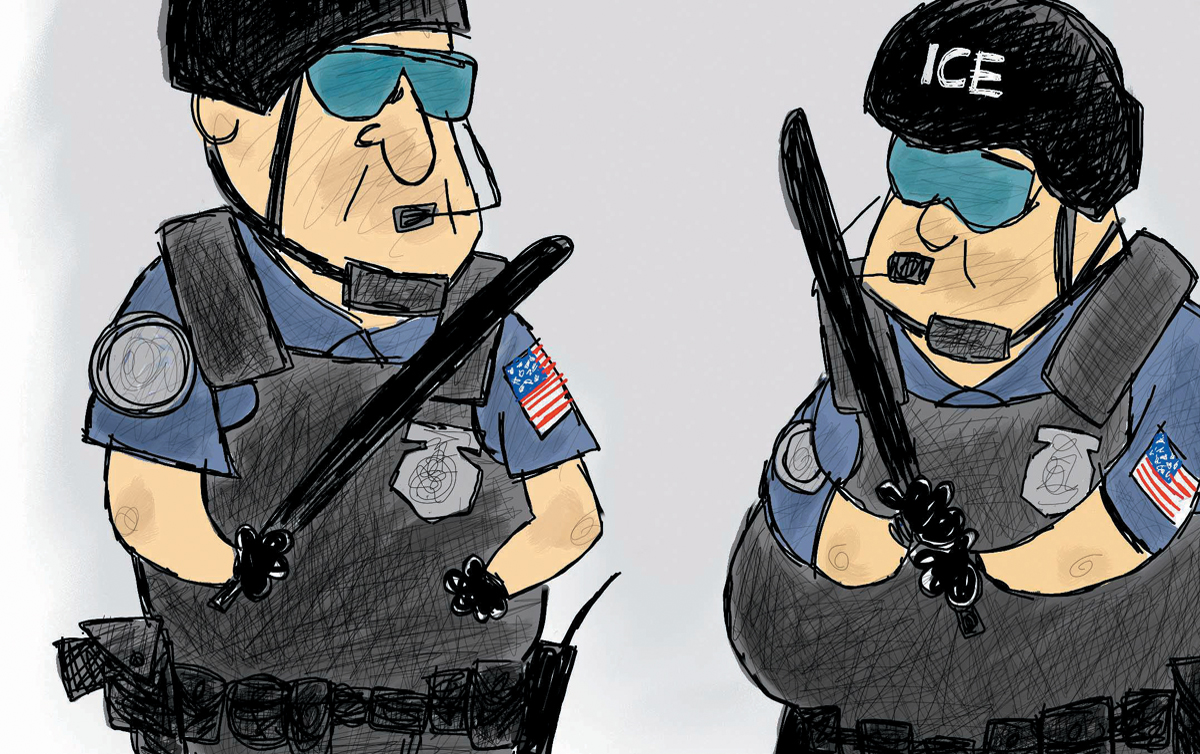
Immigrants in America, once a haven for such people, are now targets of federal crackdowns ordered by the Trump administration in sometime violent sweeps by masked and unidentified men.
The mass detention policy beginning on July 8 indiscriminately locked up immigrants who are contesting government attempts to deport them, which has been declared illegal by dozens of federal judges, according to Politico. Millions of immigrants are targeted.
In Los Angeles, Portland, Washington, D.C., Memphis and Chicago, federal troops and the National Guard were mobilized in the crackdown, which was highly controversial, unpopular, and in some cases challenged by shouting demonstrators.
How they look
“Dozens of federal agents took individuals into custody during a winding patrol Sunday through downtown Chicago,” the Chicago Sun-Times reported, “and a top U.S. Border Patrol official told WBEZ (broadcasting station) the agents were arresting people based on ‘how they look.’”
Passersby shouted at the agents, telling them to go home and “ICE sucks,” referring to U.S. Immigration and Customs Enforcement, one of the agencies in the deportation blitz. One person shouted “thank you!”, while another said sarcastically, “Real patriotic guys. Real patriotic.”
About two dozen protesters followed the agents, chanting “ICE go home!”
Illinois governor protests
On social media, Illinois Gov. JB Pritzker noted the agents were carrying large weapons in downtown Chicago while wearing camouflage and masks.
“This is not making anybody safer – it’s a show of intimidation, instilling fear in our communities and hurting our businesses,” said the Democratic governor.
Newsweek reported that ICE arrested more than 2,200 undocumented migrants in a single day.
Faced with increasing hostility, the U.S. Department of Homeland issued a statement saying: “Despite ongoing attacks and villainization of our brave U.S. Immigration and Customs Enforcement (ICE) officers, ICE continues to arrest the worst of the worst criminal illegal aliens across the country. Over the past two days, criminal Illegal aliens arrested by ICE have prior convictions for crimes including sexual conduct with a minor under 14, indecency with a child, criminally negligent DUI, homicide, drug charges, aggravated assault with a deadly weapon, theft, burglary and battery.”
Opposing politicians are comparing ICE to the Nazi Gestapo, secret police and slave patrols, said an agency official.
Collateral damage
In the first 50 days of the Trump administration, immigration officials arrested more than 32,000 migrants living in the United States without legal status. But these included 8,718 persons who were considered “collateral damage” and not immigration violators.
One of the most heated clashes with ICE agents came in Broadview, a village of 7,998 residents 12 miles west of downtown Chicago, where a federal deportation center is located. ICE agents used chemical irritants to fend off protesters at the processing center.
“We are experiencing an immediate health safety crisis,” Broadview Police Chief Thomas Mills said at a news conference. “The deployment of tear gas, pepper spray, mace and rubber bullets by ICE near the processing center in the Village of Broadview is creating a dangerous situation for the community and all first responders.”
Broadview Mayor Katrina Thompson said gas clouds released by the agents irritate people within 200 to 700 feet, but “the wind can carry it further.”
Three criminal investigations
Broadview officials asked ICE to stop using chemical sprays on protesters and said three criminal investigations were launched in the suburb against ICE agents.
Several federal officials, including two Illinois U.S. senators, sent a letter to the Department of Homeland Security asking for information about the fatal shooting of an alleged undocumented immigrant, Silverio Villegas-Gonzalez, by ICE officers during a Sept. 12 traffic stop in suburban Franklin Park.
This bulldozer approach to immigration management poses huge consequences for individual lives, torn families, the nation’s economy, labor force, health care, social services and housing.
It is still too early to fully assess the legal and ethical implications of the federal deportation blitz going on in the United States. It all boils down to deportation.
Individual lives
One of the most sensitive aspects is the impact on the lives of individuals, some fearful of what could become of them if they are identified as potential targets, rounded up legally or not, and deported to an uncertain fate in undisclosed places.
Years before the current vigilante-style manhunts for undocumented immigrants, one case came to the Ethics AdviceLine for Journalists that forecast the kind of questions facing journalists and undocumented migrants.
It involved a Rhode Island man who was severely injured on the job, possibly because of faulty equipment.
Undocumented immigrant
“The man is an undocumented immigrant from somewhere in Central America,” wrote David Ozar, an AdviceLine advisor who wrote a report on the query. “The result of the accident is that he lost one leg and part of his rectum, and now has a colostomy. He lives in an assisted living facility and has received some help from workers’ compensation, but nothing from the company.”
Pro Bono lawyers offered to bring suit against the company on behalf of the injured man because of alleged safety violations. The unidentified man wants to pursue that, even at the risk that his identity would become a matter of public record and could result in his deportation.
“He believes that the company was at fault and that other workers at the company are still at risk, as well as other undocumented workers whose safety is taken lightly by their employers because they will not sue if they are injured because of the risk of deportation,” wrote Ozar. If he won the case, the injured man might gain funds for medical treatment.
Second reason
But that is not entirely the reason this case was brought to AdviceLine’s attention.
A journalist called, encouraged by an editor, to ask about the newspaper’s ethical responsibilities in this case.
“My first question to the reporter was whether she had discussed all these risks with the man, risks that are obviously multiplied significantly if the story is published, and was she sure he understood them?” wrote Ozar.
The reporter went back to the injured man to make sure he understood the risks he was taking if the story were published.
Increased risk
“He was firm in his desire to have the story published,” Ozar wrote, “in spite of the increased risk of deportation and loss of needed health care, in order to call the public’s attention to the safety issues and the exploitation of undocumented workers by U.S. businesses.”
After further deliberation, the newspaper decided that the issues raised by the story and the human interest slant of a man willing to take risks to help others, a public benefit, “strongly supported a decision to publish if the harm to this man did not clearly outweigh it,” and the man approved.
Not discussed, said Ozar, but worth considering in such cases, was whether the newspaper’s editors should ethically decline to publish such a story because they believed the risks to the victim were too great, even if the injured man wanted it published.
Ethics is a balancing act, where the facts in each case have more or less weight that tips a decision one way or another.
The Society of Professional Journalists code of ethics encourages journalists to “minimize harm.”
The Ethics AdviceLine for Journalists was founded in 2001 by the Chicago Headline Club (Chicago professional chapter of the Society of Professional Journalists) and Loyola University Chicago Center for Ethics and Social Justice. It partnered with the Medill School of Journalism at Northwestern University in 2013. It is a free service.
Professional journalists are invited to contact the Ethics AdviceLine for Journalists for guidance on ethics. Call 866-DILEMMA or ethicsadvicelineforjournalists.org.
The freelancer who contacted the Ethics AdviceLine for Journalists was troubled at learning that the Los Angeles Times and The Washington Post had stopped endorsing presidential candidates prior to the last election.
“I realize a newspaper isn’t necessarily required to issue a presidential endorsement, but both papers have a long history of doing so, so the decision not to do one is clearly a deviation from the norm, and I’d expect that would require a valid and ethical reason. So far, the reasons provided by both publications are far from transparent or satisfactory.”
The anguished journalist admitted the endorsement issue is “weighing heavily on me since I’ve already become incredibly disillusioned with my own industry over coverage of this election…. I fear the news media already has and continues to fail its responsibility to upholding democracy.”
A retreat
Clearly, the journalist is upset at seeing a retreat from an historic media responsibility for leading public opinion at a time when parts of the media industry are redefining themselves. And give her credit for taking journalism and its responsibilities seriously.
The endorsement issue captured national attention during a wild election campaign involving a candidate known to punish those deemed disloyal to him, sowing an undercurrent of fear and caution in the media.
But this was happening at a time when political endorsements are not as common as we might think.
Once ubiquitous
“While such plugs were once ubiquitous, they’ve faded in recent decades,” reported mentalfloss.com. It said a survey by Editor & Publisher “showed that by 1996, almost 70 percent of newspapers weren’t endorsing presidential candidates….”
“Part of this is probably a reluctance to engage in partisan politics, but it also probably speaks to the decline of the newspaper as a central aspect of Americans’ lives.
“With so many avenues available for voters to get to know the candidates, it seems rather quaint to think of anyone voting how an editor tells them to.”
Social media impact
That’s another way social media changed the way journalism and the American public operate.
Two highly circulated newspapers, USA Today and The Wall Street Journal, do not endorse political candidates. The last time WSJ endorsed a candidate was in 1928, plugging for Herbert Hoover, considered “the soundest proposition for those with a financial stake in the country.” A disastrous stock market crash soon followed, souring The Journal on endorsements.
“Big headlines popped up in media circles…when the billionaire owners of The Washington Post and Los Angeles Times blocked editorials that would have endorsed Kamala Harris,” wrote Rick Edmonds of the Poynter Institute in an article explaining “why newspaper presidential endorsements have become an endangered species.”
Resignations
The blocked editorials resulted in resignations at the Times and an angry petition from opinion writers at the Post. The Times admitted losing thousands of readers because of their decision.
“I had already been looking at regional papers, where the steady move away from taking sides in presidential elections has become an epidemic,” wrote Edmonds.
“Independent, locally owned organizations dominate the shrinking list of holdouts,” said Edmonds. “Here, too, disengagement is becoming a trend.”
Murky
That included the Minnesota Star Tribune, which published an explanation, said Edmonds, “that reads, to me, as many such do: murky and excuse-filled.”
The shadow of presidential reprisals hovers over media, along with deep public distrust of media. Among Edmonds’ reasons for ending political handicapping is one that touches on public perceptions.
“No matters how many times the clarification is offered that an editorial board and the newsroom operate separately, many readers don’t see the distinction or don’t believe there is one.”
Ethics issue
This becomes solidly a media ethics issue.
Other issues Edmonds cited include pinched staffs and space, a belief that readers don’t want editors telling them what to think and the argument that regional papers don’t speak with authority on national matters.
The New York Times among national newspapers still endorses political candidates.
Partly from the public blowback from blocking endorsements, the owners at The Washington Post and the Los Angeles Times issued statements.
Tip scales
Jeff Bezos, owner of The Washington Post, said: “Presidential endorsements do nothing to tip scales of an election. No undecided voters in Pennsylvania are doing to say, ‘I’m going with Newspaper A’s endorsement.’ None. What presidential endorsements actually do is create a perception of bias. A perception of non-independence.”
Similarly, Times owner Dr. Patrick Soon- Shiong, said in an interview: “The process was (to decide): how do we actually best inform our readers? And there could be nobody better than us who try to sift the facts from fiction” while leaving it to readers to make their own final decisions. He feared picking a candidate would create deeper divisions in a nation already deeply divided over politics.
Some writers, like Jerry Moore of The Hill publication, reacted to declining political endorsements by saying: “What took them so long?” He thinks they have “outlived their purpose.”
Muddy waters
Political endorsements “muddy the waters of a newspaper’s independence,” he wrote. “A candidate favored by editorial board members becomes ‘their’ candidate moving forward.”
While “some journalists are calling it a betrayal of democratic responsibility,” writes David Artavia in yahoo!news.
That was exactly the point raised by Tara, the freelancer who came to the Ethics AdviceLine for Journalists looking for advice.
Providing facts
The AdviceLine advisor, David Craig, wrote in his report on the case: “We discussed her question but also two broader issues: the more general practice of newspaper endorsements of presidential candidates, beyond the two instances she raised. And her concern about whether (apart from editorial page choices) the normal approach to news reporting of just providing the facts – and the conventional frameworks of journalism ethics – work in what she saw as abnormal times with a threat to democracy if Donald Trump were re-elected.
“I told her I thought the decisions by the Times and Post owners were questionable from the standpoint of the principle of the (Society of Professional Journalists) code of being accountable and transparent, especially since the decision not to endorse was different from the recent past for these publications and came so close to the election.
After backlash
“I think they should have better explained the decisions both internally and externally, though Post owner Jeff Bezos did publish an opinion piece explaining his decision after backlash. I also told her I thought they violated the principle of acting independently by blocking the editorial boards from endorsement.
“She said she felt more comfortable about how she had understood the ethics of the decisions after hearing my perspective, which was essentially in line with hers.”
As for the broader issue of newspaper endorsements, Craig “noted my concern about possible negative impact on audience trust given the widespread distrust of news media today and perceptions of bias.”
Hold to principles
Addressing the broader concerns about the state of journalism, Craig urged the freelancer “to hold to the SPJ code’s principles of seeking truth, minimizing harm, acting independently and being accountable and transparent because they are not just journalism principles but human principles.
“Although there was no specific decision at issue here, it was evident she takes these matters very seriously, and she appreciated getting to talk about them.”
The Ethics AdviceLine for Journalists was founded in 2001 by the Chicago Headline Club (Chicago professional chapter of the Society of Professional Journalists) and Loyola University Chicago Center for Ethics and Social Justice. It partnered with the Medill School of Journalism at Northwestern University in 2013. It is a free service.
Professional journalists are invited to contact the Ethics AdviceLine for Journalists for guidance on ethics. Call 866-DILEMMA or ethicsadvicelineforjournalists.org.
Ethics of hugging candidates: A TV host touched off an ethics debate in 2016 by hugging political candidates.
The Society of Professional Journalists ethics code does not outlaw hugging specifically, but it does warn against conflicts of interest. From the Ethics AdviceLine for Journalists archives.
Psychographics and electoral corruption: Adrian Chen finds that “the model of the voter as a bundle of psychological vulnerabilities to be carefully exploited reduces people to mathematical inputs.”
Data-obsessed political marketing can undermine democracy, he writes.
Conflict of interest: Tony Briscoe andElvia Malagon report that the Chicago Defender fired its managing editor for taking $10,000 to perform public relations work for an Illinois political candidate.
“The Chicago Defender is a longtime voice in this (African-American) community and it is imperative that we maintain the highest level of integrity and credibility,” the newspaper said in announcing it terminated the managing editor.
Journalists take note, people lie: Elizabeth Toledo tells how journalists and news organizations can avoid falling victim to ambush videos intended to discredit or humiliate them.