Tag Archives: pandemic

Privacy in a Pandemic

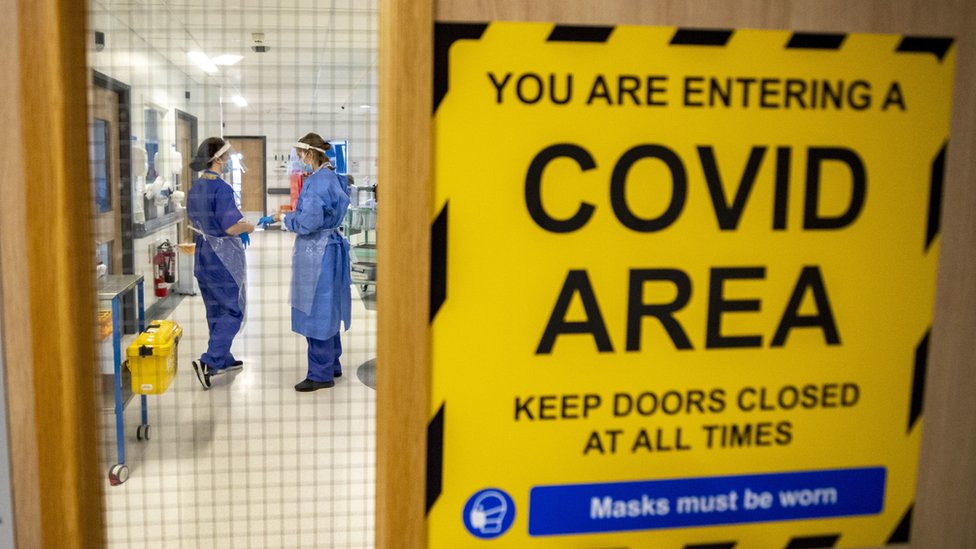
http://www.BBC.com image

By Casey Bukro

Ethics AdviceLine for Journalists

The email query came from a British Broadcasting Corporation reporter based in Ho Chi Minh City, Vietnam.

The question was short and to the point: “Does a story and photo, with the consent of the doctors, of a COVID-19 patient in hospital violate his right to privacy?”

The question came at a time when the entire world was grappling not only with the global pandemic itself, but also with how to report and explain it ethically and accurately. Those are controversial issues even now, including conflicting accounts on how the pandemic started.

Worldwide, more than 7 million COVID-19 deaths have been reported to the World Health Organization, 1.2 million of them in the United States. The pandemic was the worst world-wide calamity of the 21st century. The death toll is the highest since the 1918-20 Spanish Flu and World War Two.

Rights protected

The question from the BBC reporter demonstrates that even in the midst of a global health crisis, the rights and safety of every individual should be protected. It also shows that AdviceLine gets questions about ethics from journalists all over the world.

Joe Mathewson, who teaches ethics and law of journalism at Northwestern University’s Medill School of Journalism, was the AdviceLine advisor on duty the day the BBC reporter’s question arrived.

Responding to the reporter, Mathewson pointed out that BBC has editorial guidelines, including a section on privacy that states: “We must be able to demonstrate why an infringement of privacy is justified, and, when using the public interest to justify an infringement, consideration should be given to proportionality; the greater the intrusion, the greater the public interest required to justify it.”

Infringement

Further: “We must be able to justify infringement of an individual’s privacy without their consent by demonstrating that the intrusion is outweighed by the public interest….. We must balance the public interest in the full and accurate reporting of stories involving human suffering and distress with an individual’s privacy and respect for their human dignity.”

In this case, Mathewson asked the BBC reporter if he got the COVID-19 patient’s consent to be interviewed and photographed by the BBC or the press generally, understanding that the story would identify him?

If he did not, Mathewson told the reporter, “then the next question is, does your story constitute an infringement of his personal privacy? If so, was there a public interest in your story? Finally, was the infringement warranted by the public interest? I believe these are the questions that you should entertain and, as appropriate, answer to your own satisfaction.”

A discussion

The case did not end there. Periodically, the AdviceLine team, which includes four advisors with experience teaching ethics at the university level, have a Zoom meeting to discuss cases that come to AdviceLine. The sessions include veteran journalists who understand how newsrooms operate.

They are critique discussions intended to check whether the advice given to journalists was as good as it should be, or could have been improved. Occasionally there are disagreements, or praise for answering some particularly tough question.

Hugh Miller, another AdviceLine advisor, said he saw a parallel in the BBC case with a book about early coverage of the HIV/AIDS epidemic, which was not covered well by the media. There were few reports of the human suffering seen in AIDS hospital wards. Better coverage of the AIDS epidemic, said Miller, could have informed the subsequent coverage of COVID-19, which also was not covered well inside COVID hospital wards.

Not a hoax

“If we had been able to see more of that, it would have made people more cautious,” explained Miller. “COVID is not a hoax.”

David Ozar is a founding member of AdviceLine, and continues as an AdviceLine advisor.

The question has to be asked if it is necessary to pursue a person’s identification. “The answer is no,” Ozar insists. Patients should not be identified. He believes there were many COVID reports from hospital intensive care units.

Privacy needed

“You could not see them, could not see who they were,” said Ozar. Personal identification “needs to be private,” he insists. He is adamant on that. Ozar serves as a consulting ethicist to medical, hospital, nursing and dental groups.

Journalists  argue that stories of human suffering are told best with the help of people willing to be identified, to show that real people are involved and have personal stories to tell. That often creates sympathy and a public willingness to help the stricken.

Otherwise, disasters seem impersonal, too big to comprehend.

Another lesson here is that ethicists do not always agree on what is ethical. Miller believes media need to pay more attention to human suffering in a health crisis, while Ozar says those suffering should not be identified.

What do you think?

**********************************************************************

The Ethics AdviceLine for Journalists was founded in 2001 by the Chicago Headline Club (Chicago professional chapter of the Society of Professional Journalists) and Loyola University Chicago Center for Ethics and Social Justice. It partnered with the Medill School of Journalism at Northwestern University in 2013. It is a free service.

Professional journalists are invited to contact the Ethics AdviceLine for Journalists for guidance on ethics. Call 866-DILEMMA or ethicsadvicelineforjournalists.org.

Pandemic Top Word of 2020

libwwwfreelibrary.org

By Casey Bukro

Ethics AdviceLine for Journalists

In just 34 days, “COVID-19” went from being newly minted to a term listed online by the Merriam-Webster dictionary.

That was record time, Peter Sokolowski, Merriam-Webster’s editor at large, told the Associated Press.

“That’s the shortest period of time we’ve ever seen a word go from coinage to entry,” said Sokolowski. “The word had this urgency,” along with a few dozen that were revised to reflect the health emergency. Although “coronavirus” was in the dictionary for decades, ‘COVID-19” was coined in February.

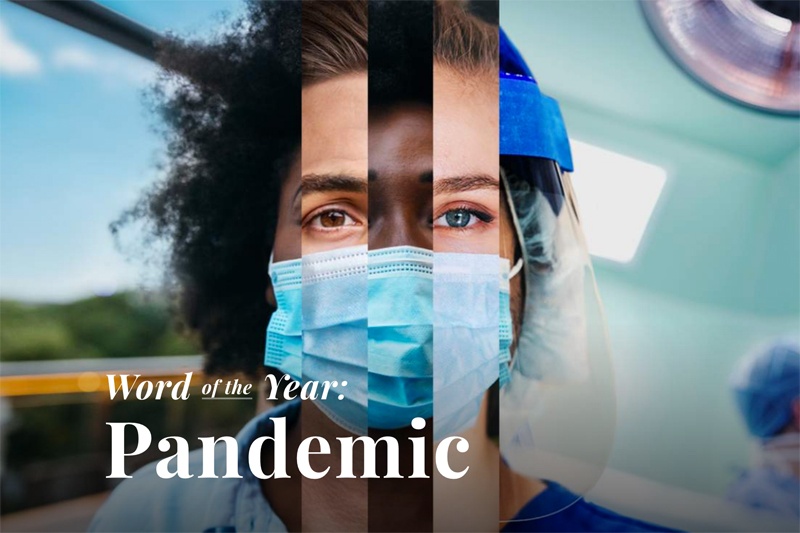
But “pandemic” took the prize as the 2020 word of the year, based on lookup spikes.

“Often the big news story has a technical word that’s associated with it and in this case, the word pandemic is not just technical but has become general,” said Sokolowski. “It’s probably the word by which we’ll refer to this period in the future.”

It also was a word that triggered staggering ethical choices over who got treatment, and eventually who got the first vaccines. On an individual level, it involved those who wore masks and those who refused. Such choices potentially could benefit or harm an entire community.

In such a wild year, the Oxford English Dictionary could not come up with one word of the year. Pandemics strike about once in a lifetime.

On March 11, the World Health Organization declared the novel coronavirus outbreak a global pandemic and online lookups for the term jumped 115,806% higher compared with the same date last year. The word searches began in January and February when the first U.S. deaths and outbreaks on cruise ships became known.

Lookup traffic for pandemic, explained Sokolowski, does not entirely mean searchers did not know the meaning of the word but could be looking for more detail.

Coronavirus was among runners up for word of the year as it jumped into the mainstream. Here are others:

Defund – The term was looked up 6,059% more often than the year before as protesting Americans called for defunding police departments in the wake of police violence against Black Americans.

Quarantine – A period of time spent in isolation or restricted movement to prevent a contagious disease from spreading. In the time of the Black Death plague of the 1300s, ships coming into port would wait outside a city for 40 days to prevent disease. The “quar” in quarantine derives from 40 in Italian.

Asymptomatic – Showing no symptoms of illness. The term became popular in 2020 as the medical community discovered a viral quirk; a person could be infected with the coronavirus, not be ill, but could spread the infection to others.

Mamba – Searches for the word spiked after the January death in a helicopter crash of Los Angeles Lakers basketball player Kobe Bryant, whose nickname was the Black Mamba.

Kraken – Lookups flooded in for kraken in July after Seattle’s new National Hockey League franchise chose the mythical sea monster for its name. The hockey expansion team ended 19 months of speculation over whether it would favor a name that was traditional or eccentric. The team’s colors are light and dark shades of blue. Fans favored kraken.

Antebellum – Country music group Lady Antebellum changed its name to Lady A, driving searchers to the online dictionary in June to check out the name.

Irregardless — Wordsmiths found another reason to haggle when Merriam-Webster decided to accept irregardless as a synonym for regardless, breaking with a long-standing rule that others might decide to keep observing. The Associated Press Style Book has long insisted that irregardless is a useless double negative and regardless is correct.

Icon – A person who is revered or idolized, a symbol. The word was used heavily in headlines after the deaths of U.S. Rep. John Lewis and U.S. Supreme Court Justice Ruth Bader Ginsberg.

Schadenfreude – Enjoyment obtained from the troubles of others. Lookups about the word spiked when it was used in the news about celebrities caught in the college admissions scandal in March, and when President Trump contracted the coronavirus in October and lost reelection in November.

Malarkey – Exaggerated or foolish talk. President-elect Joe Biden used the word during the presidential debates with opponents. Slang. Origin unknown.

The Merriam-Webster site has about 40 million monthly users and about 100 million monthly page views.

Top word searches often signal a world’s worries. In 2019, the year’s top word was “existential,” as in existential threat, dealing with existence. It was applied to climate change, gun violence and democratic institutions. The 2020 pandemic made such threats more up-close and personal. Not only was it the world’s top news story, word searches reflected some interest in pandemic ethical choices that went with it.

********************************************************************************

The Ethics AdviceLine for Journalists was founded in 2001 by the Chicago Headline Club (Chicago Professional Chapter of the Society of Professional Journalists) and Loyola University Chicago Center for Ethics and Social Justice. It partnered with the Medill School of Journalism at Northwestern University in 2013. It is a free service.

Professional Journalists are invited to contact the Ethics AdviceLine for Journalists for guidance on ethics. Call 866-DILEMMA or ethicsadvicelineforjournalists.org.
Journalism of a Plague Year

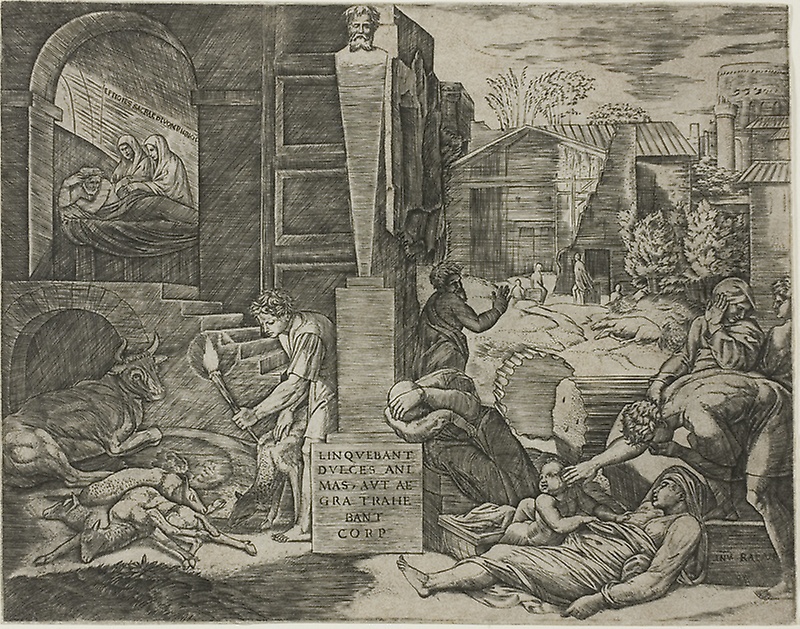
Plague in Phrygia. Art Institute

Journalism of a Plague Year

By Hugh Miller

Ethics AdviceLine for Journalists

On April 3rd, Alexandria Ocasio-Cortez, a member of the U.S. House of Representatives for the 14thCongressional district of New York, wrote in a tweet: “COVID deaths are disproportionately spiking in Black + Brown communities. Why? Because the chronic toll of redlining, environmental racism, wealth gap, etc. ARE underlying health conditions. Inequality is a comorbidity.”

The following Tuesday, April 7th, Dr. Anthony Fauci, director of the National Institute of Allergy and Infectious Diseases, stood at a podium at the White House and praised the “incredible courage and dignity and strength and activism” of the gay community’s response to the AIDS crisis. Fauci, much of whose career has been dedicated to battling HIV/AIDS, then drew a connection between the “extraordinary stigma” which then attached to the gay community, and a similar stigma and marginalization which, he argued, today was increasing the burden and death toll imposed on African-American COVID-19 sufferers, who make up a disproportionately high number of fatalities of the latter-day plague.

As a philosopher and ethicist, I’ve been reflecting on the role of my discipline in coming to grips with this new and sudden event since it first burst into the headlines in early March. As the novel virus grew from an outbreak to an epidemic and then to pandemic dimensions, and the gravity of the illness associated with it, COVID-19, became clearer, the ethical approach to it became less so, to me.

Extraordinary Times

Extraordinary times: We can no longer doubt that we are living through extraordinary times, writes Pankaj Mishra about the coronavirus pandemic.

“In fact, the last such churning occurred almost exactly a century ago, and it altered the world so dramatically that a revolution in the arts, sciences and philosophy, not to mention the discipline of economics, was needed even to make sense of it,” Mishra writes.