Assessing Michael Wolff’s brand of access journalism: Nausicaa Renner and Pete Vernon say Wolff could not have written his book “without the hard work of journalists over the past year; the fire he catalogs was often fueled by stories from mainstream reporters.”
Wolff bluffed his way into the good graces of the Trump administration and produced “a thoroughly readable portrait of the Trump administration’s chaos and lack of preparedness.”
What to do when the subject of a sex investigation dies by suicide: There’s no playbook for journalists about how to handle situations like that, writes Meg Dalton, about a Kentucky Center for Investigative Reporting and Louisville Public Media podcast revealing the troubled past of a prominent political and religious figure.
The case “is an exemplar not only of dogged local reporting, but also a how-to for newsrooms grappling with unexpected ramifications,” writes Dalton, such as the death of a subject.
Norwegian Broadcasting Corp. finds a way to weed out toxic commentary: Take a quiz.
Many large media organizations eliminated their comment sections because of abusive commentary, writes Steve Friess. The Guardian, for example, last year closed comments under articles on race, immigration and Islam because they attract “unacceptable levels of toxic commentary.”
A short quiz on the contents of a story, the Norwegian brainstorm, unlocks access to the comments section.
“We wanted to create a bump in the road to make people think a bit before ranting away,” a source tells Friess.
Reporting on Dreamers: Undocumented immigrants brought to the U.S. as children tell Itzel Guillen, Irving Hernandez and Allyson Duarte how to write about them. They’re not all Mexican; give them a voice.
Justice Department criminal investigations into sources of journalists are up 800 percent, writes Trevor Timm. Lawsuit aims to show how government is stifling freedom of speech.
Journalists take note, people lie: Elizabeth Toledo tells how journalists and news organizations can avoid falling victim to ambush videos intended to discredit or humiliate them.
Media melees at mass shootings seen as a second trauma to grief-stricken communities. Jon Allsop offers five ideas for more respectful media coverage, like good manners.
Fixing journalism with a multibillion dollar endowment fund: Emily Bell writes tech giants could donate billions for a new type of engine for independent journalism. “Now is a good time to abandon the fantasy that the health of journalism is tied to free-market economics.”
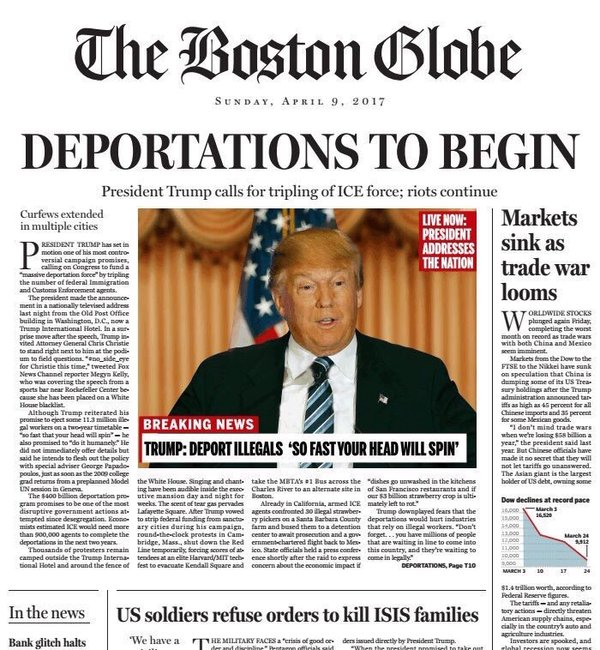
The Boston Globe publishes fake news as an editiorial-page spoof in April, 2016.
By Casey Bukro
Fake news might have proved more interesting to readers than the factual stuff.
This sobering thought has churned angst over whether social-media falsehoods contributed to Donald Trump’s presidential victory, not to mention whether the upset win could have been foreseen.
News consumers tend to believe reports that support their personal beliefs — an effect that psychologists call confirmation bias. People like to believe they’re right. In the election run-up, they clicked their way across the internet to prove it.
As President-elect Trump selects the people who’ll help him govern, observers are picking through the rubble trying to understand the forces behind a Republican victory. Here our concern is news-media accuracy and ethics.
Let’s start with something basic. What is fake news?
“Pure fiction,” says Jackie Spinner, assistant professor of journalism at Columbia College Chicago, appearing on WTTW-Channel 11 in Chicago in a “Chicago Tonight” program devoted to separating fact from fiction in internet news feeds.
“It’s something made up,” adds Spinner. “It’s fake.”
 Ethics AdviceLine for Journalists