GamerGate Revisited: Is It Really About Journalism Ethics?

AirPlay

By Casey Bukro

Is GamerGate about ethical violations in video-game journalism?

Or is GamerGate just a smokescreen for harassing women who want to work in the male-dominated gaming industry?

Or is it something else?

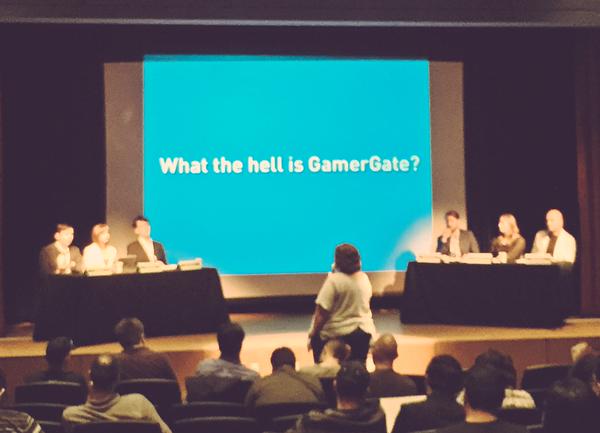
A live-streamed debate will sort it out Aug. 15 in Miami.

Elements in the controversy include the $15 billion video game industry, the video game press, game reviewers, developers, commentators and those who sell advertising in gaming magazines. It’s a volatile mixture.

Michael Koretzky, a regional director for the Society of Professional Journalists, organized the conference and will moderate. His region covers Alabama, Georgia, Florida and South Carolina. Sponsors are the region and SPJ Florida.

AdviceLine questioned Koretzky on the key issues:

Continue reading GamerGate Revisited: Is It Really About Journalism Ethics?

Standup Guise: Stealing Jokes Isn’t funny

JOKE OF THE DAY

Q: Did you hear about the new “divorced” Barbie doll in stores now?
A: It comes with all of Ken’s stuff.<
Submitted By: Anonymous

TWEET OF THE DAY

Marriage is mostly about knowing which hand towels you can use and which ones are for the better people who visit your wife’s home.
Credit: @_troyjohnson
From Chicago’s Laugh Factory

By Casey Bukro

A funny thing happened on WTTW’s Chicago Tonight show: they were talking about ethics in comedy and joke stealing.

It’s no laughing matter when comics steal jokes from other comedians. How can you stop it?

The Chicago Tonight program was prompted by a lawsuit filed by Alex Kaseberg, a Winnetka freelance comedy writer, who accuses television talk show host Conan O’Brien of stealing his jokes.

“Plagiarism is a huge deal in journalism,” said Phil Ponce, the moderator. “It’s a career-ender. Why is it not a career-ender in comedy?”

Nobody on the panel of comedy experts laughed.

“There’s a history of joke-stealing” that goes back to vaudeville, answered Anne Libera, director of comedy studies at Columbia College Chicago. Performers sometimes stood backstage and took notes so they could tell the stolen jokes later.

It’s not easy to prove when a joke is stolen, said comedian Dwayne Kennedy. People accuse others of joke-stealing all the time, he said, but “the topic is so broad,” it’s hard to prove.

Continue reading Standup Guise: Stealing Jokes Isn’t funny

Ethics of Using Internet Video of Police Conduct

WBEZ video
WBEZ reposted video it credited to YouTube user King-Dubb.


From the Ethics AdviceLine for Journalists archives

By Casey Bukro

Back in 2011, Chicago radio reporter Steve Edwards was covering gang violence and Chicago police for WBEZ when a video surfaced, showing youths menacing a suspect in the back seat of an open police squad car.

Was it ethical to use that video on a WBEZ broadcast?

That’s what Edwards wanted to know when he called the Ethics AdviceLine for Journalists. The video shows two Chicago police officers standing at the parked blue-and-white SUV with the doors open in Chicago’s violence-prone Humboldt Park area. A group of shouting young men, some possibly minors, taunt a suspect cowering in the back seat and trying to cover his face.

Someone tells the photographer, possibly a gang member, “get a close-up.” The photographer posted the video on YouTube and quickly took it down.

Edwards told AdviceLine that WBEZ had been investigating allegations that Chicago police had a history of subjecting gang members to harm by picking them up, then dropping them off in “enemy” gang territory.

The Chicago Police Department told Edwards that it got a complaint about the incident and released this statement:

“The conduct that is alleged does not reflect the behavior and core values of the men and women of the Chicago Police Department nor our commitment to serve the community in a professional manner.” The department said its internal investigations divisions began an investigation.

In 2013, the Chicago Police Department announced that it had dismissed the two police officers involved in the incident, saying the charges included “unlawfully restraining a youth, transporting him without a valid police purpose to the turf of a gang that would threaten him and making a false statement about the incident to an Internal Affairs detective.”
Continue reading Ethics of Using Internet Video of Police Conduct

Searching for the Limits of Ethics

By Casey Bukro

Some media people find it impossible to forgive Brian Williams, saying he tainted journalism through false reports.

A cascade of shame enveloped the former NBC anchor, demoted and vilified after saying repeatedly that he was aboard a military helicopter that was forced down over Iraq by enemy fire. Turns out that happened to another military helicopter, not the one he was riding.

Williams’ career began unraveling as other reports were called into question.

From a strictly ethical viewpoint, how should Williams be judged? He admitted he was mistaken about the helicopter incident and apologized.

Ethically, are there limits to forgiveness? Is it best to forgive and forget? Is he forever tainted, or is he allowed to get beyond it and redeem himself?

These questions were posed to AdviceLine’s team of ethicists.

Nancy Matchett, who teaches ethics at the University of Northern Colorado, answered this way:

“Philosophers understand ethics as ongoing reflection about ‘how one should live.’ In the professional context, that means ongoing reflection about the principles that should guide one’s work and how they apply to the concrete choices one faces every day. Ethics doesn’t exactly have a beginning or end.

“And, with respect to the Williams affair, we can evaluate his choices since the incident, and the choices of the network, as well as the original mistake.”

I asked Matchett if that suggests we should judge Williams and the aftermath by what he does from now on?

“Sure, that’s part of it,” said Matchett. “But I guess what I’m also trying to emphasize is that the fact that any particular bit of conduct that was good, bad, etc., is never ‘the whole story about Williams’ ethics.’ There is no whole story, except perhaps after a person is dead, because characters are never wholly fixed.

“What he does from now on should be judged in light of the fact that we know he is at least careless and at worst inclined to stretch the truth for the sake of a story.”

I told Matchett that appears to raise the issue of redemption.

“I don’t really have anything to say about redemption,” said Matchett. “Whether another person, or ‘the profession,’ forgives Williams doesn’t change his act from wrong to right. It acknowledges that his character isn’t all bad and that the mistake was in some sense ‘understandable’ given the various pressures he was under. And just to be crystal clear, note that ‘understandable’ is not the same as ‘justifiable.’ Or as we say in my business, an explanation is not the same as an excuse.

“As for people finding it ‘impossible to forgive,’ that’s a psychological issue or question, not the ethically central one. The ethically central issue is whether forgiveness is morally appropriate, whether people should do it, which is a little different from whether they can. … If it’s not appropriate, then folks are doing the right thing by refusing to forgive.

“But in general, I think any network would be foolish to leave him as an anchor on their main show. He has harmed his own and the network’s credibility. Even if the network execs were convinced that it was a forgivable mistake and his journalistic integrity could be counted on in the future, the average viewer surely doesn’t know Williams well enough to decide whether to trust him again.”

David A. Craig, another AdviceLine ethicist, who teaches ethics at the University of Oklahoma, sees it a different way:

“It troubles me that Williams seems to deflect responsibility for his untruths by saying he did not intend them. Journalists, especially those in roles as high profile as his, have a responsibility for every word that comes out of their mouths in a formal journalistic setting.

“If this were a single brief slipup in language, that would be different. But he was untruthful more than once about his experience in Iraq. Every viewer now has reason to question his trustfulness in the future. By failing to fully take responsibility for his words, he gives his audience ongoing reason to doubt.”

Reason to doubt Williams first emerged when military publication Stars and Stripes challenged his account of being aboard the helicopter that was forced down over Iraq.

NBC suspended Williams for six months without pay, then stripped him of his duties as anchor of NBC Nightly News.

As Matchett points out, we don’t know “the whole story” about Williams yet. Already, he is the subject of jokes and spoofs by the likes of Harry Shearer.

Forgiveness happens on two levels, personal and professional.

Journalists are notoriously soft on each other, and hard on everyone else. Journalists don’t like to criticize or censure other journalists. So, personally, they are likely to forgive Williams by finding that morally appropriate, as Matchett put it. They will write about ethical transgressions, but that’s not the same as taking a personal stand.

Professionally, it’s hard to forgive an act that weakens public trust in the integrity of journalism, which rests on a foundation of truth. The Society of Professional Journalists code of ethics begins with this tenet: “Seek truth and report it.”

Falsehoods damage the profession, and cannot be tolerated.

AdviceLine gets SDX Award for Navigating Murky Ethics Waters

SDX Awards
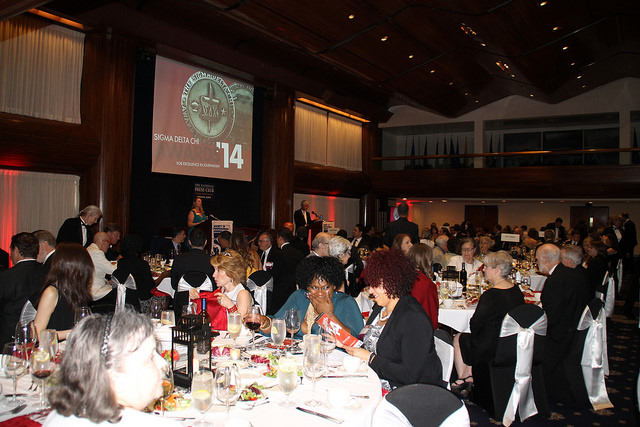
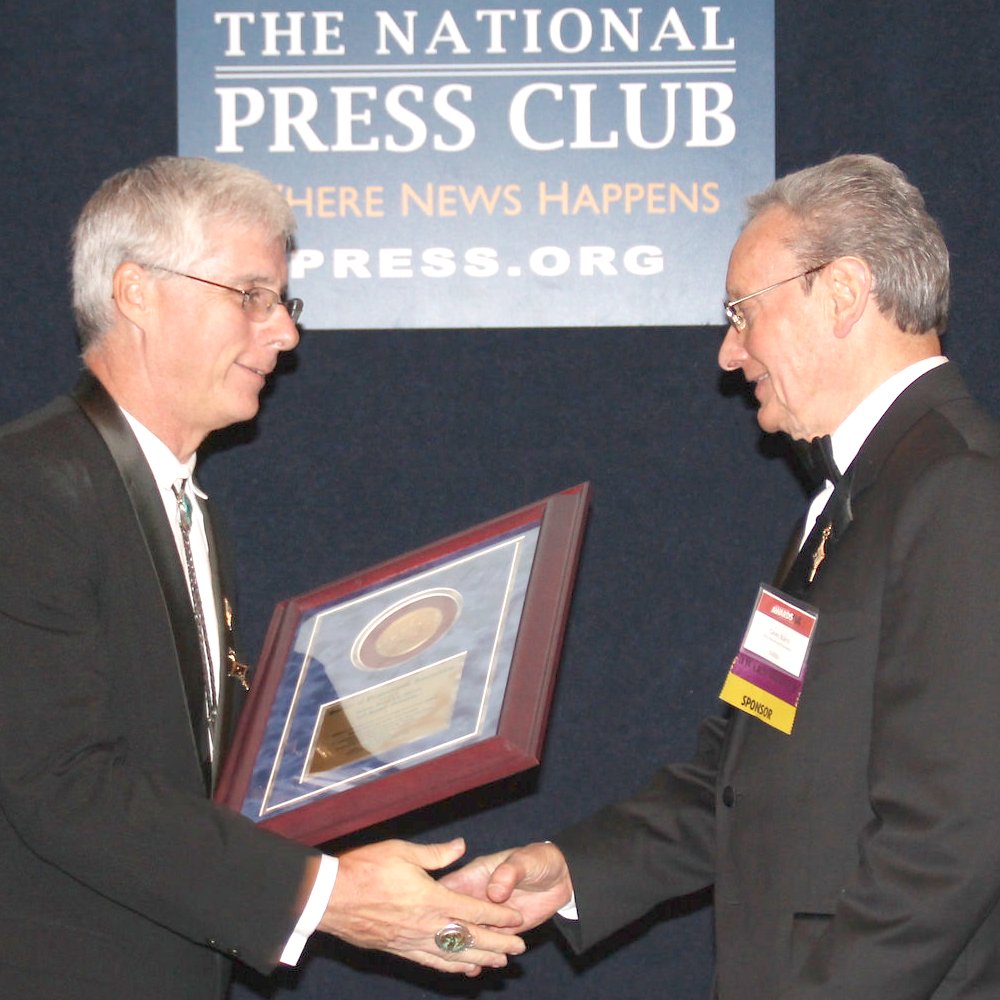
The Sigma Delta Chi Awards are presented June 26 at the National Press Club (Catherine Trifiletti photo)

By Casey Bukro

Ethics: The word can make you feel drowsy, or start your heart pounding.

It all depends on whether you are suddenly tangled in a job-threatening dilemma, or one that might destroy your credibility.

Ethics: Distinguishing between good and evil in the world, between right and wrong human actions and between virtuous and non virtuous characteristics of people.

Sounds lofty and maybe even remote from our daily journalism lives, until it’s not so remote anymore.

Seated next to me at the Sigma Delta Chi awards banquet in the National Press Club in Washington, D.C. was the editorial writer of a Midwestern newspaper who was waiting to collect his award. A fellow winner at the dinner table asked the editorial writer how his publication had gotten embroiled in a highly controversial ethics issue.

The newspaper had revealed the names of two alleged women rape victims. Typically, publications avoid naming rape victims.

Off-the-record, the editorial writer explained the difficult process of arriving at the decision to name the women. Then he added that the newspaper had no ombudsman or other trusted source to discuss the difficult decision before publication.

At that point, I reached into my pocket and handed him several Ethics AdviceLine for Journalists wallet cards, explaining how to reach AdviceLine in the event of a similar need for ethics counseling. Call toll free, 866-DILEMMA.

The editorial writer seemed grateful, and said he would carry the cards back to his newspaper and hand them out to management.

SDX Award
Sigma Delta Chi Foundation President Robert Leger presents the Sigma Delta Chi Award to AdviceLine’s Casey Bukro (Catherine Trifiletti photo)

Back to the banquet. The award dates to 1932, when the Sigma Delta Chi journalism fraternity honored six individuals for contributions to the profession. The Society of Professional Journalists continued the honors as its Distinguished Service Awards, then with a nod to its fraternal roots as the Sigma Delta Chi Awards for Excellence in Journalism.

The awards recognize the best news reporting in print, radio, television, newsletters, art/graphics, online media and research. The contest is open to any U.S. media outlet.

Ethics AdviceLine for Journalists has been guiding professional journalists through ethical minefields since 2001 – more than 900 cases. AdviceLine counsel went online early last year with an expanded ethicsadvicelineforjournalists.org website.

AdviceLine’s blog won a 2014 SDX award in the Online Column Writing (Independent) category. The blog comments on current ethics issues and describes the kind of questions it gets from professional journalists on ethics.

Here’s what the judges said in naming the AdviceLine blog the winner:

“Ethics, unfortunately, can be an afterthought in a 24-7/digital-first/anyone-can-publish-content environment. In an area that sometimes has no right or wrong answer, the Ethics AdviceLine for Journalists helps media pros navigate murky waters. They are doing a public service and helping shape the way forward for our industry, and that deserves recognition.”

Also deserving recognition are the AdviceLine ethicist consultants: David Ozar, Loyola University Chicago; Hugh Miller, Loyola University Chicago; David Craig, University of Oklahoma; Nancy Matchett, University of Northern Colorado and Lee Anne Peck, University of Northern Colorado.

Fellow bloggers Stephen Rynkiewicz and David Craig are named with me on the SDX award plaque.

Probably fair to say each of us has an ethics hero. So as a bow to those who came before us, I’ll mention one of mine: American media critic Walter Lippmann, who said in 1920, “There can be no higher law in journalism than to tell the truth and shame the devil.”

Ethics of Purging Negative Stories From News Archives

From the Ethics AdviceLine for Journalists archives

By Casey Bukro

Back in 2005, the executive editor of a California chain of community newspapers called AdviceLine with a newly emerging problem: People wanted old stories about them removed from the web archives, or blocked from Google searches.

Would that be ethical, the news executive asked?

It was a small problem then, in its infancy. Today, it’s a hot topic. A French court order holds that search engines must consider requests to remove dated links, including news stories.

In the U.S., search engines entertain appeals to remove links for issues from piracy to “revenge porn” to copyright violations. Editors continue to field requests to “unpublish” stories. “Stay on the phone until you solve the issue,” one company advises aggrieved news subjects.

“There are a number of companies out there in the business of helping people scour themselves out of online archive data,” said the digital news editor of the California media organization from which the AdviceLine question originated 10 years ago. The executive editor who posed the question retired, and a lot more has changed in the news world.

Because the deletion issue is so controversial now, the digital news editor preferred that his identity remain confidential, along with the identity of his news organization.

“It’s been an issue for years,” said the digital news editor, “since Google started indexing news content and since people began to realize that as part of a standard for employers, many look at what you do on social media and what you do on the web.”

Here’s the organization’s policy today:  “What we’ve posted online is part of our record online for publication. Our general rule is we do not remove that. If there is an error in fact, we will correct it. Or if it needs an update, we will update.”

The editor pointed out that policies change, and that could change in the future.

For that California executive editor, here’s how it started 10 years ago. One person, now divorced, wanted mention of the marriage removed from the website. A person convicted of a felony five years ago wanted the story removed, and was threatening to sue. A beauty shop owner wanted the name of a beautician removed from a story about the beauty shop because the beautician doesn’t work there anymore.

The editor asked: Is there anything unethical in keeping electronic archives? Is there any ethical requirement to honor requests for deletion? If it’s expensive to do so, would it still be ethically required? Is there an ethical requirement that a newspaper contact Google about selective removal of items from their search engines?

The AdviceLine ethics consultant at the time, David Ozar, professor of Social and Professional Ethics at Loyola University Chicago,  said, “this is an issue of benefit/harm and the first issue is what benefit the archives offer the community. The answer is the benefit of an historical record.”

The ethicist and the editor discussed whether there is any significant ethical difference between a paper archive and an electronic archive. They decided an electronic archive is more useful to the community because it is more easily accessed and searched. Therefore, the electronic archive is of greater benefit to the community than a paper archive.

Both archives, however, might contain old information that some individuals might prefer was not easily accessible.

Ozar decided after that discussion that there was no ethical difference between written or digital archives.

The newspaper should not help people remove information from the historical record, the ethicist decided. The paper may choose to see if Google will assist those people, but the paper has no obligation to bear great expense to help these people block access to information about them.

“All of this assumes, of course, that the paper has taken the usual care in publishing only news that is supported by the evidence and has taken care also to correct any errors in its publishing,” said the AdviceLine ethicist.

Although today’s digital news editor at the California publication was not aware of that long-ago exchange, he is following that advice given by the AdviceLine ethicist.

CBC Acts Fast, NBC Acts Slow

By Casey Bukro

Consider the differences in the way Canadian and United States broadcasting officials reacted when their star performers got into trouble.

The Canadian Broadcasting Corporation swiftly fired political anchor Evan Solomon, one of the biggest names in Canadian journalism, for moonlighting as a fine arts broker.

NBC is still trying to decide what to do about high-profile anchor Brian Williams, who was suspended for six months in February for saying he was aboard a helicopter over Iraq that was forced down by enemy fire, which proved untrue. Reports say Williams’ lawyer is making negotiations “excruciating” for NBC as it tries to decide what to do with Williams.

The comparison is interesting because both Solomon and Williams have been described as among the biggest media names in their countries.

Canadian Broadcasting Corporation, officially known as CBC/Radio-Canada, serves as the National Public Radio and Television broadcaster.

CBC acted swiftly after the Toronto Star reported that, for commissions of about 10 percent, Solomon had been working with a Toronto art collector and had earned at least $300,000 over two years, and believed he was entitled to another $1 million.

Solomon had disclosed to CBC in April that a production company he owned with his wife had a business partnership with an art dealer that would not conflict with his CBC News work.

After an independent investigation, CBC/Radio-Canada CEO Hubert Lacroix said Solomon was fired to protect “the integrity of the content and the journalism that we make.”

Reaction at CBC reportedly was mixed with anger and frustration, in part because of other ethics issues that had surfaced in the past. Some called it a “disproportionate response” and Solomon could appeal.

Tim Bousquet, editor and publisher of the Halifax Examiner, called what Solomon did a “crime against journalism.”

CBC’s sensitivity to ethical lapses no doubt was heightened by the earlier downfall of another CBC star, Jian Ghomeshi, who was fired for rough sex with women. He is facing trial on charges of sexual assault and choking.

The Guardian quoted critics who said the broadcaster’s decision to “groom celebrity journalists” led to a “corrosive culture” of stars with tremendous power and little self-restraint. Said one: “When you create these celebrities, you create monsters.”

Meanwhile, the Brian Williams case drags on. After suspending Williams, NBC reportedly found other instances where the anchor had exaggerated his involvement in events. Williams had apologized for the helicopter event, after military sources pointed out that Williams was not riding in a helicopter that was forced down by enemy fire.

“This was wrong and completely inappropriate for someone in Brian’s position,” Deborah Turness, president of NBC News, said in a memo.

The outcome remains to be seen. The suspension ends in August.

Nothing so far has been finalized in the Williams affair, reported columnist Lisa de Moraes, calling it a media cliffhanger.

The case drew attention from The New York Times. It said the episode “has called into question not only the credibility of Mr. Williams but also the ethics and culture of NBC News.”

Politico media writer Jack Shafer writes that Williams knows he’s dead, but is negotiating the terms of his burial.

In Vanity Fair, correspondent Bryan Burrough says the newsman is too damaged to return to the anchor’s desk. Burrough toyed with possibilities for a return.

Clearly, there are cultural and historical differences between Canada and the United States, as anyone who has traveled the two countries can attest. But maybe it’s possible to generalize and say that among the similarities between the two countries, which are fast allies, is a faith in media ethics. The details usually are messy, but ethics matters.

Ombudsmen Slice and Dice Media, Face Cuts

By Casey Bukro

The thing I like about news ombudsmen is they do to journalists what journalists do to everyone else.

Journalists hold everyone accountable; ombudsmen hold journalists accountable. It’s not a popular job, considering that their ranks grow thinner.

A report for New York’s Capital website points out that “the trend line is pointing down” because “the position is often the first to go when news executives are trying to trim their budgets.”

Associate editor Jeremy Barr quotes Jeffrey Dvorkin, a University of Toronto journalism professor, who estimates that about 20 news ombudsman exist today in the United States. Meanwhile, the job is growing in other countries, Dvorkin contends, because they value independent journalism “in a way that I think is being lost in the U.S.”

A pity.

It’s interesting to see how a good ombudsman works, sometimes finding fault with the way a news organization works, sometimes defending it.

Toledo Blade ombudsman Jack Lessenberry is a good example. In a recent column, Lessenberry tackled questions from readers about why The Blade presents corrections without stating the original error, whether the placement of a political cartoon in the text of an opinion column gave the wrong impression and why The Blade’s ink is smudging a reader’s hands.

Lessenberry dutifully investigates each question and reports back to the reader in a mild-mannered, patient way, admitting the paper is being printed with a different ink but “it also comes off easily when you wash your hands.”

An ombudsman is a modern King Solomon, famous and feared for his divine gift of wisdom. To decide which of two women who claimed to be the mother of an infant was telling the truth, Solomon proposed cutting the infant in half, so each woman could have a share.

One woman thought that was a good idea. The other, horrified, said she wanted the infant to live, and offered to surrender the child. The king declared that the woman who wanted the infant to live was the true mother, and awarded her the baby. The story is more complicated, but that’s the gist.

No ombudsman that I know has ever been confronted with such a challenge. Instead of cutting a problem neatly in half, they are more likely to slice and dice it, as does Lessenberry.

An ombudsman must look at a problem from many angles and perspectives, then come to a decision that might criticize his own organization. By comparison, King Solomon’s job might have been less stressful.

There is an existential quality in the way the job seems to be fading.

The exit of Patrick Pexton as the Washington Post’s last ombudsman in March 2013 brought some attention to the role of ombudsman. Pexton was replaced by a reader representative, a role considered less probing and critical.

Pexton offered insight to the job as he was leaving, pointing out that the No. 1 topic of complaint to the ombudsman during his term was the Post’s online comment system.

“About 10 percent of those complaints were about its functionality, which the Post has improved,” wrote Pexton. “Another 10 percent were from people who feel they were unfairly censored. But the rest were from readers who like the idea of online comments but abhor the hatefulness, name-calling, racism and ideological warfare that are constant features of the Post’s Commenting stream.”

Veiled by anonymity, the posters were just mean and vicious in a way they would not attempt if identified.

Pexton said he originally favored the anonymous nature of those online complaints, but changed his mind. He favored moving away from anonymous responses to a system that requires commenters to use their real names and to sign in via Facebook.

“What turned me,” wrote Pexton, were remarks by a high school football coach “who criticized first lady Michelle Obama’s derriere.”

More laudable, said Pexton, was the second most common type of complaint, from readers he described as “grammar police.” These are “the line-by-line readers who see every grammatical, spelling, punctuation and factual mistake in The Post.” Such criticism can be annoying, “but the grammar police help keep standards high.”

In a sense, these volunteer editors are unofficial ombudsman. They don’t really take the place of someone officially charged with investigating missteps. Yet, that may be where publishing is headed.

A USA Today report quoted Dworkin saying that there are about half as many media ombudsmen working in the U.S. today than a decade ago.

“The public is really hungry for them,” he said. And it does seem odd that while news organizations cut ombudsmen from their staffs, they also try to engage readers and viewers via Facebook, Twitter and other social media.

It appears they think social media can take the place of ombudsmen. Wonder what wise old King Solomon would say about that?

Florida Student Blows Whistle on Boca Raton Plagiarist

By Casey Bukro

Journalism student Emily Bloch thought she saw something familiar while reading a story in the Boca Raton Tribune. It looked like something she had written, exactly the way she had written it.

Turned out it was a case of plagiarism, for which the Tribune writer was fired. He had copied material Bloch had written for the Florida Atlantic University student newspaper, the University Press, about an alleged campus rape.

Students sometimes are accused of copying material written by professional journalists, but in this case the professional journalist copied material written by a student. The case was reported by New Times Broward-Palm Beach.

Plagiarism often is a career-killing offense in journalism, although not always.

A Columbia Journalism Review report found that punishment for plagiarism falls in an grey area “ranging from severe to virtually nothing even for major offenses.”

It’s an editor’s decision, one that takes a writer’s talents and past performance into consideration. In other words, how badly does an editor need that writer or how easily could that writer be replaced? And, it is no secret that editors sometimes have favorites, known among staffers as “friends of the editor’s” or FOEs.

Editors might look for a pattern of plagiarism before taking disciplinary steps.

In these days of the Internet, much is made of the ease with which text can be stolen or copied and pasted. Cut-and-paste is a dangerous practice. The only good case for it is for citing a direct quote accurately. It is commonly used in the drafting stage, but a writer might forget to recast the material.

Equally easy is finding online plagiarism checkers, or reports that list the latest examples of plagiarism, or plagiarism “hit lists” of famous journalists gone wrong. Where are they now? For the most part, out of journalism.

At The New York Times a reporter, Jayson Blair, lost his job for plagiarism, and another, Maureen Dowd, didn’t.

They were named in a Plagiarism Today report by Jonathan Bailey called “5 Famous Plagiarists: Where Are They Now?”

The so-called “celebrity plagiarists,” for the most part, “seemed to land on their feet,” according to Bailey.

In its report on top 10 cases of plagiarism and attribution, Media Ethics in 2012 named Jonah Lehrer, formerly of The New Yorker, as its No. 1 plagiarist for plagiarizing himself.

“We’re putting him on our top plagiarist list since being busted for self-plagiarism led to his downfall,” said writer Sydney Smith. How do you plagiarize yourself, you might ask?

Lehrer’s blogs duplicated content he previously published for other outlets. He also made up quotes attributed to Bob Dylan.

The Poynter Institute also published a roundup of plagiarism and fabrication cases, by Mallary Jean Tenore, showing “the range of actions news organizations have taken and some of the factors they’ve considered when making these decisions.”

Plagiarism is a slippery slope. One might argue that plagiarism could be committed by accident. But the profiles of serial plagiarists show that it’s usually not a one-time mistake. It’s a choice.

In most cases, it becomes a pattern or a bad habit, perhaps because it seems so easy. And because some get away with it for some time, they might think they can get away with it indefinitely.

It’s an illusion. One of the benefits of the Internet are the millions of eyes on our words, including print editions. Many people are voracious readers of news reports, foreign and domestic. They recognize when identical paragraphs appear in two or more publications, and don’t hesitate telling editors.

A reader once notified the Chicago Tribune that one of its stories bore an uncanny resemblance to a story in the Jerusalem Post. An investigation proved that he was right. A Tribune reporter had taken text from the Post, a publication half a world away from Chicago.

Astute readers are unpaid “copy cops,” and anyone who works for a publication knows what I mean. They are really good at catching errors, among other things, and enjoy playing “gotcha.”

I think it’s fair to say the industry standard is zero tolerance for plagiarism. Penalties can be harsh even for a single infraction.

The Society of Professional Journalists code of ethics flatly says: “Never plagiarize. Always attribute.”

I suppose I fall into the zero tolerance camp for plagiarism, because zero means zero. Otherwise, journalists can argue over how much is allowed and how much is not.

My intolerance dates from my earliest days of writing the 1973 version of the SPJ code of ethics. Some ethics committee members argued for a little of this, and a little of that. It was hard to define how much is a little, or too much.

So I decided that it’s best to draw a bright line. No means no, and there is no quibble room to haggle over.

Journalists are terrible hagglers and nit-pickers. The result is a long, drawn-out process that sometimes does not reach a conclusion or a consensus. Get a room full of journalists and they will argue over all the possibilities and change the punctuation. There is a point at which that is not productive. Best to draw bright lines.

Plagiarism is theft. It can’t be allowed.


Donations Might Help to Define a Journalist

By Casey Bukro

One of the questions roiling journalism’s waters these days is, what defines a journalist?

One of the answers sometimes given is that a journalist is defined by what he or she does — committing acts of journalism like writing, reporting, editing or producing something that gives people information.

Usually standards exist for doing those activities, such as the Society of Professional Journalists code of ethics.

Lately, though, some broadcast journalists have shown that they might be confused about those standards, or simply ignored them. Or, are they leading the way toward a new era when broadcast opinion and partiality are overwhelmingly becoming the standards?

The most notorious case is Brian Williams, the NBC anchor who was suspended without pay for six months, for falsely reporting that he had been on a helicopter shot down in Iraq. Actually, another helicopter had been hit by a rocket-propelled grenade and forced down.

Williams apologized for the exaggeration, saying: “I don’t know what screwed up in my mind that caused me to conflate one aircraft with another.” The military publication Stars and Stripes had reported that Williams’ account of the incident was inaccurate.

“The episode has called into question not only the credibility of Mr. Williams but also the ethics and culture at NBC News,” The New York Times reported. NBC is investigating whether Williams exaggerated other reports, and will decide whether Williams returns to his post.

The SPJ ethics code says: Seek truth and report it.

Less prominent is the case of ABC News analyst and anchor George Stephanopoulis, who apologized for donating $75,000 to the Bill, Hillary and Chelsea Clinton Foundation without disclosing his donation to the network, as required. The donations were reported in the foundation’s public disclosure.

“We accept his apology,” ABC said in a statement. “It was an honest mistake.”

Stephanopoulos called the donations an “uncharacteristic lapse.”

His actions led to demands that Stephanopoulos recuse himself from all 2016 election coverage.

Critics recall that Stephanopoulos served President Bill Clinton as a political strategist before moving into broadcasting, despite allegations that he lacked journalistic objectivity.

“But with his acknowledgment that he had given a significant sum to the Clinton Foundation, he found himself facing accusations that he was effectively trying to buy favor with his former employers as Mrs. Clinton seeks the presidency for a second time,” reported the New York Times.

The Stephanopoulos disclosures prompted Judy Woodruff, PBS News Hour co-anchor, to make an on-air disclosure of her own: She said she gave $250 to the Clinton Foundation “for charitable purposes.”

The SPJ code says: Be accountable and transparent. It also says: Avoid conflicts of interest, real or perceived.

But are traditional standards and values still important, now that opinion or advocacy journalism are so widespread online? If those traditional standards were as entrenched as they seemed during Walter Cronkite’s day, when he was considered one of the most trusted men in journalism, perhaps Williams and Stephanopoulos would not have overlooked them so easily till they were caught.

Add to their stumbles the recent case of Rolling Stone, which apologized for reporting an alleged gang rape on the campus of the University of Virginia, a story based largely on one anonymous source. The story later was discredited by police and Rolling Stone was sued.

These cases, says Stephen J.A. Ward, a University of British Columbia ethicist, point to a “striking fragmentation” in journalism ethics and how they are applied, holding some anchors and reporters to the ideal of objectivity and independence while others are not.

“This only points to the utter breakdown of any consensus on journalism ethics,” said Ward.

The SPJ ethics code says: Boldly tell the story of the diversity and magnitude of the human experience.

With changing perspectives in journalism, it’s important for news organizations to adopt written standards, so employees understand the standards that govern their organization. As journalism changes, these standards might change depending on how news organizations define themselves.

Their audiences, too, benefit from knowing what to expect.