Category Archives: Social Media

Three Ethics Takeaways From ONA Conference

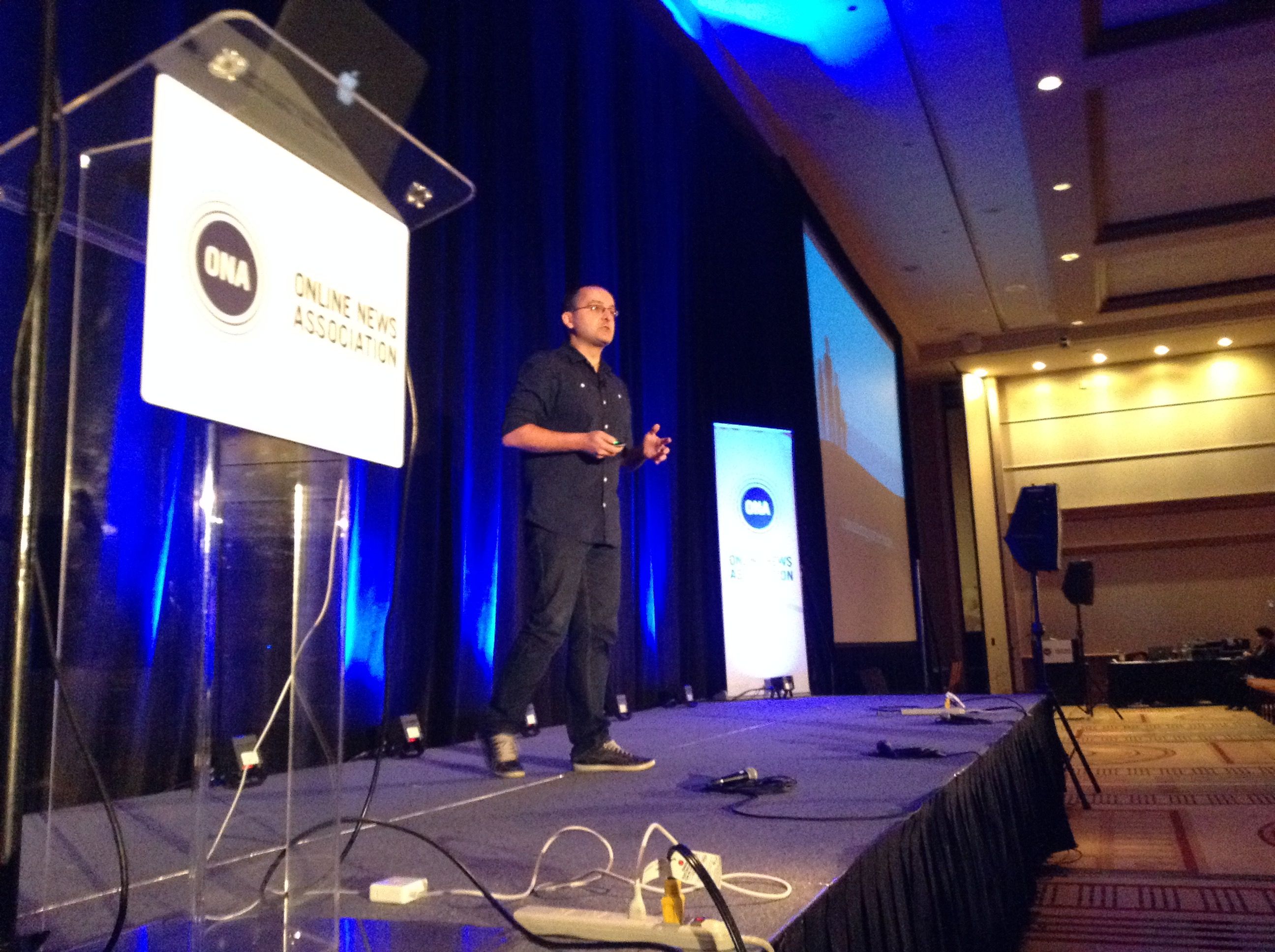
Alberto Cairo
Alberto Cairo of the University of Miami says ethics have not kept pace with data visualization techniques. (Stephen Rynkiewicz photo)

By David Craig

The Online News Association annual conference, which I attended September 24-27 in Chicago, always provides great updates on trends and issues in digital journalism. But it’s also a great place to hear about ethical challenges, both new and continuing.

Ethical issues were the focus of three sessions, including a challenge session in which audience members had to react quickly to ethical scenarios on topics such as use of user-generated content. But ethics also came up in sessions that were primarily about other topics.

Here are three ethics takeaways from the conference:

1. Content that disappears will create new ethical challenges. Amy Webb, founder of Webbmedia Group, delivered her annual talk on “10 Tech Trends for Journalists.” One of them was “ephemeral content,” an increasingly popular kind of social media communication.

Webb said Snapchat, an app developed to share photos that’s popular with young people, provided a way to send private content that users might not want to stay around, but “it’s also a way to clear up our cluttered social streams.” She said other companies are providing messaging services with content that disappears, appears anonymously or is even encrypted. She predicted that most messaging apps will have some kind of means of making content ephemeral in the next 24 months.

Ephemeral content is relevant to journalism because some news organizations including The Washington Post are experimenting with it. But Webb pointed to an ethical difficulty: “Ephemeral content can be used for publishing news. But it can’t be corrected, because no record is left.”

This kind of communication raises questions of accountability for the accuracy of content because once it’s gone, there’s no way to amend a false message or even verify what the message said.

“Talk internally about the implications,” Webb suggested to news organizations.

Even for journalists who don’t use this kind of content, the discussion points to ongoing questions about what it means to ethically handle incorrect content in social media messages.

2. Algorithms shape the truth that people learn about the world and point to new ethical obligations for journalists. Kelly McBride, vice president for academic programs at the Poynter Institute for Media Studies, and Nick Diakopoulos, a journalism professor at the University of Maryland and an expert in computational journalism, presented a session titled “Algorithms are the New Gatekeepers.”

McBride said algorithms, because they shape how news is distributed and to whom, have a powerful influence on what gets attention in the marketplace of ideas. As one of the presentation slides showed, they also affect a huge number of other areas of life including search rankings, online recommendations, advertising and relationships.

Diakopoulos talked about the power of algorithms in influencing the information we receive because of their ability to prioritize, classify, associate and filter it. He argued that the power they carry suggests new responsibilities – and opportunities – for journalists in reporting because they can help hold algorithms accountable. Stories might address issues including discrimination, mistakes that deny service, censorship, illegal activity or false predictions.

This kind of reporting isn’t easy. He pointed to several possible approaches to “auditing” algorithms – reviews of computer code, surveys of users about their experience, analysis of input and output, having users report data and (with ethical problems he acknowledged) impersonating users with programs.

Despite the difficulties, the social and economic impact of algorithms make it important for journalists to try new ways of reporting.

3. The power and availability of data visualization tools call for increasing attention to the ethics of visualization messages. Alberto Cairo, a professor at the University of Miami who teaches on informational graphics and data visualization, gave a session called “The Journalist, the Artist and the Engineer: The Ethics of Data Visualization.”

Cairo argued that the core goal of journalism ethics is to improve the public’s understanding of issues “relevant for their conducting good lives” while minimizing any potential harm. He said tools to create interactive charts, maps and other informational graphics are becoming more popular and widely available but that ethics is not keeping pace. He said that helping the public understand what good, ethical visualizations look like can help to better society and avoid the impact of misleading messages.

Even though great data visualizations are beautiful as well as functional, Cairo said, they must hold to a high standard of truthfulness that doesn’t oversimplify or distort the information being represented. Using the example of a graphic from the National Cable Television Association, he talked about going from showing things that are true but may leave out important information to showing a picture that’s more complicated but also truer and more accurate.

Cairo urged the audience not to hide complexity from the public or point to patterns that really aren’t there. In doing so, he is rightly pointing to a standard of care in visualization that is as high as the standards used in good investigative writing.

New SPJ Code


By Casey Bukro

Some might argue that it takes a certain amount of hutzpah to adopt a set of principles intended to curb the worst  behavior of journalists, sometimes seen by the public as an unruly bunch of ruffians.

But that’s what the Society of Professional Journalists did at its annual convention in Nashville. Actually, it was an updated, boiled down, tweaked, massaged version of a code SPJ adopted in 1996.

The framers of the new version started the revision process by arguing that the 1996 version failed to take into account all the technological innovation that has transformed journalism. Others argued that the ethical foundations of journalism don’t change, regardless of technological changes.

A reading of the updated code suggests that the foundationalists won, since the new code does not mention technology.  It’s a smoother read in places, but most of the original principles are still there, with some added emphasis on transparency and accuracy.

The code does not “sing,” as some journalists had wished, hoping that journalists who pride themselves as wordsmiths might have produced a more inspiring document. It tends to plod from one “do” and “don’t” to another.

But it is the nature of journalists to quibble about how things are worded.

The Society of Professional Journalists introduced its first original code of ethics in 1973,  causing a wave of consternation and congratulation among journalists.  Some thought a code of conduct was contrary to First Amendment protection of Freedom of the Press.

The reaction to the 2014 version was more subdued.

Kevin Smith, outgoing SPJ ethics chair, said one of the goals of the revision was to address “the growing problems with transparency, including news outlets failing to disclose clear conflicts of interest.”

Al Tompkins of the Poynter Institute pointed out that, at the same joint convention, the Radio Television Digital News Association disclosed its own proposed code of ethics.

“The SPJ and RTDNA codes are similar,” said Tompkins, “both focusing on accuracy, accountability and independence.” He also pointed out that the SPJ code took aim at using anonymous sources in stories.

Public Relations practitioners also would benefit from taking note of the SPJ code because it addresses two key issues: Anonymous sources and a prohibition against paying for access to news.

“So if you’re ever talking to a journalist to give information,” writes Ellis Friedman, “think twice about requesting anonymity….”

Most people might think that adopting a code of ethics is not especially controversial, but they should think again. Such efforts always trigger powerful emotions for one reason or another. Journalists can be fractious.

Among those is Michael Koretzky, an SPJ regional director, who complained that the society was unethical in the manner in which the code was rewritten, charging that it was done in secrecy. SPJ leaders were not pleased with his remarks.

And he complained that the new code was adopted by an antiquated method through representatives attending a national convention.

“The code may have needed a tech update,” Koretzky wrote, but “SPJ leaders clung to a century-old system that featured less than 125 insiders making the decision for all its 7,500 members.” Voting should have been done electronically, he argued, giving all members of the society a chance to vote on the updated code.

Koretzky promises that’s not the last word on SPJ’s code of ethics.

“But from bad things, sometimes good things come,” he wrote. “Already, work is underway on an alternate SPJ code of ethics.”


Plagiarism: A Renaissance for Attribution

he Young St. John the Baptist
Piero di Cosimo, “Young St. John the Baptist” (Metropolitan Museum of Art)

When New York Times critic Carol Vogel previewed an artist’s retrospective, readers were quick to question her report.

By Stephen Rynkiewicz

Renaissance artists might have struggled with the idea of plagiarism. Florentine salons respected tradition and uniformity, and apprentices in Piero di Cosimo’s studio learned by imitating the master. National Gallery of Art curator Gretchen Hirschauer told New York Times critic Carol Vogel that Piero’s work entered American collections partly by accident. It was attributed to other artists.

But the concept of plagiarism has evolved. When Vogel previewed Hirschauer’s retrospective of Piero’s work, a few readers were quick to question her report. It started with a list of Piero’s peculiarities, citing contemporary Giorgio Vasari, who’s still studied in paperback. But the wording was close to an even more common source, Wikipedia. The print passage is shortened online, and ombudsman Margaret Sullivan suggests Times editors might take further steps if a pattern emerges.

The word plagiarism first appears during the Reformation. The Random House Dictionary defines it as “to use the words or ideas of another person as if they were your own words or ideas.” Universities have moved beyond the Renaissance academy, with rules against copying and paraphrasing. The Society of Professional Journalists ethics code simply says, “Never plagiarize.

Yet the practice continues. Evidence of plagiarism in Sen. John Walsh’s Army War College research puts him under pressure to withdraw from the November election. Repeated instances on the website BuzzFeed got a producer fired last month. And delegates to SPJ’s 2014 convention will consider adding another ethics directive: “Always attribute.

Continue reading Plagiarism: A Renaissance for Attribution

Vanishing Facts, Finding Truth


By Casey Bukro

Looks like this new generation of online and social media writers don’t care much about fact-checking, favoring speed over accuracy.

Though that might be obvious from reading  the internet, a survey by the Dutch company ING seems to prove the point.

It found that only 20 percent of international journalists questioned bothered to check their facts before publishing.

Forty-five percent of them “publish as soon as possible and correct later,” according to the report.

This is further proof of online journalism’s faith in the self-correcting nature of the internet. Report it fast and report it first, they say. Corrections can come later.

This is a far cry from that old-school Chicago journalism motto: If your mother says she loves you, check it out. It was the ultimate in fact-checking, applied to anything and everything. The rule was to get it right the first time.

More in keeping with a different sort of saying: Never let the facts get in the way of a good story.

Another ING survey finding: Sixty percent of the international journalists said they felt less constrained by journalism standards when reporting in social media. Though they expressed low regard for the accuracy of social media, 50 percent said much of their news tips and information come from social media.

They agree social media is an informational trash bin, but dipping into that bin is addictive.

Angela Wascheck in “10,000 words” described the ING survey.

The ING report comes on the heels of a Columbia Journalism Review story on the values of modern-day newsrooms, entitled “Who Cares If It’s True?”

“In the newsrooms of this moment, with growing agreement that audiences want information that is true, journalists are coming together around the same basic questions: When is information sufficiently baked to be served up as accurate? Who decides? Should there be rules, or just ideals? Is it enough merely to try to be right eventually?”

The author, Marc Fisher, traces the shoot-from-the-hip history of some digital newsrooms, their differences with old-school journalism, and the growing recognition of the value of accuracy and credibility — even in social media.

It began with the digital journalists’ belief that truth would emerge through open trial and error. Transparency was the answer. If you don’t know, just say so.

But that could be changing.

Fisher cites one high-flying digital operation that is “embracing the ultimate symbol of the overstuffed print newsrooms of the pre-digital past.” It is hiring copy editors.

In another, Fisher finds a plan “to marry print traditions of completeness, verification and authority with the digital imperatives for speed and connection with the audience’s interest.”

Battles between the two camps still exist, but Fisher quotes a source who says conflicts diminish “as digital people have moved into leadership roles, and as everyone learned that aggregation can only take you so far, and as people from both backgrounds learn that it’s better to be second than wrong.”