Category Archives: Fairness

Clinching the Debate: Is Hugging Political Candidates Unethical?

By Casey Bukro

All is fair in love, war and politics. But do they mix?

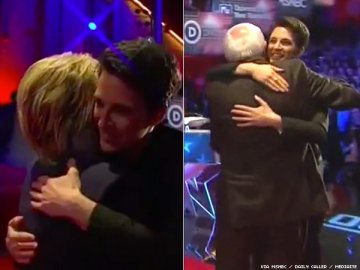
Critics say Rachel Maddow, MSNBC television host and political commentator, crossed a line when she hugged Democratic presidential contenders Bernie Sanders and Hillary Clinton after a televised debate.

Rachel Maddow hugs Hillary Clinton and Bernie Sanders
Rachel Maddow hugs Hillary Clinton and Bernie Sanders.

Maddow says she’s a hugger, and probably will hug again if invited to host another debate regardless of political party.

Conservative Fox News analyst Howard Kurtz is among those who object. “She shouldn’t have been on that stage as moderator,” Kurtz writes on foxnews.com. “She is an unabashedly liberal commentator who rips the Republicans every night on her program. She should not have been put in that position.”

Kurtz acknowledges that Maddow is a smart lady, a Rhodes scholar with deep knowledge of the issues. But as Kurtz sees it, the hugs restrict MSNBC’s efforts to shed its left-wing label and rebrand itself as a news network.

Brit Hume, another political commentator, tweeted about the clutch play, saying “I don’t think I’ve ever seen a moderator do that before.”

Washington Post media critic Erik Wemple shrugs it off.

“Consider the hugs through the prism of journalism ethics,” writes Wemple. “Were they transparent? Yes, there’s a video of the hugs, which took place in front of the cameras; any clandestine backstage moderator-candidate hugging is strictly forbidden. Were they even-handed? Yes, both Sanders and Clinton received hugs of very comparable warmth, duration and hand-pats. Were they prejudicial? Nah, coming at the end of the event, it’s hard to say that the affection received by Maddow influenced the questions, which were solid.

“So, that’s the verdict, considering that there doesn’t appear to be a hug provision in the Society of Professional Journalists’ code of ethics.”

True, the code does not outlaw hugging specifically. But it does warn against conflicts of interest, “real or perceived.” And it urges journalists to “remain free of associations and activities that may compromise integrity or damage credibility.”

Those tenets apply to this case, which is why some journalists might do a double-take at Maddow’s embrace.

In a later blog post, Wemple returns to the debate-ending squeeze. “The industry’s orthodoxy dictates that those with opinions shouldn’t be running such straight-news events. Count me out of that strain of hollow thought. We’ll take Maddow over some ‘objective’ drone every time,” he writes.

Which is to say journalism standards and customs change over time. Lines are drawn and redrawn. And journalists will agree or disagree. It’s the nature of ethics.

That Herman Hupfeld song from the movie “Casablanca” comes to mind, “As Time Goes By.”

“You must remember this, a kiss is just a kiss, a sigh is just a sigh. The fundamental things apply as time goes by.” Nothing there about hugs.

In your view, was Maddow wrong? Leave a reply below.

Edited by Stephen Rynkiewicz.

Professional journalists with ethics questions may contact us at ethicsadvicelineforjournalists.org.

Health Care Freelancers Face Tough Ethics Challenges

By David Ozar and Casey Bukro

Freelancing is a tough way to make a living – even tougher as downsized journalists turn to freelancing.

For writers specializing in health care, it’s especially challenging because of the ethics issues faced in navigating the cross connections between clients who want stories written for them or about them. Or both.

“Ethical guidelines for subspecialties may vary,” Tara Haelle in an email exchange with the Ethics AdviceLine for Journalists.

A freelancer herself, Haelle traced the obstacles in a story that appeared on the Association of Health Care Journalists website.

Tara Haelle
Tara Haelle

Haelle calls it the conflict-of-interest maze: “Ensuring that work for one client doesn’t create a conflict for another, present or future.” Though that might sound simple, Haelle said it isn’t because freelancers work for companies, journalism publications, universities and foundations or as consultants.

Haelle went to several sources, asking how she can avoid ethical conflicts of interests under the conditions in which she works and found that ethical guidelines vary. One source said “there’s no clear answer.” Another said journalists should “decide for ourselves what we think is ethical behavior.”

That sounded like a challenge for the Ethics AdviceLine for Journalists, which has a staff of five university ethicists to answer questions of the kind posed by Haelle.

One of them, David Ozar, is professor of social and professional ethics in the department of philosophy at Loyola University Chicago. AdviceLine asked Ozar to read Haelle’s story and offer his perspective on how he would have answered her call for guidance on ethics.

Continue reading Health Care Freelancers Face Tough Ethics Challenges

Ombudsman: ‘Loneliest Job in the Newsroom’

Kathy English
Kathy English, Toronto Star public editor (Toronto Star photo by Lucas Oleniuk)

By Casey Bukro

I’m a sucker for stories about news ombudsmen, or public editors or readers representatives, even though they are branded these days. I can’t help myself. It’s a compulsion, an addiction.

Think about it: An ombudsman might walk up to the top boss and tell him he’s wrong. She might pick through the details of a complicated story, then defend a reporter for doing a thankless, difficult or even dangerous job, or discover that a reporter did not go far enough to find the truth, and then say so publicly.

It’s almost heroic.

I suppose I also admire ombudsmen because what they do is so idealistic: speaking up without fear or favor, letting the chips fall where they may.

Maybe that’s why there are only about 20 of them working at American news outlets today, according to a Politico article, “The State of the Ombudsman in 2015.” That’s about half as many as a decade ago, according to USA Today.

Still, ombudsmen in the U.S. and elsewhere trudge on.

Kathy English, public editor of the Toronto Star in Canada, recently wrote an article titled, “So what does the public editor do?” Readers had asked her to explain her job, which she’s done for eight years.

Continue reading Ombudsman: ‘Loneliest Job in the Newsroom’

GamerGate Revisited: Is It Really About Journalism Ethics?

AirPlay

By Casey Bukro

Is GamerGate about ethical violations in video-game journalism?

Or is GamerGate just a smokescreen for harassing women who want to work in the male-dominated gaming industry?

Or is it something else?

A live-streamed debate will sort it out Aug. 15 in Miami.

Elements in the controversy include the $15 billion video game industry, the video game press, game reviewers, developers, commentators and those who sell advertising in gaming magazines. It’s a volatile mixture.

Michael Koretzky, a regional director for the Society of Professional Journalists, organized the conference and will moderate. His region covers Alabama, Georgia, Florida and South Carolina. Sponsors are the region and SPJ Florida.

AdviceLine questioned Koretzky on the key issues:

Continue reading GamerGate Revisited: Is It Really About Journalism Ethics?

Going Undercover for Drugs

From the files of the Ethics AdviceLine for Journalists

By Casey Bukro

An Arizona community newspaper staff is considering sending a reporter/photographer team out with a few $20 bills to do a story on how easy it is to buy drugs, but fear they might be arrested if they do that.

What are the legal and ethical implications? A staff writer asked in an email to the Ethics AdviceLine for Journalists.

AdviceLine does not answer legal questions, but from an ethical perspective, said an AdviceLine adviser, the marginal issue is that the reporter would be acting as a buyer and misrepresenting himself.

If they went ahead with the plan to buy drugs, the staff writer added, would they be compelled to report it to the police? The adviser answered that they would have been a witness to a crime, and “it seems to me they would be obligated to do so.”

The assignment sounds more like police work than journalism, said the adviser, and “while I applaud the motive and the courage of the reporter, have you looked at other ways to accomplish the same thing?”

One possibility would be to cooperate with police, instead of embarrassing them, which an article about an undercover journalist might do.

Also, the Society of Professional Journalists Code of Ethics discourages undercover or other surreptitious methods of gathering information “unless traditionally open methods will not yield information vital to the public.”

The AdviceLine adviser summarized his views by saying: “First, the project is dangerous. Second, it should be left to the police. And third, as an alternative, contact the police and ask if a reporter might accompany an officer who might carry out the ‘bust’…”

The writer said he had not thought about working with police in that way.

FOLO: Another Philosopher Thinks About Charlie Hebdo

The Battle of Algiers
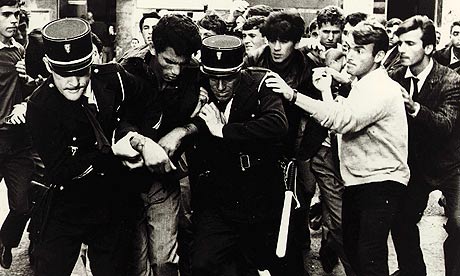
Scene from “The Battle of Algiers” (1965)

By Hugh Miller

Many thanks to my friend and Loyola colleague David Ozar for his reflections on the Charlie Hebdo murders. My reflections here are meant as a supplement to his.

I agree pretty much completely with what Dave has to say. I agree wholly with his position on the first group of issues, that is those involving the morality of violent assaults upon persons to prevent such persons from expressing their views.

As to the second group — having to do with the issue of jihad as it is understood and practiced in Islamic contexts — I have nothing to say. I am myself neither Muslim nor sufficiently educated in the concrete issues to be able to say anything useful, not to mention edifying, about the matter. It is really for experts in Islam to make things clearer for us.

On the third set of issues — where the journalism-ethics rubber meets the road, so to speak — I think I also largely agree with Dave. His distinction between “needed information” and “valued information” is very useful. Satire clearly falls in the second category. But we should perhaps note that the division between the two is somewhat porous.

Clearly, one of the functions (or at least results) of the provision of “needed information” often involves being disobliging, to use a polite word, to those in positions of power or authority. As Murray Gurfein once famously said, “A cantankerous press, an obstinate press, a ubiquitous press, must be suffered by those in authority in order to preserve the right of the people to know.”

The mission or aim of satirical humor, as commentators have repeatedly noted, is to cause readers or listeners to criticize the words and actions of their leaders, especially when those words and actions are absurd or harmful to those whom they profess to lead. (See an especially good piece about this by the British author Tim Parks in his New York Review of Books blog.)

The means employed by satire differ from those employed by “straight” reporting; but, in at least some respects, the ends are the same, or at least quite similar. The satirist Harry Shearer made a similar point recently on his radio show, Le Show: Genuine satire always involves critiques of those in positions of power and authority.

It is for this reason, I presume, that in so many newspapers it has been historically the tradition to place editorial cartoons in a different category, and indeed in a different physical location, in the newspaper from the “comics.” Indeed, editorial cartooning faces many of the same push-back pressures and intimidations from those whom it covers as do reporters writing articles. Columns and cartoons alike risk “spiking.”

What has been prompting my own reflections most, though, has been the problem of “offense” which Dave discusses toward the end of his post. And, really, his own reservations and hedging about the possibility of getting clear on the issue are to his great credit, and are more or less the jumping off point for my own ideas.

Philosophical debates about the Charlie Hebdo tragedy that I have read have tended to take various abstract positions. Some have voiced a full-throated support for “Enlightenment values”: for example that in a liberal democracy that practices the separation of church and state one has (or ought to have) a perfect right to say what one thinks, and to have that saying protected, if necessary, by state power — limited only by concerns of public safety, incitement to riot, hate speech, etc.

Others (in what might be called the “ethics of care” position) argue that we have a prima facie obligation to avoid knowingly giving offense to others, absent a very good reason for doing so. But what has struck me, and worried me, about many such positions has been precisely their abstractness.

Abstraction is at once the strong suit and the Achilles’ heel of traditional philosophical practice. In philosophy we tend to think that our job is to get to a position of general or universal conceptual clarity and logical rigor, and from such a standpoint to lay down canons of knowledge and action that (we think) ought to be shared and carried out by “the rational person.”

In doing so we commonly leave behind many of the concrete, historical, individual details of persons and situations, viewing them either as accidental or as something that can be accounted for by tweaking the theory later, once the basic ground rules have been agreed upon. First, we think, let us get our virtue-ethics, or utilitarian, or deontological, or communitarian systematic ducks in a row. Then we can take care of gender, history, power, etc., in a kind of cleanup sweep at the end.

Along with many other contemporary philosophers, I’ve come to think of such a philosophical practice as deeply problematic, if not fatally flawed. For once we step away from the concrete facts and situations and relegate them to the periphery of “accidents,” we seem unable to retrieve them later as anything but that, in fact—as inessential accidents.

We also absolve ourselves too quickly of responsibility for thinking through ways in which our vaunted theories have been applied historically. “Duty,” for example, is a compelling idea, and as Kant articulates it, a powerful foundation for moral judgment. But it is also the key idea deployed by those for whom by obedience to commands is the dominant imperative of moral life—and rigorous obedience to commands can carry us very far indeed from moral behavior.

More generally, “Enlightenment values” were born and developed over a long period in which huge historical moral catastrophes like slavery, colonialism, racial segregation, totalitarianism, capitalist exploitation, the oppression of women and environmental degradation have been dominant facts. Are we to say that those values have no real relation to such events—that they have been only meant to correct such failures? If so, they have been unsuccessful.

What this means is that, for me, and for others who think like this, moral reasoning must be contextualized and made concrete, every step of the way. Out first responsibility is to think critically, especially self-critically, of what we claim as our values and how we claim to be able to apply them to a situation. We must first investigate the concrete details thoroughly. We must listen—really listen, not just record facts distractedly while our real attention is directed to our theories—to the parties involved.

We must learn the history, the details, the particulars, and especially the relations of power and powerlessness that mark and have marked the participants. In the case of Charlie Hebdo, that means looking at the status of the various Muslim communities in France, at the very least since the Second World War and the Algerian struggles for independence.

What of the young disenfranchised Muslim youth in the banlieues of Paris and the other great cities of France? How are Muslims treated in France, now and historically? What effect has the struggle over the public ban on the wearing of the hijab been on the Muslim community?

For that matter, what is the historical tradition of polemical satire, like that of Charlie Hebdo, which is common not only in France but in many countries in Europe? Is such polemical satire really a blow for freedom, as its (current) defenders insist, or also an instrument of ridicule of oppressed and discriminated-against minorities, women, etc.?

In the case of Charlie Hebdo, there have been a number of incidents (for example, in 2006, 2011 and 2012) where publication of provocative and offensive cartoons have caused both foreign governments and French leaders themselves to call for restraint and greater sensitivity to offense. Simply to continue to plump for a rigid application of an exceptionless liberty of expression in such conditions seems not just insensitive but the height of moral obtuseness.

I don’t mean to say that there are no universal moral principles. But I do think that there are no meaningful or useful moral principles that do not arise from a careful critical engagement with the concrete facts of the situation. In particular, they must arise from a committed engagement, by all sides, genuinely to listen to each others’ stories, to criticize their own presuppositions and privileges, to attempt to see others’ points of view, and to assume responsibility for their own thoughts and actions, and even for the thoughts and actions of others.

I think it especially important to make this point in the light of an impassioned plea on January 26th by the Moroccan journalist and activist Zineb El-Rhazoui, who worked for Charlie Hebdo, for all of us to support free speech. (She escaped being killed because she was in Morocco at the time the massacre occurred.)

At an interview in Montreal she appealed to the West to stand up against Islamic fundamentalism. What was interesting about her argument was that it was not based upon a claim of the cultural superiority of western secularism to Islam (even though she admitted she believed in that superiority, and embraced it).

Rather, she said, there was a subtle, paternalistic racism implicit in those who urged sensitivity to Muslim outrage. Those who claim that we should leave Muslims to their own culture and not criticize them, lest we be called racists, she said, are in essence saying, “Those people are not capable of universalism, that they don’t deserve it, that the only thing they deserve is to be ruled by [medieval] rules.”

Those who have read Edward Said’s influential book Orientalism (1978) will recognize the argument: the West has culturally patronized the Arab/Turkish/Persian/African “East,” both elevating itself against that “East” and demeaning it as unworthy of Western values.

My point is that we must understand El-Rhazoui’s position as well: many women (in particular) have found liberation and protection from their experiences of gender discrimination by seeking refuge in exile in the West.

We must listen to their voices as well. But we must situate their claims in a larger context, and recognize that their experiences do not mean that we must abandon our sensitivity to the many other situations of cultural conflict, domination and discrimination. Of course, no one is incapable of, or unworthy of, “universalism.” But the question remains: when one adopts “universal” values, what comes along with that adoption? And what might be left behind?

This is a lot of work. It is easier to formulate a code and then just to apply it, even if it means having to bang the square pegs quite hard to wedge them into the non-square holes on the moral playing board.

But that is hardly a decent way to proceed. The ethics of publications like Charlie Hebdo have to be worked out now, going forward, in an atmosphere of respect, of listening, and of mutual concern. That would not be censorship. It might, in fact, be the birth of a kind of satire that would be genuinely liberating for all concerned.
A Philosopher’s Thoughts on Charlie Hebdo


  • Cartoonists pay Tribute to Charlie Hebdo attack victims - 25 Cartoons

By David Ozar

I am a philosopher and ethics professor.

Some of what has been said about the murder of staff at Charlie Hebdo has seemed to me to make very good sense; but some of it has been muddled by treating together a number of ideas that are very different from each other. There are at least three sets of ethical or social-ethical issues that these events put on the table for careful reflection.

I began writing about these issues because I was pretty sure that drawing a clear conclusion about one of these issues does not lead us to clear conclusions about the others.  I offer my reasons for this point of view here in the hope that they will help others think carefully about these issues and, if I am correct, avoid muddling them together.

One set of ethical issues raised by the events at Charlie Hebdo focuses on whether killing people to prevent them from speaking their views is ever morally/ethically justifiable. Very few people in the world believe it is.

No philosophical and theoretical position, Islamic or otherwise, that affirms every human being has a value that does not depend on what the person believes or how he or she acts would ever support such killings as morally/ethically justifiable.

Clearly, committed terrorists of any religious stripe or of no religion view humans differently.  But I am assuming the fact that there are people who hold other views about human beings is not counter-evidence enough for the rest of us to withhold judgment about the value of a human being, or a reason to view terrorists as anything but profoundly mistaken and dangerous enough to the rest of us that ethically extraordinary measures may be necessary to prevent them from acting on their views.

But as I said, I don’t think being clear about this set of issues provides clarity to the other two.

A second set of issues concerns what is or is not required of Muslims who seek to act faithfully in accord with the Koran.  The fact that the jihadists we are dealing with say they read the Koran as justifying acts of terrorism — and let us assume this is genuine and not strategic posturing for the sake of grabbing power or whatever, though their being genuine in this is also something that would need evidence for us to be sure — tells us nothing at all about other strands of Islam and nothing dependable about the Koran and surely provides no evidence about Islam in general or Muslims as a group.

I have no detailed knowledge about Islam and its many varieties and all the Muslims I have known personally have been good people whom I would be happy to call my friends. My guess is that there are as many strands of Koranic interpretation as there are regarding interpretation of the Judaic and Christian Scriptures; and the news about the Paris massacre has evidenced many devout Muslims who condemn terrorist acts of all sorts as being clear violations of Koranic teaching.

In fact, while these terrorists and ISIS do use the word “jihad” to describe their efforts, this probably tells us nothing specific enough to draw conclusions about jihad itself as this idea occurs in the Koran or is understood by Muslims generally.

For I do not know – and we would need to listen carefully to Koranic scholars to draw any conclusions – whether the notion of jihad in the Koran or in various Muslim traditions of interpreting it always requires terrorism. Religion-based wars have been fought — by partisans of many different religions — without resorting to terrorism. That is, in accord with the rules of ethical war (articulated for example, but not exclusively, in the West’s understanding of “Just War Theory”). There could just as easily be Islamic traditions that interpret jihad this way rather than seeing it as requiring terrorism.

And ethical/moral questions about what justifies acts of mortal violence under any circumstances, much less circumstances having any relevance to the present situation of various peoples in the Middle East, is a huge set of questions I am not even attempting to say anything about here.

Anyone wishing to understand the ethical issues involved in justifying war’s violence will find a good, careful discussion in Michael Walzer’s book, Just and Unjust Wars. A good example of a discussion of the ethical issues involved specifically in addressing the threat of organized terrorism that our country learned it must deal with in the events of 9/11 is Jean Bethke Elshtain’s book, Just War Against Terror.

The third set of ethical issues raised by the events at Charlie Hebdo concerns journalists and their various appropriate professional roles.  In an essay entitled, “An Explanation and Method for the Ethics of Journalism,” which I co-authored with another philosopher/ethicist, Professor Deni Elliott, I proposed an answer to the question “What Values Do Journalists Bring About For Those They Serve (i.e. in their designated social role in our society)?”

The book is: Journalism Ethics: A Philosophical Approach edited by Christopher Meyers, pp.9-24. This is a central question to reflect on when asking about the professional ethics of any profession.

I argued there that Needed [by the public] Information comes first and Valued [by the public] Information comes second.

Clearly the creation and publication of humor, and more narrowly of satirical humor, is not part of the role of journalists to provide the public with needed information or even information which the public does not need but values having for one reason or another.

I argued that the other kinds of good that journalists can do may well be ethically appropriate to their professional role, at least in Western societies, and I think that producing humor is one of these, either as entertainment or as something valued for other reasons, perhaps including thoughtful social criticism.

But I take it for granted that every profession’s ethics are the product of a dialogue between that group and the specific larger society in which it functions. So I think that, in today’s world where the products of journalists’ work go far and wide, it is a complex question to know whether societies where other things besides these two are not part of journalists’ social role are ethically justified in those societies.  This is a question I will not try to comment on here, but which would make a great topic for discussion by those who care about journalism’s professional ethics in today’s digital world.

With that as background, I can pose the key question about journalism’s professional ethics that is at stake here: Is satirical humor sufficiently socially-ethically justifiable within the social-ethical role of a professional journalist or professional journalist organization that such humor continues to be ethically justifiable when it is highly offensive to large numbers of otherwise reasonable, not-fanatic, peace-loving and neighbor-caring people?

This is a very complex ethical question.  What a person finds offensive is, for want of a better word, painful to them, it hurts.  And in general we think hurting others’ feelings ought to be avoided unless there is a good reason for it. In addition, it is rare that we judge hurting someone’s feelings, offending someone, for no other reason than to entertain other persons (besides the one who is hurt) to be something that is morally/ethically justifiable if the situation is one in which the hurt party has little realistic opportunity of avoiding the hurt.

The great American philosopher, Joel Feinberg, determined that his examination of rights should include a careful discussion of the extent to which offense can ever be morally/ethically justified and if there are circumstances in which it should be legally prohibited.

The work ended up taking him a whole, complex book to sort out. [The book is: Joel Feinberg, Offense To Others.]

So it seems to me that well-thought-out answers to the question I just asked are going to take time and effort to sort out, especially in an international digital world in which “news” of all sorts is flashed on screens, billboards, etc., at least in many parts of the world.  For that means that the ethical issue is not resolved by just saying, “Well, if you think it will be offensive (or even know it because they said it would be), just refuse to buy Charlie.”

That is not a realistic answer to the opportunity-to-avoid question in a world where the line between information, entertainment, and advertising has been blurred so thoroughly (although this blurring has not been solely the result of the changes in journalism in recent decades, but on the other hand journalist organizations have certainly played a part in the process).

So I think there is a lot here that is worth discussing, especially if we are willing to assume that short, quick answers are almost certainly going to be too simple once we get past the “do not kill” part of the matter.  That’s my ‘two cents” on this. Well, to be honest, it’s quite a few cents! But then I am a philosopher and I am unwilling to pretend complex ethical things are simple !

The Steve Kroft Affair


By Casey Bukro

We here at Ethics AdviceLine for Journalists sometimes clash over what is ethical or not.

The Steve Kroft affair is the latest example.

The veteran “60 Minutes” correspondent admits he had a three-year fling with a New York City lawyer, though both are married.

“I had an extramarital affair that was a serious lapse of personal judgment and extremely hurtful to my wife and family, and for that I have nothing but regret,” Kroft said in a statement to the New York Post. Both the Post and the National Enquirer published salacious text messages between Kroft and his lover, proving once again that anything on the internet is not private.

A CBS spokesperson said “It’s a private matter.”

Soon after the scandal broke, an AdviceLine colleague wrote: “Are personal values/ matters the same as professional matters? Should I teach my students that I don’t care what they do in their personal lives as long as they make good ethical choices in their professional ones? Personally, this Kroft story does not interest me. His professional work does.”

Kroft is one of the most high-profile journalists in America. He has been a CBS newsman for 31 years, 26 of them as a correspondent with “60 Minutes,” which specializes in asking the high and mighty tough questions about their personal lives, their entanglements, their dalliances and the quality of their professional judgment.

Here’s what I say to my AdviceLine colleague: What people do in their personal lives reflects on their credibility and integrity. I don’t think you can separate personal and work lives that easily.

By your reasoning, we should have ignored Bill Clinton’s affair with Monica Lewinsky, as we did with JFK and his affairs. Looking back on JFK, journalists are criticized now for turning a blind eye to his dalliances. Now we’re more inclined to think about accountability.

Kroft is a very public figure by virtue of his role on “60 Minutes.” Part of his job is exposing the conduct of public officials. I would buy your argument if he were not a public figure. That is why, in ethics, we draw the distinction between public and private individuals.

Also, there is the issue of blackmail. Anyone involved in something he or she does not want the public to know is subject to the possibility of blackmail and manipulation.

Tell your students that they have to be smart enough to recognize that ethical values apply to all facets of people’s lives, especially to public figures, and that they, themselves, become public figures when they become very visible journalists. Think Woodward and Bernstein.

That’s why, these days, we encourage publishers and editors to avoid becoming involved in civic organizations, a practice that once was common, and to a degree still is. There is the public perception that if a publisher is an official on the board of a civic organization, he will favor that organization and give it favorable publicity. He also is seen likely to keep bad information about the organization out of the news.

The Society of Professional Journalists code of ethics warns journalists to avoid conflicts or interest, real or perceived.

All of this is in the realm of accountability, an issue we take more seriously these days. People with ethics issues should not be pointing fingers at others with ethics issues. “60 Minutes” sets very high standards and its correspondents should measure up to them.

Personally, I always thought my role as a journalist meant that I was forbidden from doing things others could do. When I covered finance, I avoided buying stock in companies I covered. I did not join organizations I covered. I did not take part in political campaigns.

You can argue that any American citizen is entitled to do those things, and you would be right. But I always believed that anything I did should be above reproach. Being a journalist was paramount. It is an honor, a privilege and a duty to be smart enough to avoid any activity that could tarnish my reputation, and the reputation of the journalism organization I worked for.

Too often, the public complains that the media gleefully write about the transgressions of politicians and others, while keeping silent about the transgressions of journalists. The “old boy” syndrome. They say we cover up for each other. It’s a double standard. We should report on the transgressions of journalists as vigorously as we do about the transgressions of others. It’s only fair.

Comments are welcome.

Rape, Cosby and UVA

A story in Rolling Stone featured the alleged gang rape of a University of Virginia student, launching calls for reform and more attention to the issue of sexual assaults on campus. Recent reporting by the Washington Post, however, has raised doubts about the veracity of the story.
Fraternity house named in alleged rapes (Ryan M. Kelly, The Daily Progress/AP file)

How aggressively did journalists pursue the facts?

By Casey Bukro

Rape became big news with allegations against Comedian Bill Cosby and an explosive Rolling Stone story describing a gang rape of a co-ed at a fraternity house on the University of Virginia campus, for which editors later apologized for “discrepancies.”

Both rape stories raised questions about how journalism works in America and whether it can be trusted.

Where were the editors while these stories were being covered? Tough editors ask tough questions, and demand answers from their own reporters about how they got the story and whether it’s supported by hard investigation.

Media are accused of failing to dig into serial rape accusations over decades against Cosby, who was seen as a popular father figure as he was portrayed on his television show.

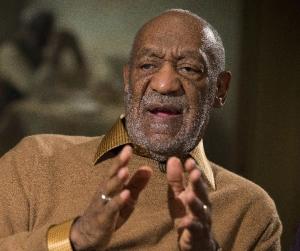
About 20 women have accused Cosby of drugging them, and often raping them. But he has not answered to what he calls “innuendos.” Some of the accusers have been challenged. Cosby’s most recent comment is that his wife is dealing well with the controversy.

Pushing back, Cosby’s lawyer accuses a reporter of deception, and his wife, Camille, contends the media failed to take a close look at her husband’s accusers.

The Rolling Stone gang rape story by Sabrina Rubin Erdely is based on a single source, a woman identified only as “Jackie,” who claimed she was lured to a 2012 fraternity party by a man named “Drew,” and raped by seven men. The Washington Post described the story.

Good reporting usually involves getting all sides of the story. Erdely admitted that she made a deal with Jackie that no attempt would be made to find and interview anyone else involved in the alleged rape, or knew about it.  And her editors allowed her to get away with a violation of a basic tenet of good reporting – getting multiple sources to verify the accuracy of the story

The editors allowed this unusual dispensation from careful reporting because the story was “sensitive.” Yes, rape is a sensitive issue, but not a reason to suspend professional standards in reporting. Sensitive stories require more careful reporting, not less.

The Society of Professional Journalists code of ethics urges caution in reporting sex crimes.

The story was widely reported and put a spotlight on campus rape. Then came questions about its accuracy. The accused fraternity had no party on the night the rape allegedly happened, and issued a statement saying that sexual assault was not “part of our pledging or initiation process.” It appeared to be fabricated and continues to be called into question from many sources.

Media followed the story as a lesson in journalism and ethics. A defamation suit against Rolling Stone is a possibility.

Rolling Stone’s managing editor, Will Dana, issued a statement:  “In the face of new information, there now appear to be discrepancies in Jackie’s account, and we have come to the conclusion that our trust in her was misplaced.”

Other media noticed the discrepancies. Pittsburgh Post-Gazette Columnist Jack Kelly calls the story “an unforgivable breach of journalism ethics” and thinks the fraternity house should sue Erdely and Rolling Stone for libel.

Rolling Stone editors believed Jackie was credible, according to Leslie Loftis in the Columbia Journalism Review,  because of a bias – a willingness to believe Jackie because “everyone knows that there is an epidemic of rape on campuses around the country….”

It’s what you know, or want to believe, that can set a trap.

The editors at the Washington Post wanted to believe one of their bright and upcoming reporters, Janet Cooke. She wrote “Jimmy’s World,” a story about an 8-year-old heroin addict in a family of addicts. Narcotics addiction was a big issue in 1980.

That story was so good, it won a Pulitzer Prize in 1981.

Then came the questions. A Washington Post editor asked Cooke to get in a car and go with him to identify where Jimmy lived. They drove around and could find no Jimmy. Cooke eventually admitted she invented Jimmy.

Cooke said the Post’s high-pressure newsroom corrupted her judgement. She said she had heard about somebody like Jimmy. She decided to write the story, based on anonymous sources, to satisfy her editors, she said.

The Post’s ombudsman wrote a long critique on the “Jimmy’s World” story, and found that the editors bore heavy responsibility, adding that “everybody who touched this journalistic felony was wrong.”

Good editors are supposed to do the hard work of keeping stories honest.

“Don’t tell me what you think, chum. Tell me what you know!” said a fabled, crusty editor at the former City News Bureau of Chicago, once called the Devils Island of Journalism. He grilled his reporters as vigorously as he expected his reporters to grill their sources.

Cosby: When The Media Watchdogs Bark, Or Not


By Casey Bukro

The serial rape allegations against Comedian Bill Cosby have reached the stage where people are asking why the media failed to report them when they happened.

It’s complicated and messy, in part because Cosby denies the allegations and calls them “innuendos” from the distant past which he will not dignify with a response.

The public often blames the media for hounding celebrities, sometimes to the point of ruining their reputations. Other times, the media are accused of promoting popular celebrities to the point of being a cheering section.

Both true.

It could be argued that Cosby got the cheering section treatment for decades. But now that’s changing and causes observers to wonder if media watchdogs failed, professionally and ethically.

Especially troubling are media reports that, in exchange for an exclusive interview, Cosby made a deal with the National Enquirer to delay a story about a new rape accusation while the civil suit in another rape case was going on. That strikes to the heart of media responsibility to report the facts, and whether the media did that in Cosby’s case.

The Columbia Journalism Review  says the press is responsible for ignoring Cosby rape allegations, pointing out that People Magazine published an article in 2006 about five women who accused him of rape.

About 20 women have accused Cosby of assaults, most dating to the 1970s and 1980s.

From a wider perspective, rape is one of those issues where the media tend to reflect societal attitudes, which includes the issue of privacy for both public and private figures. And all of that is changing fast. Media always had a responsibility to lead public opinion, not just follow it.

Not so long ago reporters ignored the private peccadillos of powerful figures in the belief that what they did in private was their business, not the public’s. Their silence was called “a gentleman’s agreement.”

Think President John F. Kennedy and President Dwight D. Eisenhower.

Kennedy was a known cavorter, but the White House press corps ignored it, in part to stay in the president’s good graces.

Rumor had it that Eisenhower had an affair with his war-time chauffeur, Kay Summersby, who confirmed it in 1975 in a memoir titled “Past Forgetting: My Love Affair with Dwight D. Eisenhower,” before she died. The rumors stayed mostly under wraps until the memoir appeared.

But rape is far more complicated. In the past, police departments sometimes minimized it as a he said/she said sort of thing. Women were sometimes twice victimized by rape and then accused of bringing it upon themselves. Sometimes they were ashamed to talk about it, especially when alcohol was involved.

It is a topic coming out of the shadows as women are more inclined to talk about it, and the media more inclined to report on it partly as a result of that openness and changing social views. That comes at a time when other sensitive issues, such as gay rights and abortion, are discussed more openly.

The Cosby accusations  stretch over decades, enough time to show how differently the issue is treated, then and now.

The case against Cosby snowballed recently after supermodel Janice Dickinson publicly accused the entertainer of drugging then raping her in 1982 when she met with him, hoping he would help advance her career. Dickinson is one of about 20 women who tell similar stories, one of whom was 15 years old at the time.

Nostalgia is another time-related thing.

Entertainment is a fantasy, just as Cosby as Cliff Huxtable was a fantasy. But it was a fantasy that the public desperately wanted to believe, wrote Vox.com’s Amanda Taub. They wanted to keep happy childhood memories of the Cosby show.