Category Archives: Accuracy

Ethics Scan: Media Bias in Poland and Britain


4c9ed35c-e03c-47d6-a453-7fda3790d05f.file

By Casey Bukro

Media ethics in nations around the globe can be as controversial, and thought-provoking, as they are in the United States. They are worthy of an occasional look, which is the goal of Ethics Scan.

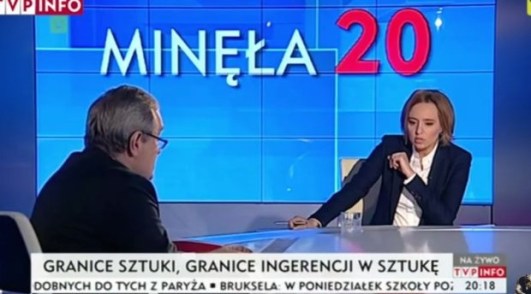
A Polish public broadcaster is back to work after a suspension stemming from her tough interview with Poland’s deputy prime minister over his attempts to block a controversial theater production. He accused TVP, the public broadcaster in Poland, of “manipulating” public opinion.

The interviewer was suspended hours after the interview when the minister complained that her aggressive techniques were contrary to the expected standards of public television. However, TVP’s ethics committee decided that the journalist did not violate network ethics standards and was justified in grilling the government official, whose comments about TVP and its journalist were considered “unjust and hurtful.”

In the United Kingdom, the British Broadcasting Corp. discovered from a viewer survey that they wanted “less bias and political opinion in journalism and news reports.”

The BBC Trust, the network’s governing body, also found that viewers wanted fewer game shows and cooking programs, but more high-quality drama. BBC is the world’s oldest national broadcaster, dating to 1920.

In its analysis of the survey results, BBC said it was not clear how it was biased, since respondents on both sides of the political spectrum complained the corporation was against them.

A Second Look at the Mizzou Uproar, Pros and Cons


thefederalist.com photo


By Casey Bukro

Since all the Ethics AdviceLine for Journalists consultants teach on campuses across the country, it seemed logical to ask them how they and their students reacted to events that played out at the University of Missouri over press freedoms and protests over racial tensions.

An earlier AdviceLine blog post focused on what appeared to be an attack on First Amendment press freedoms when faculty member Melissa Click attempted to banish two student photographers from the protest scene, for which she later apologized.

Hugh Miller, assistant professor of philosophy at Loyola University Chicago, took what he called a contrarian view.

“I disagree,” said Miller, citing a lawyer friend who pointed out that the First Amendment of the U.S. Constitution “is a restriction imposed upon the state, not upon individuals…. It imposes no restrictions on individuals.

“Reporters are perfectly free to jam a microphone in my face – no government authority can prevent them from doing so. And I am perfectly free to tell such reporters to get stuffed if I don’t want to talk or have them around. In so doing I do not violate the First Amendment. The First Amendment is not, IMHO [in my humble opinion], a license for journalists to demand, and get, access to coverage.

“Whether the contested access is on public property makes little difference to the First Amendment issue (though it may be important in a property rights sense). Nor does the First Amendment impose duties or obligations upon individuals to afford journalists the opportunity to cover them.

Continue reading A Second Look at the Mizzou Uproar, Pros and Cons

Mizzou Students and Faculty Flunk Press Freedom Test

Heated: Activists at the University of Missouri were caught on camera forcing photographer Tim Tai (left) off the public quad on Monday, during their celebrations over the resignation of President Tim Wolfe

Photographer Tim Tai explains First Amendment

By Casey Bukro

Amid the chaos of student and faculty protests over racial tensions at the University of Missouri, student photographers Tim Tai and Mark Schierbecker stood out as young men who understood their First Amendment rights to photograph and videotape the historic event in a public place.

Sadly, Tai and Schierbecker were badgered, harassed and bullied by students and faculty while trying to do their jobs.

Schierbecker videotaped Tai as he was harangued, surrounded and pushed by a crowd of students and older individuals who held their hands in front of his camera and would not allow him to move forward.

“We will just block you,” says one. “You need to go.”

Others chanted, “hey, hey, ho, ho. Reporters have got to go.”

Another says, “You gotta go, bro. You lost this battle, bro. Just back up.”

To his credit, Tai stood his ground and explained patiently, “The First Amendment protects your right to be here and mine.” He added, “I’ve got a job to do.”

Continue reading Mizzou Students and Faculty Flunk Press Freedom Test

A Code of Ethics All Your Own

By Casey Bukro

Everyone is in favor of ethics, until you get into the details. That’s when the fights break out.

This is something the Online News Association is likely to learn as it makes its way through a project called the Build Your Own Ethics Code. Journalists are invited to crowdsource and document their ethical practices.

Code of Ethics
Can Stock Photo

I have some personal experience in this realm. Back in 1972, I was national professional development committee chairman for Sigma Delta Chi, later named the Society of Professional Journalists.

The public, then as now, tended to have a low opinion of journalists. A public opinion poll in 1972 showed only 19 percent of the public had confidence in the press. Garbage collectors ranked higher.

Hoping to counteract that, delegates at the 1972 convention in Dallas adopted a resolution asking the group to do something about that low image of American journalists. That resolution was sent to my committee.

We decided to write a code of ethics reflecting SDX values and standards, acting on a constitutional mandate to inform the public as part of journalism’s role in a democracy. We wanted to show that journalists do have standards, and can act in an ethical manner.

Continue reading A Code of Ethics All Your Own

A Reporter Discovers the Pain of Being Ethical

By Casey Bukro

It’s hard to be good and ethical. Sometimes it comes at a cost.

Amelia Pang, metro reporter for Epoch Times in New York, discovered this when she called the Ethics AdviceLine for Journalists in 2012 and asked a question that AdviceLine gets sometimes:

When calling a news source, is it necessary for reporter to admit to being a reporter? That is, not say that she is a reporter, unless asked?

It is a question that arises among young reporters, those learning the ropes or those who work for organizations without printed standards or spelled out ethical guidelines that can leave a reporter wondering what to do.

In Pang’s case, she called AdviceLine on advice from a colleague.

“I am doing an article about a controversial homeless shelter in New York City,” Pang told AdviceLine adviser Hugh Miller, an assistant professor of philosophy who teaches ethics at Loyola University Chicago.

“The shelter is located in a very rich area, therefore many residents have been quite unhappy about it. The shelter has received a lot of bad press since they opened last year, and now they are reluctant to talk to any media.”

Continue reading A Reporter Discovers the Pain of Being Ethical

Health Care Freelancers Face Tough Ethics Challenges

By David Ozar and Casey Bukro

Freelancing is a tough way to make a living – even tougher as downsized journalists turn to freelancing.

For writers specializing in health care, it’s especially challenging because of the ethics issues faced in navigating the cross connections between clients who want stories written for them or about them. Or both.

“Ethical guidelines for subspecialties may vary,” Tara Haelle in an email exchange with the Ethics AdviceLine for Journalists.

A freelancer herself, Haelle traced the obstacles in a story that appeared on the Association of Health Care Journalists website.

Tara Haelle
Tara Haelle

Haelle calls it the conflict-of-interest maze: “Ensuring that work for one client doesn’t create a conflict for another, present or future.” Though that might sound simple, Haelle said it isn’t because freelancers work for companies, journalism publications, universities and foundations or as consultants.

Haelle went to several sources, asking how she can avoid ethical conflicts of interests under the conditions in which she works and found that ethical guidelines vary. One source said “there’s no clear answer.” Another said journalists should “decide for ourselves what we think is ethical behavior.”

That sounded like a challenge for the Ethics AdviceLine for Journalists, which has a staff of five university ethicists to answer questions of the kind posed by Haelle.

One of them, David Ozar, is professor of social and professional ethics in the department of philosophy at Loyola University Chicago. AdviceLine asked Ozar to read Haelle’s story and offer his perspective on how he would have answered her call for guidance on ethics.

Continue reading Health Care Freelancers Face Tough Ethics Challenges

Ombudsman: ‘Loneliest Job in the Newsroom’

Kathy English
Kathy English, Toronto Star public editor (Toronto Star photo by Lucas Oleniuk)

By Casey Bukro

I’m a sucker for stories about news ombudsmen, or public editors or readers representatives, even though they are branded these days. I can’t help myself. It’s a compulsion, an addiction.

Think about it: An ombudsman might walk up to the top boss and tell him he’s wrong. She might pick through the details of a complicated story, then defend a reporter for doing a thankless, difficult or even dangerous job, or discover that a reporter did not go far enough to find the truth, and then say so publicly.

It’s almost heroic.

I suppose I also admire ombudsmen because what they do is so idealistic: speaking up without fear or favor, letting the chips fall where they may.

Maybe that’s why there are only about 20 of them working at American news outlets today, according to a Politico article, “The State of the Ombudsman in 2015.” That’s about half as many as a decade ago, according to USA Today.

Still, ombudsmen in the U.S. and elsewhere trudge on.

Kathy English, public editor of the Toronto Star in Canada, recently wrote an article titled, “So what does the public editor do?” Readers had asked her to explain her job, which she’s done for eight years.

Continue reading Ombudsman: ‘Loneliest Job in the Newsroom’

GamerGate Revisited: Is It Really About Journalism Ethics?

AirPlay

By Casey Bukro

Is GamerGate about ethical violations in video-game journalism?

Or is GamerGate just a smokescreen for harassing women who want to work in the male-dominated gaming industry?

Or is it something else?

A live-streamed debate will sort it out Aug. 15 in Miami.

Elements in the controversy include the $15 billion video game industry, the video game press, game reviewers, developers, commentators and those who sell advertising in gaming magazines. It’s a volatile mixture.

Michael Koretzky, a regional director for the Society of Professional Journalists, organized the conference and will moderate. His region covers Alabama, Georgia, Florida and South Carolina. Sponsors are the region and SPJ Florida.

AdviceLine questioned Koretzky on the key issues:

Continue reading GamerGate Revisited: Is It Really About Journalism Ethics?

Standup Guise: Stealing Jokes Isn’t funny

JOKE OF THE DAY

Q: Did you hear about the new “divorced” Barbie doll in stores now?
A: It comes with all of Ken’s stuff.<
Submitted By: Anonymous

TWEET OF THE DAY

Marriage is mostly about knowing which hand towels you can use and which ones are for the better people who visit your wife’s home.
Credit: @_troyjohnson
From Chicago’s Laugh Factory

By Casey Bukro

A funny thing happened on WTTW’s Chicago Tonight show: they were talking about ethics in comedy and joke stealing.

It’s no laughing matter when comics steal jokes from other comedians. How can you stop it?

The Chicago Tonight program was prompted by a lawsuit filed by Alex Kaseberg, a Winnetka freelance comedy writer, who accuses television talk show host Conan O’Brien of stealing his jokes.

“Plagiarism is a huge deal in journalism,” said Phil Ponce, the moderator. “It’s a career-ender. Why is it not a career-ender in comedy?”

Nobody on the panel of comedy experts laughed.

“There’s a history of joke-stealing” that goes back to vaudeville, answered Anne Libera, director of comedy studies at Columbia College Chicago. Performers sometimes stood backstage and took notes so they could tell the stolen jokes later.

It’s not easy to prove when a joke is stolen, said comedian Dwayne Kennedy. People accuse others of joke-stealing all the time, he said, but “the topic is so broad,” it’s hard to prove.

Continue reading Standup Guise: Stealing Jokes Isn’t funny

Searching for the Limits of Ethics

By Casey Bukro

Some media people find it impossible to forgive Brian Williams, saying he tainted journalism through false reports.

A cascade of shame enveloped the former NBC anchor, demoted and vilified after saying repeatedly that he was aboard a military helicopter that was forced down over Iraq by enemy fire. Turns out that happened to another military helicopter, not the one he was riding.

Williams’ career began unraveling as other reports were called into question.

From a strictly ethical viewpoint, how should Williams be judged? He admitted he was mistaken about the helicopter incident and apologized.

Ethically, are there limits to forgiveness? Is it best to forgive and forget? Is he forever tainted, or is he allowed to get beyond it and redeem himself?

These questions were posed to AdviceLine’s team of ethicists.

Nancy Matchett, who teaches ethics at the University of Northern Colorado, answered this way:

“Philosophers understand ethics as ongoing reflection about ‘how one should live.’ In the professional context, that means ongoing reflection about the principles that should guide one’s work and how they apply to the concrete choices one faces every day. Ethics doesn’t exactly have a beginning or end.

“And, with respect to the Williams affair, we can evaluate his choices since the incident, and the choices of the network, as well as the original mistake.”

I asked Matchett if that suggests we should judge Williams and the aftermath by what he does from now on?

“Sure, that’s part of it,” said Matchett. “But I guess what I’m also trying to emphasize is that the fact that any particular bit of conduct that was good, bad, etc., is never ‘the whole story about Williams’ ethics.’ There is no whole story, except perhaps after a person is dead, because characters are never wholly fixed.

“What he does from now on should be judged in light of the fact that we know he is at least careless and at worst inclined to stretch the truth for the sake of a story.”

I told Matchett that appears to raise the issue of redemption.

“I don’t really have anything to say about redemption,” said Matchett. “Whether another person, or ‘the profession,’ forgives Williams doesn’t change his act from wrong to right. It acknowledges that his character isn’t all bad and that the mistake was in some sense ‘understandable’ given the various pressures he was under. And just to be crystal clear, note that ‘understandable’ is not the same as ‘justifiable.’ Or as we say in my business, an explanation is not the same as an excuse.

“As for people finding it ‘impossible to forgive,’ that’s a psychological issue or question, not the ethically central one. The ethically central issue is whether forgiveness is morally appropriate, whether people should do it, which is a little different from whether they can. … If it’s not appropriate, then folks are doing the right thing by refusing to forgive.

“But in general, I think any network would be foolish to leave him as an anchor on their main show. He has harmed his own and the network’s credibility. Even if the network execs were convinced that it was a forgivable mistake and his journalistic integrity could be counted on in the future, the average viewer surely doesn’t know Williams well enough to decide whether to trust him again.”

David A. Craig, another AdviceLine ethicist, who teaches ethics at the University of Oklahoma, sees it a different way:

“It troubles me that Williams seems to deflect responsibility for his untruths by saying he did not intend them. Journalists, especially those in roles as high profile as his, have a responsibility for every word that comes out of their mouths in a formal journalistic setting.

“If this were a single brief slipup in language, that would be different. But he was untruthful more than once about his experience in Iraq. Every viewer now has reason to question his trustfulness in the future. By failing to fully take responsibility for his words, he gives his audience ongoing reason to doubt.”

Reason to doubt Williams first emerged when military publication Stars and Stripes challenged his account of being aboard the helicopter that was forced down over Iraq.

NBC suspended Williams for six months without pay, then stripped him of his duties as anchor of NBC Nightly News.

As Matchett points out, we don’t know “the whole story” about Williams yet. Already, he is the subject of jokes and spoofs by the likes of Harry Shearer.

Forgiveness happens on two levels, personal and professional.

Journalists are notoriously soft on each other, and hard on everyone else. Journalists don’t like to criticize or censure other journalists. So, personally, they are likely to forgive Williams by finding that morally appropriate, as Matchett put it. They will write about ethical transgressions, but that’s not the same as taking a personal stand.

Professionally, it’s hard to forgive an act that weakens public trust in the integrity of journalism, which rests on a foundation of truth. The Society of Professional Journalists code of ethics begins with this tenet: “Seek truth and report it.”

Falsehoods damage the profession, and cannot be tolerated.