Category Archives: Accountability

An Ombudsman’s Dilemma

By Casey Bukro

See how the Toledo Blade’s ombudsman handles a reader’s complaint that the newspaper’s president and general manager also serves as chairman of the University of Toledo’s board of trustees.

The reader calls that a conflict of interest. The ombudsman says it’s not because the paper’s president operates on the business side of the newspaper, not the news side.

The reader correctly wondered how the newspaper can independently cover university activities when its president is head of the university’s board, especially when the university is in the process of selecting a new president.

AdviceLine periodically gets complaints about cases like this where top news officials serve on local civic organizations. The defense often is that the media official is performing a civic duty.

The Blade’s ombudsman cites the Society of Professional Journalists code of ethics in his president’s defense, but does not mention that the code warns against conflicts of interest, “real or perceived.”

Notice that in the Toledo case the reader is not convinced that the president’s involvement with the university is innocent and free of potential duplicity. That’s probably a typical reaction.

Civic organizations usually invite media officials to serve on their boards in hopes of publicity. The public knows that.

Given the threat to media credibility, this long-time practice should be abandoned. It’s from another era, before the changes now transforming journalism.

Especially lately, AdviceLine is getting more complaints from reporters about publishers and editors dictating news coverage favoring advertisers, in the pursuit of revenue.

In the real world, the argument that publishers or other top media managers operate strictly on the business side and do not influence the news side is a bit misleading. The boss, after all, is the boss, and he or she knows it. That can lead to a few “suggestions” from the top.

But it’s always interesting to see how an ombudsman defends the actions of his boss. You can decide how convincing he was.

Three Ethics Takeaways From ONA Conference

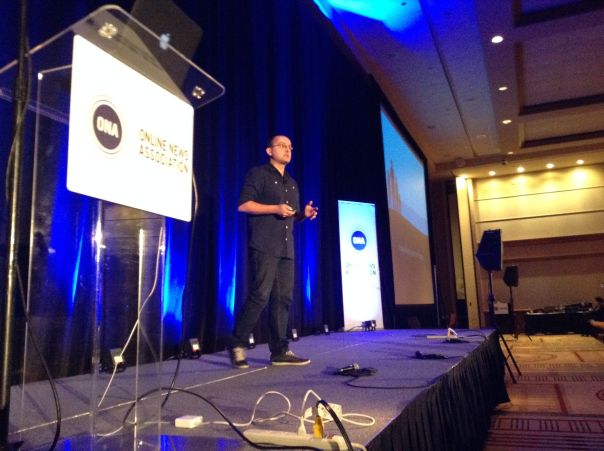
Alberto Cairo
Alberto Cairo of the University of Miami says ethics have not kept pace with data visualization techniques. (Stephen Rynkiewicz photo)

By David Craig

The Online News Association annual conference, which I attended September 24-27 in Chicago, always provides great updates on trends and issues in digital journalism. But it’s also a great place to hear about ethical challenges, both new and continuing.

Ethical issues were the focus of three sessions, including a challenge session in which audience members had to react quickly to ethical scenarios on topics such as use of user-generated content. But ethics also came up in sessions that were primarily about other topics.

Here are three ethics takeaways from the conference:

1. Content that disappears will create new ethical challenges. Amy Webb, founder of Webbmedia Group, delivered her annual talk on “10 Tech Trends for Journalists.” One of them was “ephemeral content,” an increasingly popular kind of social media communication.

Webb said Snapchat, an app developed to share photos that’s popular with young people, provided a way to send private content that users might not want to stay around, but “it’s also a way to clear up our cluttered social streams.” She said other companies are providing messaging services with content that disappears, appears anonymously or is even encrypted. She predicted that most messaging apps will have some kind of means of making content ephemeral in the next 24 months.

Ephemeral content is relevant to journalism because some news organizations including The Washington Post are experimenting with it. But Webb pointed to an ethical difficulty: “Ephemeral content can be used for publishing news. But it can’t be corrected, because no record is left.”

This kind of communication raises questions of accountability for the accuracy of content because once it’s gone, there’s no way to amend a false message or even verify what the message said.

“Talk internally about the implications,” Webb suggested to news organizations.

Even for journalists who don’t use this kind of content, the discussion points to ongoing questions about what it means to ethically handle incorrect content in social media messages.

2. Algorithms shape the truth that people learn about the world and point to new ethical obligations for journalists. Kelly McBride, vice president for academic programs at the Poynter Institute for Media Studies, and Nick Diakopoulos, a journalism professor at the University of Maryland and an expert in computational journalism, presented a session titled “Algorithms are the New Gatekeepers.”

McBride said algorithms, because they shape how news is distributed and to whom, have a powerful influence on what gets attention in the marketplace of ideas. As one of the presentation slides showed, they also affect a huge number of other areas of life including search rankings, online recommendations, advertising and relationships.

Diakopoulos talked about the power of algorithms in influencing the information we receive because of their ability to prioritize, classify, associate and filter it. He argued that the power they carry suggests new responsibilities – and opportunities – for journalists in reporting because they can help hold algorithms accountable. Stories might address issues including discrimination, mistakes that deny service, censorship, illegal activity or false predictions.

This kind of reporting isn’t easy. He pointed to several possible approaches to “auditing” algorithms – reviews of computer code, surveys of users about their experience, analysis of input and output, having users report data and (with ethical problems he acknowledged) impersonating users with programs.

Despite the difficulties, the social and economic impact of algorithms make it important for journalists to try new ways of reporting.

3. The power and availability of data visualization tools call for increasing attention to the ethics of visualization messages. Alberto Cairo, a professor at the University of Miami who teaches on informational graphics and data visualization, gave a session called “The Journalist, the Artist and the Engineer: The Ethics of Data Visualization.”

Cairo argued that the core goal of journalism ethics is to improve the public’s understanding of issues “relevant for their conducting good lives” while minimizing any potential harm. He said tools to create interactive charts, maps and other informational graphics are becoming more popular and widely available but that ethics is not keeping pace. He said that helping the public understand what good, ethical visualizations look like can help to better society and avoid the impact of misleading messages.

Even though great data visualizations are beautiful as well as functional, Cairo said, they must hold to a high standard of truthfulness that doesn’t oversimplify or distort the information being represented. Using the example of a graphic from the National Cable Television Association, he talked about going from showing things that are true but may leave out important information to showing a picture that’s more complicated but also truer and more accurate.

Cairo urged the audience not to hide complexity from the public or point to patterns that really aren’t there. In doing so, he is rightly pointing to a standard of care in visualization that is as high as the standards used in good investigative writing.
Anon Again


By Casey Bukro

Anonymous sources — used by media and by government officials — came up again in a New York Daily News piece by James Warren.

Warren used a press briefing by Josh Earnest, the new White House press secretary, to illustrate how Earnest and a reporter dueled, trading accusations of withholding sources. Back and forth they went, parry and thrust.

Warren also comments on the value of White House news briefings, and whether they actually produce news.

“It has been a fairly informative ritual at times evolved (perhaps partly as a result of the cameras) into an hour or so of premeditated evasions by the spokesman; a bit too much prosecutorial posturing by some of the reporters; and, ultimately, rhetorical stand-offs in which there’s little advancement in public understanding of important matters.

Actually, Warren noted, if a White House reporter’s annual salary depended on legitimate stories produced by the briefings, he’d “be eligible for unemployment compensation.”

But the bulk of Warren’s story deals with the give-and-take between Earnest and a reporter, who was asking for more on-the-record sources from the White House. That would depend, said Earnest, on a case-by-case evaluation and ground rules “that will serve your interests and the White House interest the best.”

Warren called the “spitball fight” hypocritical.

“The Washington media, like media at other levels of journalism, is often involved in a mutual self-protection racket with the people we cover,” he wrote. “It can be at the White House, City Hall in Chicago or a county board in Texas. The dynamic is roughly similar. Too many reporters are manipulated with scarcely a qualm.”

About.Com Media describes the dangers of using anonymous news sources and offers five questions to ask yourself before trusting anonymous sources.

The site points out that inexperienced reporters might believe that using anonymous sources “make news stories sound more important,” but the practice presents “many ethical and legal dangers.”

Taking a Devil’s Advocate approach, New York News & Politics explored whether the Watergate investigation leading to President Nixon’s resignation could have been possible without  W. Mark Felt, later identified as the “Deep Throat” confidential informant.

The story touches on the working habits of Seymour Hersh and Jayson Blair, with comments from Bob Woodward.

“Journalism exists to get us closer to all sorts of truth, and anonymous sources are essential to the endeavor,” concludes the author, Kurt Andersen. “Even now, they provide more social benefit than they (exact) in moral costs.”


Vanishing Facts, Finding Truth


By Casey Bukro

Looks like this new generation of online and social media writers don’t care much about fact-checking, favoring speed over accuracy.

Though that might be obvious from reading  the internet, a survey by the Dutch company ING seems to prove the point.

It found that only 20 percent of international journalists questioned bothered to check their facts before publishing.

Forty-five percent of them “publish as soon as possible and correct later,” according to the report.

This is further proof of online journalism’s faith in the self-correcting nature of the internet. Report it fast and report it first, they say. Corrections can come later.

This is a far cry from that old-school Chicago journalism motto: If your mother says she loves you, check it out. It was the ultimate in fact-checking, applied to anything and everything. The rule was to get it right the first time.

More in keeping with a different sort of saying: Never let the facts get in the way of a good story.

Another ING survey finding: Sixty percent of the international journalists said they felt less constrained by journalism standards when reporting in social media. Though they expressed low regard for the accuracy of social media, 50 percent said much of their news tips and information come from social media.

They agree social media is an informational trash bin, but dipping into that bin is addictive.

Angela Wascheck in “10,000 words” described the ING survey.

The ING report comes on the heels of a Columbia Journalism Review story on the values of modern-day newsrooms, entitled “Who Cares If It’s True?”

“In the newsrooms of this moment, with growing agreement that audiences want information that is true, journalists are coming together around the same basic questions: When is information sufficiently baked to be served up as accurate? Who decides? Should there be rules, or just ideals? Is it enough merely to try to be right eventually?”

The author, Marc Fisher, traces the shoot-from-the-hip history of some digital newsrooms, their differences with old-school journalism, and the growing recognition of the value of accuracy and credibility — even in social media.

It began with the digital journalists’ belief that truth would emerge through open trial and error. Transparency was the answer. If you don’t know, just say so.

But that could be changing.

Fisher cites one high-flying digital operation that is “embracing the ultimate symbol of the overstuffed print newsrooms of the pre-digital past.” It is hiring copy editors.

In another, Fisher finds a plan “to marry print traditions of completeness, verification and authority with the digital imperatives for speed and connection with the audience’s interest.”

Battles between the two camps still exist, but Fisher quotes a source who says conflicts diminish “as digital people have moved into leadership roles, and as everyone learned that aggregation can only take you so far, and as people from both backgrounds learn that it’s better to be second than wrong.”


Anon


By Casey Bukro


Pssst! Hey buddy, over here. Got some really important news for you. Can’t tell you where I got it. But trust me.

That, in effect, is the con played often on the public by some of the nation’s leading newspapers, like the New York Times and the Washington Post. It’s called anonymity.

This con was neatly spelled out in a Reuters piece by Jack Shafer, who counted the number of times the Times offered corrections recently on stories based on anonymous sources, citing anonymous sources again to make the corrections.

That’s carrying the con a bit far.

Shafer traces the history of citing anonymous sources from a time when it was rare, to a time when it was rampant. It’s probably  fair to say that this journalistic disease is especially prevalent in Washington, involving government and political reporting.

Most reporters know that stories are only as good as the reliability of identified sources who are quoted.

“Anonymous sources reduce the pressure on official sources to take responsibility for their utterances,” writes Shafer. “And it promotes the gaming of news outlets, with anonymous sources gravitating to the most pliant reporters and editors.”

Weak or lazy scribes sometimes think they’re acting like “the big boys” by writing stories veiled in mystery, as though they know really important people who want to stay in the shadows. Sometimes these journalists know they are being used, but think that’s how the game is played. With more digging, they might find sources willing to be identified.

The Society of Professional Journalists code of ethics says “the public is entitled to as much information as possible on sources’ reliability.” There are times when anonymity is warranted, such as protecting someone’s life or welfare.

Scholars believe the Washington Post’s Watergate coverage was the “watershed moment for anonymous reporting,” touching off a wave of imitators who lusted for the fame of Bob Woodward and Carl Bernstein.

Getting cozy with news sources is another way to play the game, as Bob Garfield, host of NPR’s “On the Media” program pointed out in his scathing commentary on the White House Correspondents Dinner in a piece entitled “When the Watchdogs Wear Tuxedos, Politicians Rest Easy.”

All of this leads to a point made by Thomas Baekdal, who investigated the meaning of quality journalism. He found that although some of the leading newspaper managers say they are doing a great job, they are losing readers.

It’s just possible that readers are disenchanted with journalism that depends on anonymous sources and making nice with news sources, like the White House correspondents dinner.  It’s journalism with a wink and a nod.

Readers know what’s going on there, and they’re turned off. They know they’re entitled to a better journalism, and better journalists.


The Times Telling Its Own Story

By Casey Bukro

The New York Times is a classic case of how poorly the media tell stories about themselves.

Times Publisher Arthur O. Sulzberger Jr. fired Jill Abramson as executive editor, touching off a storm of speculation over who did what to whom and why, and motivations behind the story that was told or not told.

Days after the dismissal, Sulzberger issued a statement complaining that “a shallow and factually incorrect storyline has emerged.”

One version of that storyline held that Abramson was sacked because of her complaints that her $525,000 salary was less than her predecessor’s, a man, setting up the argument that a woman was paid less than a man for the same job.

Another thread was Abramson’s management style, described as polarizing, non collegial, mercurial and pushy, traits that might be tolerated in a man but not in a woman.

“I decided that Jill could no longer remain as executive editor for reasons having nothing to do with pay or gender,” said Sulzberger’s statement, as he hoped to clear up the matter as it seemed to get murkier.

Hard-charging media organizations like the Times often demand full disclosure from the government agencies or corporations that stumble into controversial territory. But, when media get into trouble, they often get defensive, say they’ve been misunderstood or say it’s nobody else’s business.

The Society of Professional Journalists code of ethics says journalists should “abide by the same high standards to which they hold others.”

Another good guideline in a crisis is: Tell it all and tell it fast. That advice comes from Frank M. Corrado, a Chicago communications specialist.

Some observers say the New York Times affair has settled into “navel gazing by the media,” described as an occupational hazard. The writer of that sentiment wondered why Abramson was fired only nine days after the Times’s chief executive “gushed” about her.

A Vanity Fair report, including an interview with Sulzberger explaining his intentions, said “The New York Times is an institution whose employees are adept at, perhaps addicted to, in-house Kremlinology.” Even those closest to the story are wondering if they know the true story, or the whole story.

Women flocked to Abramson’s defense, but it was not universal.

Some of the more thoughtful and detailed information about the New York Times affair appears in The New Yorker, by Ken Auletta. He says:

“It is an affair in which neither side behaved well or with any finesse and the institution, which is so central to American journalism, suffered.”


Jayson Blair


By Casey Bukro

Jayson Blair lied, plagiarized and fabricated stories, shaming the New York Times where he worked.

Why would he do that, knowing that the eyes of the world were focused on one of the world’s great newspapers?

Leonard Pitts Jr., a columnist for the Miami Herald, seemly comes as close as anyone to an answer in a recent column — Blair simply believed he’d never get caught.

It’s a myth, says Blair, that fear of being caught keeps people from doing unethical things. After getting away with it, “once you cross that barrier where you know the chances are you won’t be caught, it becomes very hard to discipline yourself,” Pitts quotes Blair.

It’s a fantasy. And that could be part of the answer.

Anyone in journalism who believes nobody really pays attention to accuracy and fairness is delusional.  The American Journalism Review, in writing about Blair, pointed to other journalists who met their downfalls through dishonesty. It’s usually a matter of time before the distortions that lying create are noticed.

Blair did leave a legacy of sorts.  Some journalists contend media are more concerned about fact-checking now. Maybe.

Recently, films and television broadcasts focused on Blair.

“A Fragile Trust: Plagiarism, Power and Jayson Blair at the New York Times” is a 75-minute documentary.

Blair had a record of poor work habits at the New York Times, which should have raised red  flags before it was too late to prevent what has been described as “one of the most notorious scandals in the history of American journalism.” Some heads rolled.

Now out of journalism,  Blair is described as a “life coach.”

This season of Blair mania comes while several journalism organizations are writing or rewriting codes of ethics, such as the Society of Professional Journalists. Such documents usually list activities that journalists should or should not do.

But rarely do they mention consequences for people like Jayson Blair, who believe there are no consequences for lying, cheating and stealing. They just cross the barrier and set the stage for another scandal.


Pictures Worth A Thousand Touch-Ups

By Casey Bukro

Let’s start with a hoary cliche: A picture is worth a thousand words.

Why?

Think of photos that stick in your mind:  The Hindenburg zeppelin wrapped in flames; dead soldiers at the Battle of Gettysburg; Robert Capa’s D-Day Invasion images; the Iwo Jima flag-raising by Joe Rosenthal; the Beatles; Muhammad Ali; Marilyn Monroe; Elizabeth Taylor; that Afghan girl with haunting eyes in National Geographic; Einstein and Picasso, to name a few.

They are iconic images, in part because they are believed to be accurate portrayals of people and events. Some of those people are famous because they are so photogenic. You want to stare at them.

That makes the relationship between photographers and their audience important, especially now when pictures are vital to covering the news, and when technology makes it so easy to alter images.

It was not considered a big deal a decade or more ago. But now it is, because accuracy in photography is seen as important as accuracy in reporting.

That point was made by the Associated Press when it cut ties with Pulitzer prize-winning freelance photographer Narciso Contreras for altering a picture. He admitted that he edited out a video camera from the bottom left corner of a photo of a fighter holding a rifle.

The Guardian said the “sacking” seemed “very draconian.”

The Associated Press did not think so.  Brian Schwaner, AP bureau chief in New Orleans, said:

 ” AP is quite strict on its requirements for unaltered material, even photos of only marginal value. For example, a few weeks ago the flack for a political candidate sent us a rather standard mugshot for our files, for use during the election. Our bureau photographer took a look at it and was suspicious. After running some tests, he discovered it had been heavily PhotoShopped. The flack was informed and we rejected the photo.

            “So the scrutiny ranges from the basics – like this simple mugshot – all the way up to celeb shots and battlefield photos.”
That’s the way it’s done these days, although, ironically, it’s a time when news organizations cut their photo staffs as a cost-saving measure. That means more reliance on freelancers. Contreras was a freelancer, and maybe that’s part of the message.

Bashir’s Legal But Unethical Comments

By Lee Anne Peck

Occasionally, when outraged news consumers want to vent about a professional media organization and/or its staff, Ethics AdviceLine for Journalists will receive calls from these disgruntled citizens.

Our line, however, helps journalists with ethical dilemmas they face; we do not take complaints from callers who want us to get someone reprimanded or fired.  We do advise these callers to contact the news organization with which they have an issue and voice their concerns. (See the SPJ code of ethics which states: “Encourage the public to voice grievances against the news media.”)

Such was the case after MSNBC political talk show host Martin Bashir’s commentary Friday, Nov. 15. I returned to Colorado from a trip to South America the weekend after his diatribe about Sarah Palin; I was clueless to the outrage Bashir had caused, but three callers to the AdviceLine wanted his head.

Bashir, formerly a host of ABC’s Nightline program, took Palin to task for her comments about the U.S. debt to China and slavery. On air, Bashir told the story of plantation owner Thomas Thistlewood, who had a slave “flogged and pickled, then made … another slave shit in his mouth.”

“When Mrs. Palin invokes slavery,” Bashir said during his commentary, “she doesn’t just prove her rank ignorance, she confirms that if anyone truly qualified for a dose of discipline from Thomas Thistlewood, then she would be the outstanding candidate.”

Let’s consider the SPJ code of ethics. What does this code say about behavior such as Bashir’s? The guidelines are often too cut and dry for specific situations, of course. However, we could start with these principles from the code. Journalists should:

  • Examine their own cultural values and avoid imposing those values on others.
  • Avoid stereotyping by race, gender, age, religion, ethnicity, geography, sexual orientation, disability, physical appearance or social status.
  • Support the open exchange of views, even views they find repugnant.
  • Distinguish between advocacy and news reporting. Analysis and commentary should be labeled and not misrepresent fact or context.

Did Bashir have the right to speak the way he did about Palin? Sure—First Amendment rights. Was it ethical for Bashir to say those things about her? Probably not. Just because it was legal for him to say those things doesn’t make it right for him to say what he did merely because of the “golden rule.” The public made that very clear.

He apologized on air the next Monday, but that wasn’t good enough. On Dec. 4 he resigned.

“60 Minutes” Trips on Truth

By Casey Bukro

“60 Minutes” built a towering reputation as the TV news magazine that gets it right, but now is apologizing for getting it wrong in its report about the terrorist attack last year on the U.S. diplomatic mission in the Libyan port city of Benghazi.

Lara Logan, who reported the story, said it was a mistake to highlight a supposed eyewitness account of the attack by a security contractor who later was found to be lying about being at the scene of the attack, and seeing the body of U.S. ambassador J. Christopher Stevens at a local hospital.

“We made a mistake, and that’s very disappointing for any journalist,” said Logan.

The mistake involves an interview with Dylan Davies, a security contractor whose firm worked for the U.S. government, who was identified by “60 Minutes” by his pseudonym, Morgan Jones. He gave Logan a dramatic account of his role in fighting the terrorists, even smashing a terrorist in the face with a rifle butt. Logan appeared to coach him in describing the encounter.

“It was a mistake to include him in our report. For that, we are very sorry,” she is quoted in a New York Times story.

Actually, Davies/Jones told FBI investigators and his employer that he never left his villa the night of the attack because it was too dangerous. He did not visit the attack scene until the next morning. The conflicting government report caused the “60 Minutes” report to unravel.

From a journalist’s point of view, one can wonder about the CBS report, admittedly in retrospect. Why was Davies allowed to use a fake name on camera? And was any attempt made to prove that Davies was at the attack scene or at the local hospital, as he alleged?

The Times reported that CBS News Chairman Jeff Fager called the Logan report “as big a mistake” as “60 Minutes” has made in its 45-year history, but that its televised apology would be its last word on the issue.

This is seen as a “defensive crouch” by a news organization with a hard-hitting reputation and little pity for those caught in its cross-hairs. Fager also is executive producer of “60 Minutes.”

Marvin Kalb, a former CBS news correspondent, said in Politico.com that an apology from CBS is not enough.

“What has CBS learned, if anything?” asks Kalb, a senior adviser to the Pulitzer Center on Crisis Reporting.

Following the apologies, said Kalb, “perhaps CBS (and other networks, too) will engage in a wide-ranging, no-holds-barred self-analysis of its reporting standards, starting one hopes with the unholy alliance it has formed with book publishers pushing their hot exclusives,” he wrote.

Davies/Jones had a book deal with Simon & Schuster, which is owned by CBS’s parent corporation.

If an apology is all CBS News can muster, clearly it is not being as tough on itself as it is on others.

The Society of Professional Journalists code of ethics encourages journalists to “abide by the same high standards to which they hold others.”

On the upside, “60 Minutes” admitted its mistake and apologized, a rarity in TV journalism.  SPJ says “admit mistakes and correct them promptly.” The admission phase is done; the correction remains to be seen.

Later, CBS announced that Logan and her producer were placed on leave of absence.

In a memo to staff, Fager wrote that he asked Logan and Max McClellan, the producer, to take a leave of absence, which they agreed to do.

“When faced with a such an error, we must use it as an opportunity to make our broadcast even stronger,” Fager wrote. “We are making adjustments at 60 Minutes to reduce the chances of it happening again.”

As executive producer, Fager said, “I am responsible for what gets on the air.”