Coronavirus illustrated: Steve Brodner writes about the worst takes on the virus, featuring Rush Limbaugh, Geraldo Rivera and President Trump.

Coronavirus illustrated: Steve Brodner writes about the worst takes on the virus, featuring Rush Limbaugh, Geraldo Rivera and President Trump.
Why reporters should cover Trump: The president abuses journalists at his daily briefings.
Jay Rosen gives 13 reasons they should “stick around for that,” even though the president misinforms the nation.
Verify Social Media Virus News: People spread hoaxes thinking they’re sharing valuable information with friends and family, writes Jessica Roy. Verify social media accounts, sites and the information, she writes.
Masking the coronavirus: Seeing is believing, writes Al Tompkins, but “hospitals are blocking journalists from documenting what it’s like inside their walls….”
Imagery from inside hospitals is needed, though “no reasonable person would suggest journalists should sneak into hospitals to grab photos.”
Pandemic journalism: “My hope is that journalism, as an industry, will stop viewing itself as an external body meant to serve the public and instead begin to see itself as a member of the public,” writes Alexandra Neason.
By Casey Bukro
Ethics AdviceLine for Journalists
Back in 1972, a Harris poll found that only 18 percent of the public had confidence in the print media; television ranked lower.
Garbage collectors scored higher in public confidence.
As a reporter for the Chicago Tribune at the time, I thought that was shameful, and not only for journalism and journalists.
That got me started on a lifelong mission to make the news media more trustworthy, and to earn public confidence in the belief that factual information is the lifeblood of a self-governing democracy.
You’d think you were on the side of the angels if you spent much of your life campaigning for journalism ethics. But you need more than angels to make much headway in getting the public’s respect and the cooperation of journalists, some of whom consider journalism ethics an oxymoron. A contradiction in terms.
Better newspaper business model: “The time is now to make a painful but necessary shift,” writes Ben Smith. “Abandon most for-profit local newspapers, whose business model no longer works, and move as fast as possible to a national network of nimble new online newsrooms” to rescue journalists.
Bailout’s impact on media: Much of America’s daily and weekly press can benefit from the new Small Business Administration program, writes Ken Doctor, from loans up to a million dollars.
“We need a journalism stimulus,” writes Craig Aaron, saying that journalism is too important to democracy to be left to the whims of the market.
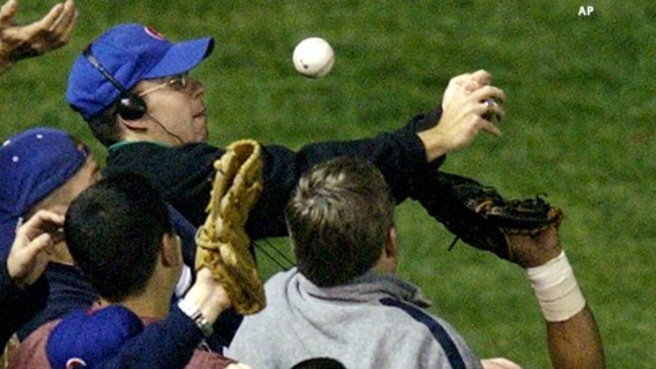
Bartman and the ball —- NBCsports.com photo
By Casey Bukro
Ethics AdviceLine for Journalists
The coronavirus batted the 2020 major league baseball season into limbo, but stories about baseball never get old.
Here’s one about the Chicago Cubs, a seriously maligned baseball fan and journalism ethics. Like many classic tales, it’s told, retold and people argue about the details in their favorite watering holes. Sometimes the story gets better each time it’s told.
It boils down to this: Was it ethical to name a baseball fan who deflected a foul ball, possibly costing the Chicago Cubs a trip to the World Series? This question has become a staple in some journalism ethics classes. I was reminded of that when a student named Maddie contacted the Ethics AdviceLine for Journalists, asking if news organizations violated the Society of Professional Journalists code of ethics by naming that hapless fan.

