Tag Archives: Society of Professional Journalists

Killing the Messenger, Live: Journalists Killed on Video

By Casey Bukro

Killing the messenger takes new meaning when you see it live, in living color, as happened in the deaths of a Virginia television news reporter and her cameraman.

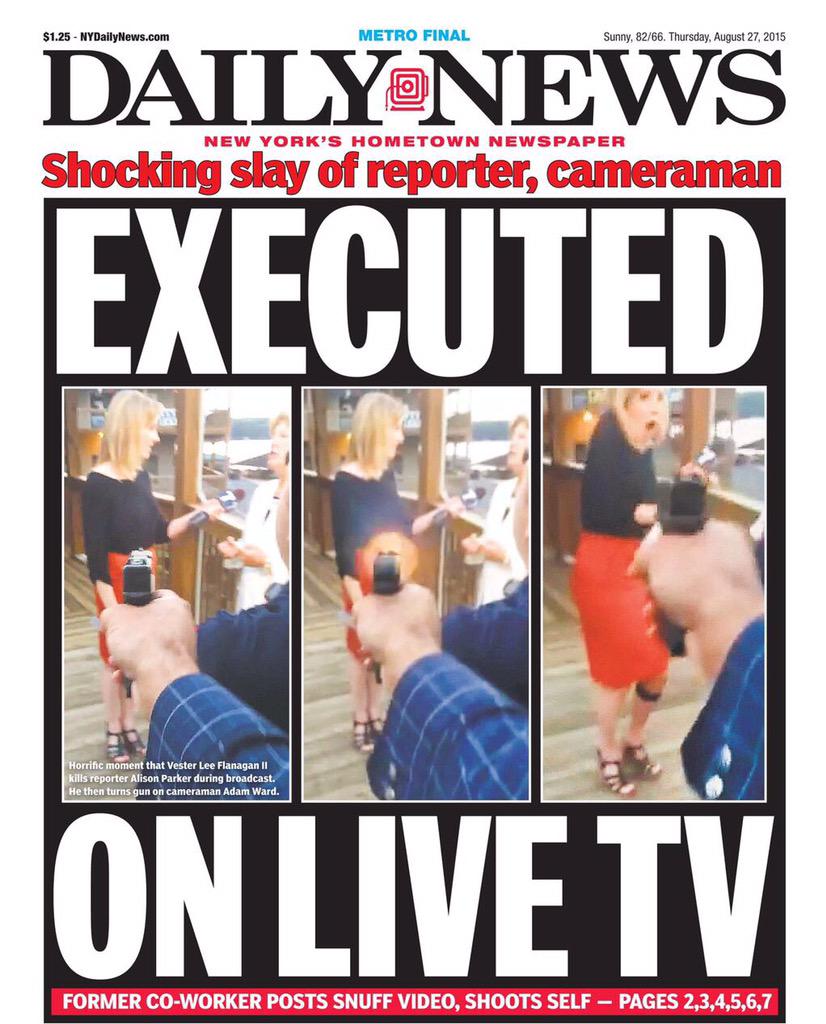
WDBJ correspondent Alison Parker was conducting an on-air interview in a Moneta, Va., shopping center when she and the photographer, Adam Ward, were shot and killed by a disgruntled former colleague who also videotaped the attack and put it on social media.

The New York Daily News gave the murders front-page display, in very graphic detail than some TV outlets shunned.

Embedded image permalink

Killings on video are increasingly common these days. Journalists are among those targeted now, becoming victims and not just reporters of  events. Parker and Ward’s names are now added to a list that included James Foley and Daniel Pearl.

Tech-savvy killers use social media and the internet these days to show their crimes.

The Islamic State group released a video in 2014 showing Foley, clad in an orange gown, kneeling on the ground next to a man dressed in black holding a knife. Foley makes a short statement and then is decapitated.

In 2002, Pearl, a correspondent for The Wall Street Journal, disappeared while on assignment in Karachi, Pakistan. Video shown around the world via the Internet showed Arab extremists cutting his throat, then decapitating the reporter.

In this world of social media, terrorists don’t need reporters to tell their message. Terrorists can do that themselves now, and one way of doing that is killing reporters.

Continue reading Killing the Messenger, Live: Journalists Killed on Video

Charlie Hebdo’s Dead Boy Cartoon Triggers Global Ire

Photo published for Charlie Hebdo Mocks The Death of Syrian Child Aylan Kurdi

Nilufer Demir/Reuters photo

By Casey Bukro

Charlie Hebdo, the French satire newspaper, published a cartoon of a drowned 3-year-old boy and showed why codes of ethics should warn against satirical cruelty.

Satire can be cruel, inspiring or infuriating. Maybe all at once. But are there limits to this form of freedom of expression?

Charlie Hebdo clearly touched a nerve by joking about the boy lying facedown in the surf of a Turkish beach, after drowning with his mother and a brother while attempting to flee war-torn Syria, becoming a stark symbol of Europe’s growing migrant crisis.

The cartoon was based on photos of the boy, first described as Aylan Kurdi and corrected later as Alan Kurdi.

“The haunting photograph of 3-year-old Aylan Kurdi, the Syrian boy whose lifeless body washed up on a Turkish beach last week, has been inescapable; even if you’ve just seen it once, it’s an image you can’t forget,” wrote Carolyn O’Hara, managing editor of The Week magazine.

O’Hara compared it with other grim photos of the past that forced the world to confront some tragic realities, such as the the 1972 photo of a naked Vietnamese girl screaming in agony from napalm burns, the 1993 image of a vulture stalking a starving Sudanese toddler and the hooded Abu Ghraib prisoner with outstretched arms.

It could be argued that these images served a greater purpose. Can the same be said about Charlie Hebdo?

Continue reading Charlie Hebdo’s Dead Boy Cartoon Triggers Global Ire

Health Care Freelancers Face Tough Ethics Challenges

By David Ozar and Casey Bukro

Freelancing is a tough way to make a living – even tougher as downsized journalists turn to freelancing.

For writers specializing in health care, it’s especially challenging because of the ethics issues faced in navigating the cross connections between clients who want stories written for them or about them. Or both.

“Ethical guidelines for subspecialties may vary,” Tara Haelle in an email exchange with the Ethics AdviceLine for Journalists.

A freelancer herself, Haelle traced the obstacles in a story that appeared on the Association of Health Care Journalists website.

Tara Haelle
Tara Haelle

Haelle calls it the conflict-of-interest maze: “Ensuring that work for one client doesn’t create a conflict for another, present or future.” Though that might sound simple, Haelle said it isn’t because freelancers work for companies, journalism publications, universities and foundations or as consultants.

Haelle went to several sources, asking how she can avoid ethical conflicts of interests under the conditions in which she works and found that ethical guidelines vary. One source said “there’s no clear answer.” Another said journalists should “decide for ourselves what we think is ethical behavior.”

That sounded like a challenge for the Ethics AdviceLine for Journalists, which has a staff of five university ethicists to answer questions of the kind posed by Haelle.

One of them, David Ozar, is professor of social and professional ethics in the department of philosophy at Loyola University Chicago. AdviceLine asked Ozar to read Haelle’s story and offer his perspective on how he would have answered her call for guidance on ethics.

Continue reading Health Care Freelancers Face Tough Ethics Challenges

Bomb Threats Tilt GamerGate Event

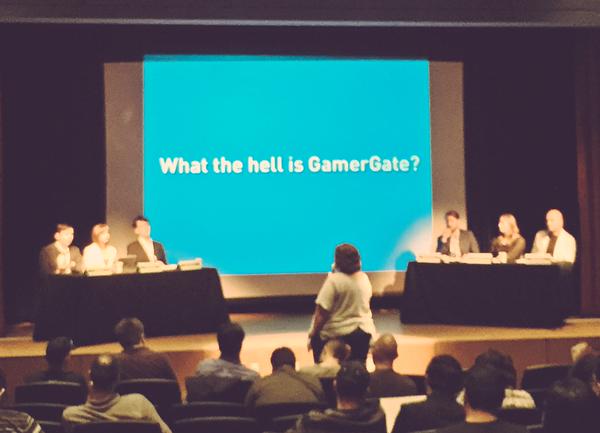
SPJ AirPlay panel
SPJ AirPlay panel (SPJ Florida photo)

By Casey Bukro

GamerGate from its beginning a year ago seemed touched by lunacy, and that was borne out when bomb threats forced the abrupt closure of a video-game program in Miami.

The Society of Professional Journalists event AirPlay aimed to pin down the social-media campaign GamerGate – whether it’s about journalism ethics and accurate reporting about the video-game industry, attacks on women in the male-dominated industry, or resistance to political correctness and censorship. Or something else.

The conference goal was to “make a good gaming press better, or a bad gaming press good,” said Michael Koretzky, an SPJ regional director who organized and moderated. The conference “concocted some novel yet practical ideas for achieving that,” he said, such as an SPJ award for games journalism or recruiting games media critics.

A Twitter feed and hashtag and a YouTube channel suggest the event provoked lively discussion. SPJ secretary/treasurer Lynn Walsh said “if mainstream media jumps on this, it should be done well and ethically.”

Topics included plagiarism, fabrication, anonymity, fair reporting and the performance of Gamer writers. Koretzky asked about a “troll patrol,” how to vet or write about their social-media statements, and how to expose anonymous digital mischief-makers.

Then it all ground to a halt.

Miami police cleared the building after a series of bomb threats, UPI reported. Breitbart.com reported that the event got 10 bomb threats before police stopped the program and moved participants out of the building and into the streets.

Koretsky said two separate conferences in the building drew about 135 participants, of which about 60 attended the AirPlay event.

AirPlay was supposed to teach us something about GamerGate. AdviceLine asked Koretzky what the abbreviated conference taught him.

“I learned I was right about one thing,” Koretsky responded in an email. “Face-to-face opens minds. As for the bomb threat, it was awesome. It happened only 30 minutes before we ended, and it made @SPJAirPlay trend worldwide.”

Such threats are not new to GamerGate. Earlier this year a bomb threat cleared 300 people from a Washington, D.C., event aimed at GamerGate supporters. And Anita Sarkeesian, creator of a video series of pop-culture critiques, canceled an appearance at Utah State University last year because of the threat of a mass shooting.

AdviceLine asked Koretzky if continued threats of violence prove that some of those GamerGate folks really are nuts.

“I knew some GGers were nuts from the get-go,” he said. “But I learned just how many aren’t. I’d say it’s 50-50 &ndash which might offend both sides. But really, that’s a ringing GG endorsement, since so many folks told me the stat was 100 percent.”

And what else did he learn from the event?

“I’ve been talking to some gaming journalists post-AirPlay about why it wasn’t covered. Interestingly, the reporters are cool, editors are not. So once again, it’s age more than philosophy.”

As for his next move, Koretzky said he’s considering hosting a feminism-and-media debate.

Mark Samenfink, a lifelong gamer, wrote that he was frustrated by the way the Miami GamerGate event ended.

“This feels like a hollow victory,” Samenfink wrote. “But since at least half of the event took place (and was streamed live, worldwide), it’s not completely hollow. I was excited all day, my hype was real, I sat down to watch the debates and was overjoyed by them, but this … it just killed the mood.”

Did the gaming press cover the event?

“No,” said Koretzky, “just the bomb threats, and some not even that. It says more in defense of GG than anything else to date.”


GamerGate Revisited: Is It Really About Journalism Ethics?

AirPlay

By Casey Bukro

Is GamerGate about ethical violations in video-game journalism?

Or is GamerGate just a smokescreen for harassing women who want to work in the male-dominated gaming industry?

Or is it something else?

A live-streamed debate will sort it out Aug. 15 in Miami.

Elements in the controversy include the $15 billion video game industry, the video game press, game reviewers, developers, commentators and those who sell advertising in gaming magazines. It’s a volatile mixture.

Michael Koretzky, a regional director for the Society of Professional Journalists, organized the conference and will moderate. His region covers Alabama, Georgia, Florida and South Carolina. Sponsors are the region and SPJ Florida.

AdviceLine questioned Koretzky on the key issues:

Continue reading GamerGate Revisited: Is It Really About Journalism Ethics?

Searching for the Limits of Ethics

By Casey Bukro

Some media people find it impossible to forgive Brian Williams, saying he tainted journalism through false reports.

A cascade of shame enveloped the former NBC anchor, demoted and vilified after saying repeatedly that he was aboard a military helicopter that was forced down over Iraq by enemy fire. Turns out that happened to another military helicopter, not the one he was riding.

Williams’ career began unraveling as other reports were called into question.

From a strictly ethical viewpoint, how should Williams be judged? He admitted he was mistaken about the helicopter incident and apologized.

Ethically, are there limits to forgiveness? Is it best to forgive and forget? Is he forever tainted, or is he allowed to get beyond it and redeem himself?

These questions were posed to AdviceLine’s team of ethicists.

Nancy Matchett, who teaches ethics at the University of Northern Colorado, answered this way:

“Philosophers understand ethics as ongoing reflection about ‘how one should live.’ In the professional context, that means ongoing reflection about the principles that should guide one’s work and how they apply to the concrete choices one faces every day. Ethics doesn’t exactly have a beginning or end.

“And, with respect to the Williams affair, we can evaluate his choices since the incident, and the choices of the network, as well as the original mistake.”

I asked Matchett if that suggests we should judge Williams and the aftermath by what he does from now on?

“Sure, that’s part of it,” said Matchett. “But I guess what I’m also trying to emphasize is that the fact that any particular bit of conduct that was good, bad, etc., is never ‘the whole story about Williams’ ethics.’ There is no whole story, except perhaps after a person is dead, because characters are never wholly fixed.

“What he does from now on should be judged in light of the fact that we know he is at least careless and at worst inclined to stretch the truth for the sake of a story.”

I told Matchett that appears to raise the issue of redemption.

“I don’t really have anything to say about redemption,” said Matchett. “Whether another person, or ‘the profession,’ forgives Williams doesn’t change his act from wrong to right. It acknowledges that his character isn’t all bad and that the mistake was in some sense ‘understandable’ given the various pressures he was under. And just to be crystal clear, note that ‘understandable’ is not the same as ‘justifiable.’ Or as we say in my business, an explanation is not the same as an excuse.

“As for people finding it ‘impossible to forgive,’ that’s a psychological issue or question, not the ethically central one. The ethically central issue is whether forgiveness is morally appropriate, whether people should do it, which is a little different from whether they can. … If it’s not appropriate, then folks are doing the right thing by refusing to forgive.

“But in general, I think any network would be foolish to leave him as an anchor on their main show. He has harmed his own and the network’s credibility. Even if the network execs were convinced that it was a forgivable mistake and his journalistic integrity could be counted on in the future, the average viewer surely doesn’t know Williams well enough to decide whether to trust him again.”

David A. Craig, another AdviceLine ethicist, who teaches ethics at the University of Oklahoma, sees it a different way:

“It troubles me that Williams seems to deflect responsibility for his untruths by saying he did not intend them. Journalists, especially those in roles as high profile as his, have a responsibility for every word that comes out of their mouths in a formal journalistic setting.

“If this were a single brief slipup in language, that would be different. But he was untruthful more than once about his experience in Iraq. Every viewer now has reason to question his trustfulness in the future. By failing to fully take responsibility for his words, he gives his audience ongoing reason to doubt.”

Reason to doubt Williams first emerged when military publication Stars and Stripes challenged his account of being aboard the helicopter that was forced down over Iraq.

NBC suspended Williams for six months without pay, then stripped him of his duties as anchor of NBC Nightly News.

As Matchett points out, we don’t know “the whole story” about Williams yet. Already, he is the subject of jokes and spoofs by the likes of Harry Shearer.

Forgiveness happens on two levels, personal and professional.

Journalists are notoriously soft on each other, and hard on everyone else. Journalists don’t like to criticize or censure other journalists. So, personally, they are likely to forgive Williams by finding that morally appropriate, as Matchett put it. They will write about ethical transgressions, but that’s not the same as taking a personal stand.

Professionally, it’s hard to forgive an act that weakens public trust in the integrity of journalism, which rests on a foundation of truth. The Society of Professional Journalists code of ethics begins with this tenet: “Seek truth and report it.”

Falsehoods damage the profession, and cannot be tolerated.

AdviceLine gets SDX Award for Navigating Murky Ethics Waters

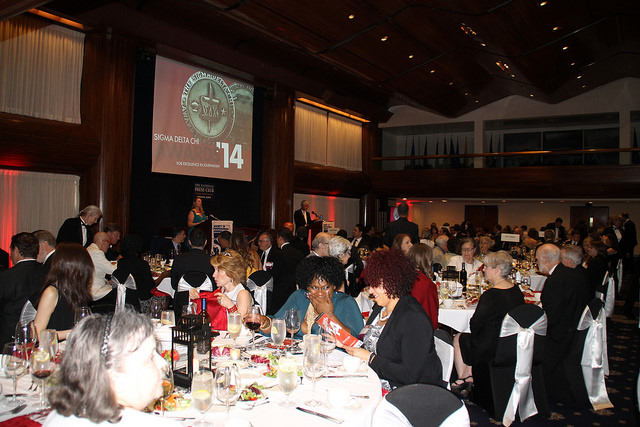
SDX Awards
The Sigma Delta Chi Awards are presented June 26 at the National Press Club (Catherine Trifiletti photo)

By Casey Bukro

Ethics: The word can make you feel drowsy, or start your heart pounding.

It all depends on whether you are suddenly tangled in a job-threatening dilemma, or one that might destroy your credibility.

Ethics: Distinguishing between good and evil in the world, between right and wrong human actions and between virtuous and non virtuous characteristics of people.

Sounds lofty and maybe even remote from our daily journalism lives, until it’s not so remote anymore.

Seated next to me at the Sigma Delta Chi awards banquet in the National Press Club in Washington, D.C. was the editorial writer of a Midwestern newspaper who was waiting to collect his award. A fellow winner at the dinner table asked the editorial writer how his publication had gotten embroiled in a highly controversial ethics issue.

The newspaper had revealed the names of two alleged women rape victims. Typically, publications avoid naming rape victims.

Off-the-record, the editorial writer explained the difficult process of arriving at the decision to name the women. Then he added that the newspaper had no ombudsman or other trusted source to discuss the difficult decision before publication.

At that point, I reached into my pocket and handed him several Ethics AdviceLine for Journalists wallet cards, explaining how to reach AdviceLine in the event of a similar need for ethics counseling. Call toll free, 866-DILEMMA.

The editorial writer seemed grateful, and said he would carry the cards back to his newspaper and hand them out to management.

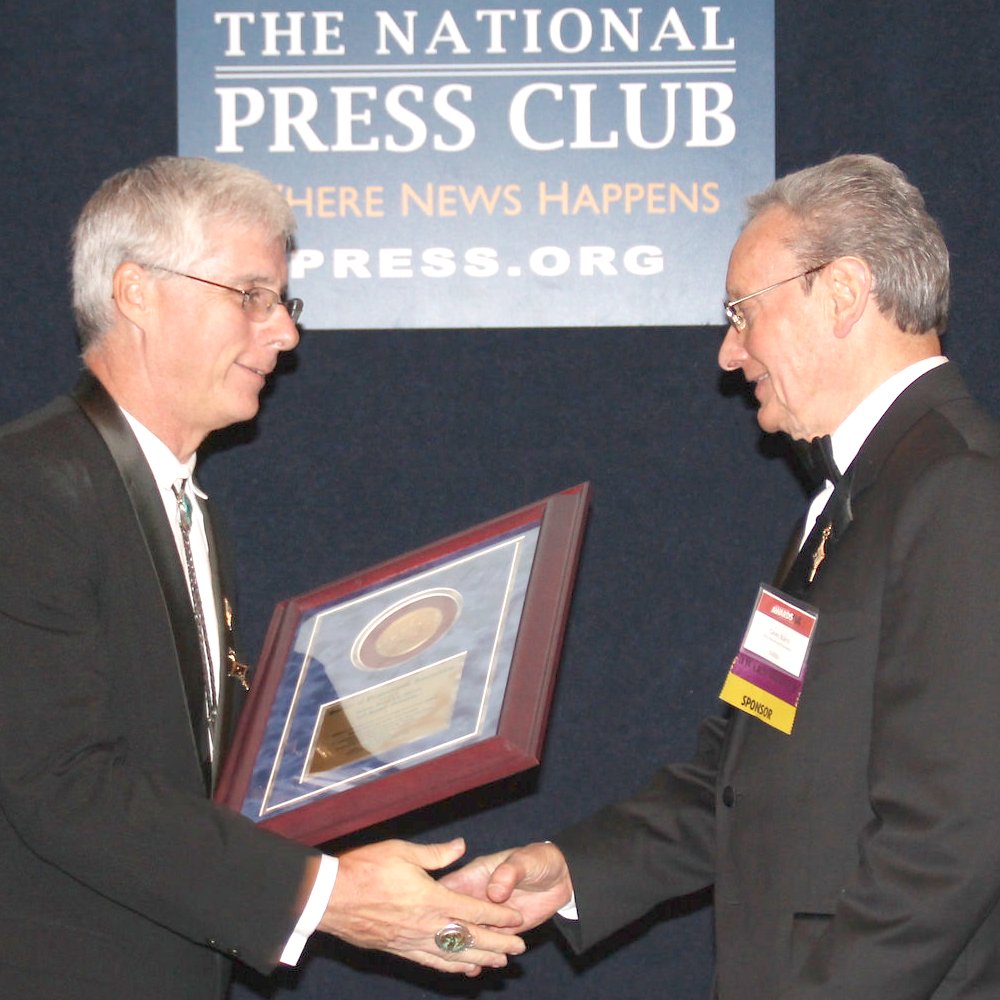
SDX Award
Sigma Delta Chi Foundation President Robert Leger presents the Sigma Delta Chi Award to AdviceLine’s Casey Bukro (Catherine Trifiletti photo)

Back to the banquet. The award dates to 1932, when the Sigma Delta Chi journalism fraternity honored six individuals for contributions to the profession. The Society of Professional Journalists continued the honors as its Distinguished Service Awards, then with a nod to its fraternal roots as the Sigma Delta Chi Awards for Excellence in Journalism.

The awards recognize the best news reporting in print, radio, television, newsletters, art/graphics, online media and research. The contest is open to any U.S. media outlet.

Ethics AdviceLine for Journalists has been guiding professional journalists through ethical minefields since 2001 – more than 900 cases. AdviceLine counsel went online early last year with an expanded ethicsadvicelineforjournalists.org website.

AdviceLine’s blog won a 2014 SDX award in the Online Column Writing (Independent) category. The blog comments on current ethics issues and describes the kind of questions it gets from professional journalists on ethics.

Here’s what the judges said in naming the AdviceLine blog the winner:

“Ethics, unfortunately, can be an afterthought in a 24-7/digital-first/anyone-can-publish-content environment. In an area that sometimes has no right or wrong answer, the Ethics AdviceLine for Journalists helps media pros navigate murky waters. They are doing a public service and helping shape the way forward for our industry, and that deserves recognition.”

Also deserving recognition are the AdviceLine ethicist consultants: David Ozar, Loyola University Chicago; Hugh Miller, Loyola University Chicago; David Craig, University of Oklahoma; Nancy Matchett, University of Northern Colorado and Lee Anne Peck, University of Northern Colorado.

Fellow bloggers Stephen Rynkiewicz and David Craig are named with me on the SDX award plaque.

Probably fair to say each of us has an ethics hero. So as a bow to those who came before us, I’ll mention one of mine: American media critic Walter Lippmann, who said in 1920, “There can be no higher law in journalism than to tell the truth and shame the devil.”

Ethics Confidential: As AdviceLine Wins Awards, Critic Recalls Its Origins

By Casey Bukro

It might pain Michael Miner, media critic for the Chicago Reader, to know that he can claim some responsibility for how the Ethics AdviceLine for Journalists handles confidentiality.

From the start, Miner has assumed that anyone who presumes to tell journalists what to do about ethics is a bit daft, silly or pretentious. He tends to be in the camp of those who believe that journalism ethics is an oxymoron.

“The old solution to journalism’s intractable contradictions was to build newsrooms no more than 100 feet from a bar,” Miner wrote in a column published March 9, 2001, a month after AdviceLine’s advent. Instead of a bar, wrote Miner, journalists now could pick up a phone and say, “Hello, sweetheart. Get me ethics.”

It’s good for journalists, and ethicists too, to have an unsympathetic, cold-eyed lampooner.

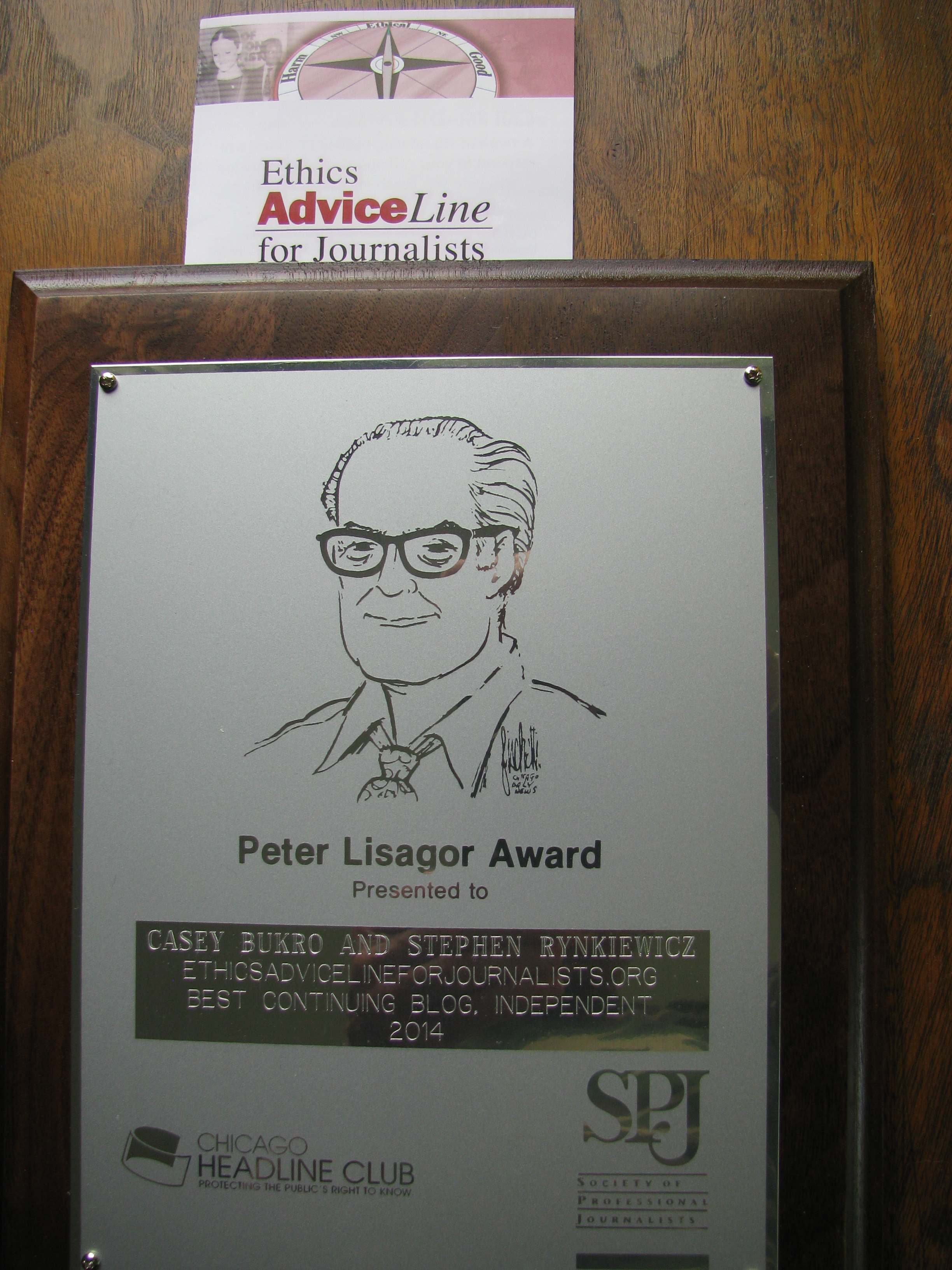
And Miner continues prodding, even when he wrote a column mentioning that AdviceLine had been awarded a Peter Lisagor Award May 8 by the Chicago Headline Club as best independent continuing blog. The Lisagor awards are given for exemplary journalism. Miner was not impressed.
Lisagor Award“But as life is richer when Bukro’s around to disagree with, I’m pleased to report he hasn’t gone away,” wrote Miner. It’s good to have a media critic, even after the passage of 14 years, who still closely follows developments in journalism and ethics with a wry bent.

The Lisagor award, named for the late Washington correspondent and PBS commentator, was the second in a few weeks given to AdviceLine. The Society of Professional Journalists announced in April that AdviceLine won a Sigma Delta Chi award for online independent column writing. The award will be presented in June in Washington, D.C.

Miner writes for the Reader, which describes itself as “Chicago’s Free Weekly/ Kicking Ass Since 1971.”

Miner is a good kicker. He wrote one of the first pieces about AdviceLine, saying in the 2001 column that a Chicago Tribune columnist beat him to using “a smart-alecky tone … forcing me to scramble for higher ground.”

Miner is also a very good reporter. He interviewed me in 2001 about what kind of calls we were getting from journalists, and I described some of our first. I thought I was being careful about identifying callers or details that could not be disclosed under our confidentiality policy.

Miner has a soothing voice on the telephone, teasing out information in a way that non-journalists might find disarming. He told others on the AdviceLine team that I had described some of the cases we handled, and encouraged them to do the same. And they did.

What followed was what I called a Miner uproar. After reading the Miner column, one AdviceLine member wrote in an email “I hardly know what to say about the extent to which confidences and commitments have been violated” in response to Miner’s questions.

The first reaction from some AdviceLine members was to say they had said too much, especially me for “spilling the beans,” causing others to follow suit.

This was virgin territory. How much can be said about ethics cases? Nothing at all, some argued. And, if you are not accustomed to being interviewed, it can be shocking to see your comments in print.

It was a tumultuous beginning for AdviceLine.

Even Miner was criticized for being too informative about the AdviceLine cases he described.

“I’m stunned, stunned, stunned to read that the contents of the phone calls to the ethics line were reported openly,” was one reaction that appeared in Jim Romenesko’s media news site.

The president of an SPJ chapter, not identified by name, had called AdviceLine with a question, and his question was described. He later told Romenesko that he had not expected his phone call to result in a news story.

My take at the time: “On the face of it, it looks as though some members of our team lost their moral bearings and we had an ethical meltdown as a result of the Miner article. How could that happen with a group trained in ethics?”

It was not ethics at fault. It was learning to communicate effectively. It was a hard-won lesson, one that rattled some members of the AdviceLine team.

At the core was knowing our standard on confidentiality, and sticking to it. Yet one of AdviceLine’s goals is education – learning what ethics issues plague professional journalists, and the advice given to help solve those dilemmas. There can be no education if the cases cannot be described publicly, even without names and places.

An AdviceLine staff member at the time, the late Mary Myers, reminded all of us of our mission: “We not only want to man an AdviceLine, but contribute to the greater discussion, understanding and body of knowledge regarding ethics and journalism.”

AdviceLine has refined its confidentiality policies periodically. Here are the questions asked every time AdviceLine gets a call or query.

1. Do I have your permission to share the details of your case, including your name and organization, with the AdviceLine team?

2. Education in journalism ethics is one of the AdviceLine’s core missions, so may we have your permission to discuss the nature of your case anonymously in the AdviceLine’s educational reports, books or online blogs, but without identifying you or your organization?

3. Real-life case reports are very important resources for education in journalism ethics, so may we have your permission to use the content of your case and our discussion of it, including using your name and organization, in the AdviceLine’s educational reports, books or online blogs?

The goal is to be clear on what AdviceLine can say publicly about the cases. Thanks, Mike!

An Editor’s Dilemma: Taking Donated Money for Reporting

From the Ethics AdviceLine for Journalists Archives

By Casey Bukro

In tough economic times, newspaper managers are always looking for new ways to raise money and pay the staff.

For an editor-in-chief of a small Idaho newspaper, that was always a problem. But in 2005, he got an offer that seemed too good to refuse. So he called AdviceLine and explained his dilemma:

A county commissioner called the editor saying he should have a reporter at an afternoon meeting of the county commission, because the commissioner is having a conflict with the county clerk and expects “there may be some monkey business on the agenda.”

Strapped for funds, the editor could not afford to send a reporter to cover the meeting.

Not a problem said the commissioner. She has a friend willing to pay for the reporter’s presence at the meeting. The editor called AdviceLine, wondering “Is it ethical to accept this money?”

This is how the conversation went:

Editor: I’m inclined to say so. Without the money, no reporter. Without the reporter, no possibility of a story, something the public may need or want to hear.

Adviser: The Society of Professional Journalists ethics code says journalists should “avoid conflicts of interest, real or perceived,” “Remain free of associations and activities that may compromise integrity or damage credibility” and “refuse gifts, favors, fees, free travel and special treatment … if they compromise journalists integrity.”

Editor: How would this payment scheme be a “conflict of interest?” How could it “compromise journalistic integrity or damage credibility?”

Adviser: Consider “perceived conflict of interest.” Suppose you are a reader. You read the story that results, which recounts a dispute between the clerk and the commissioner. You find out later, though, that the reporter’s presence was paid for by a friend of the commissioner’s. What are you likely to think?

Editor: Depends on the slant of the story.

Adviser: Why should it?

Editor: Hmmmm.

Adviser: Say you watch a press conference held by an embattled public official. One reporter gets called on a lot. You find out later he was paid for by friends of the official. What do you think, even if this questions seemed at the time “hardball?”

Editor: At the very least I’d re-read the press conference transcript and ask myself what he was up to.

Adviser: What do you think other media outlets in your area would say if they found out you’d done this?

Editor: Actually, we’re pretty much it in these parts, except for trade papers. But what about press passes to, say, concerts, rodeos, etc.? The organizers and promoters pay for them, not us.

Adviser: The pass is to enable the journalist to attend as a reporter, not a spectator. A better analogy might be: What might a reader think of the review if she knew that the promoter not only had issued the reporter a pass but paid the paper a sum of money equivalent to the reporter’s wage for the night?

Editor: Hmmm.

Adviser: I realize small-town journalism is different from the big-city type. The Tribune has a Clydesdale, and you’ve got a Shetland. But the issues are basically the same and you need to adapt them the best you can to your situation.

Editor: You’ve given me lots of food for thought. I’m now inclining the opposite way from the position I had at the beginning. Let me mull it over. Can I call you back?

Adviser: Sure.

Ten years later, AdviceLine tracked down the editor, who is no longer in the newspaper business. He quit in a dispute with new management over, among other things, raising revenue.

What did he do about that offer 10 years ago?

“I doubt that I allowed somebody else to pay for it,” said the ex-editor. “What might have happened? I didn’t cover it.”

But the editor admitted the temptation was great, because he knew that local commission meetings had a way of becoming explosive, making for interesting reading.

“It was so crazy,” he recalled. “In one case the commissioner slapped a clerk. And commissioners gave rants and got tossed out. It was great!”

He misses those days, but also recalls the never-ending tide of dilemmas.

“The buck stops with the editor,” he said. “The editor is responsible. Questions come up every week.”

Looking back on it, the adviser said he should have recommended that the editor adopt a procedures manual, “or some other way of maintaining an institutional ethical memory,” so that he or a future editor could ask, “have we ever dealt with something like this before? If so, how did we handle it?”

Conflict of Interest: What Does it Mean?

By Nancy Matchett

A reporter who covers town meetings wonders whether it is appropriate to pursue a relationship with a councilmember’s daughter.

A community activist learns that the editor of the local newspaper plans to run for town supervisor, and asks whether this is OK.

An editor discovers that one of her reporters is covering an issue he previously wrote editorials about, and wants to check whether her instinct to give the story to someone else is correct.

And a publisher posts a notice that “no anti-fracking info [is] welcome,” overturning the paper’s previous policy of printing flyers on both sides of the issue. This prompts at least one reporter to resign, and she wants to know whether we share her concern that the new policy poses a threat to journalistic integrity.

All of these AdviceLine cases raise the general question, “What counts as a conflict of interest?” Interestingly, the SPJ code is relatively silent on this.

It does say that journalists should “avoid conflicts of interest, real or perceived,”and “disclose unavoidable conflicts.” But the code does not provide further details about what would make a conflict unavoidable, nor does it offer a precise definition of what it means to say a conflict of interest exists.

This is not a criticism of the code itself; it is a reason why ethical professionals sensibly seek advice from time to time.

Conflict of interest is an example of an “open concept.” While it’s possible to give some textbook examples, there is no single definition that adequately covers all cases.

At best, there is what the philosopher Ludwig Wittgenstein called a “family resemblance” among the various situations in which the concept is appropriately used. When dealing with an open concept, testing your thinking against other professionals’ reactions is one of the best ways to ensure that you have fully understood what the concept means.

Whether a real conflict exists will also depend on facts about the particular individual whose interests potentially conflict. All of us have different abilities to bracket off our emotional attachments and understand conflicting points of view. So while one reporter might be able to draw a bright line between objective reporting and editorial work, another might find it impossible to report seriously on the arguments made by those with whom he disagrees.

One of the things AdviceLine respondents try to do is make sure callers are attending to this kind of detail. But even when it’s plausible to say that only the journalist herself knows whether a real conflict exists (the first three cases above could be examples of this), the need to avoid perceived conflicts of interest remains.

Why should journalists avoid perceived conflicts of interest even when no real conflict exists? The answer comes from reflection about the profession’s societal role. The average citizen isn’t in a position to know which reporters and editors can fight which forms of temptation.

And even the most seasoned journalist occasionally might be mistaken about his or her own ability to resist. To protect the profession’s integrity, it’s better for everyone involved if journalists avoid anything that looks remotely like conflict of interest. Only then can journalists and readers alike be confident that the profession is fulfilling its broader obligation to seek and report the truth.