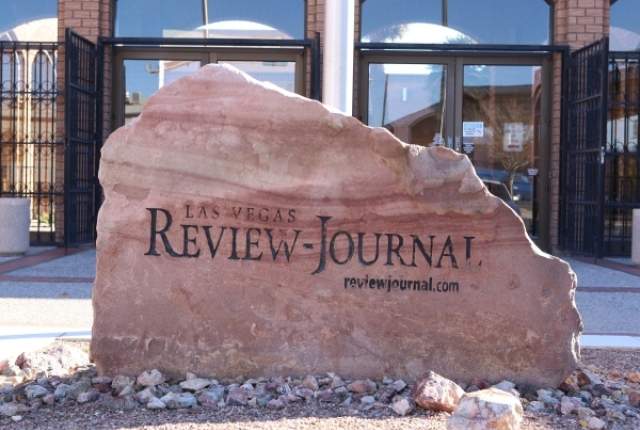
The proverbial other shoe dropped in the case of Las Vegas casino mogul Sheldon Adelson, who secretly bought the Las Vegas Vegas Review-Journal after days of denial.
The newspaper’s columnist John L. Smith resigned in protest after being told he could not write about Adelson or Steve Wynn, both Vegas casino magnates who unsuccessfully sued Smith for libel and drove him into bankruptcy through legal fees.
The paper’s editor, J. Keith Moyer, argued that it would be a conflict of interest for Smith to write about two of the most powerful men in town, who had sued him, not for his work on the newspaper, but for books he had written about them.
The one mentioning Adelson was titled “Sharks in the Desert.” The other book was titled “Running Scared: The Life and Treacherous Times of Las Vegas Casino King Steve Wynn.” Clearly, neither book offered much sympathy for either power player.
But this is a story about fabulous Las Vegas, a town with an explosive history of gambling, gangsters, show-business megastars, showgirls and entertainment. It’s in a constant state of drama or turmoil. All you have to do is walk through the downtown casinos at 3 a.m. and see the action on the roulette and blackjack tables to know things don’t slow down there.
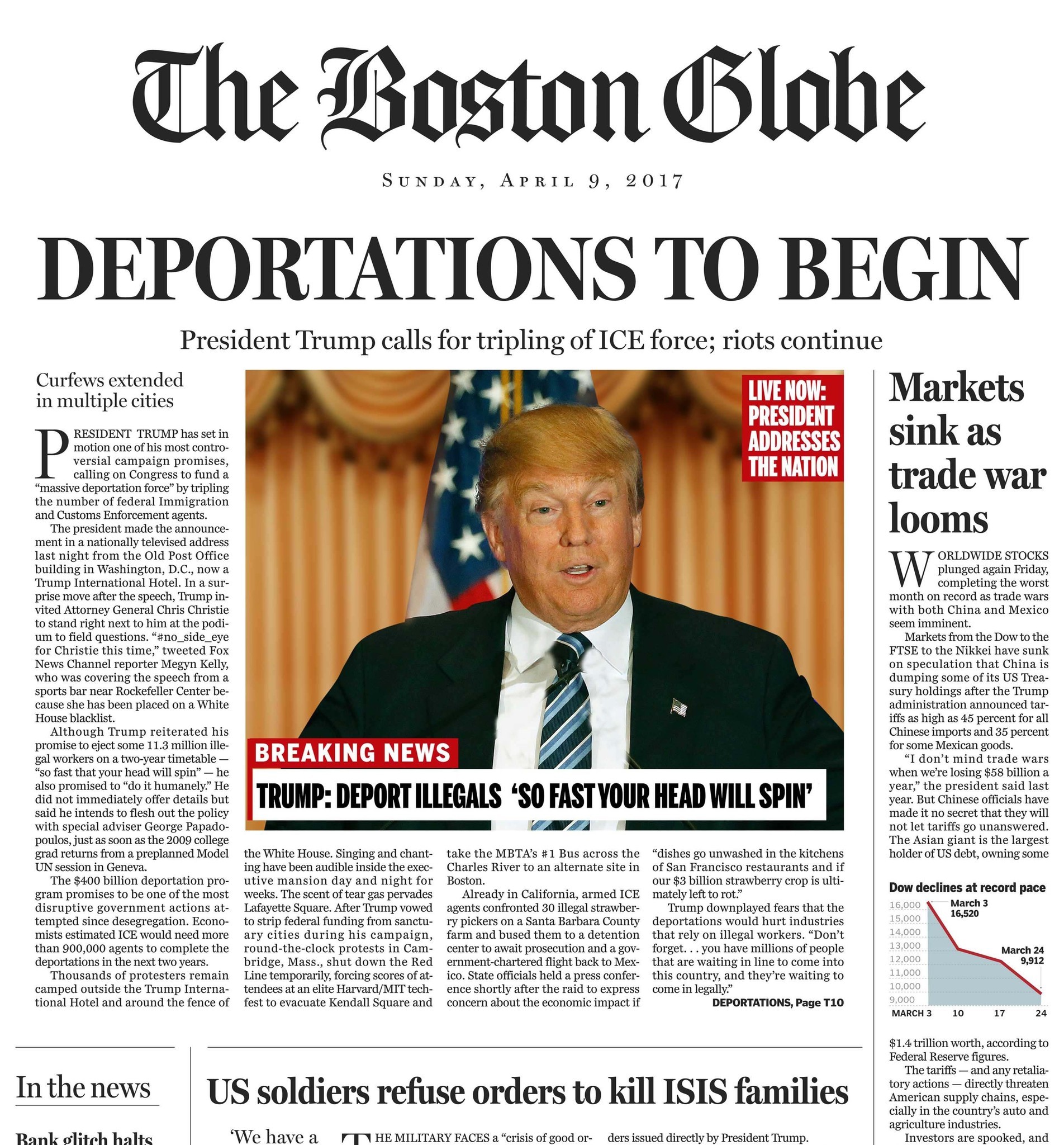
The Boston Globe added another twist to a bizarre political season by publishing a satirical front page intended to show a future based on presidential candidate Donald Trump’s words and proclamations.
“Deportations to Begin,” was the banner headline of the fake page, dated Sunday, April 9, 2017. “Markets sink as trade war looms,” read one headline. “New libel law targets ‘absolute scum’ in press,” read another.
Let me make it clear right now that this is not an attempt to cover politics. AdviceLine patrols the journalism ethics beat. We let the political writers, columnists, bloviators, commentators, prognosticators and fulminators deal with the uncertainties and comedy of political life.
The Boston Globe’s hypothetical front page did not run on the actual front page of the newspaper, but appeared inside as a front page of the Ideas Section of a Sunday edition of the Globe. It referred to an editorial, “The GOP must stop Trump.”
Reuters called the page a “parody.” CNN said “the faux front page resembles an April Fools’ Day prank by a college newspaper,” although it was nine days too late for that.
More importantly, the Globe was not joking. It was trying to show “Donald Trump’s America,” according to an editor’s note in the lower left-hand corner of the bogus page. “What you read on this page is what might happen if the GOP front-runner can put his ideas into practice, his words into action.” The editorial made the same point.
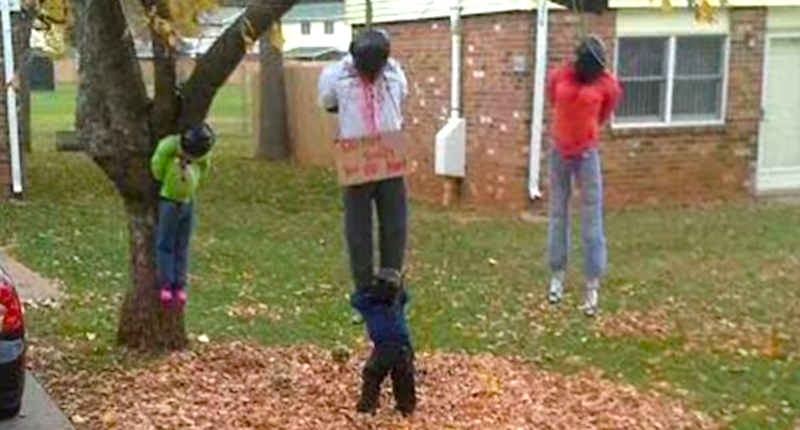
Halloween display at Fort Campbell taken down after complaints. Contributed photo from clarksvillenow.com.
By Casey Bukro
Lynching is no joking matter in the United States. News manager Robert Selkow found himself in the middle of a controversy over a Halloween display featuring three figures hanging from a tree.
“I got a photo on a smartphone,” recalled Selkow, who is site manager and news director of clarksvillenow.com, an online hyperlocal website affiliated with six radio stations serving Middle Tennessee and southern Kentucky. “It looked like a scene out of (the movie) ‘Mississippi Burning,’ black figures being hanged.”
He said it turned out to be “the most powerful image we ever published.”
Selkow contacted Ethics AdviceLine for Journalists in facing this sensitive issue, and agreed to discuss details of the case publicly.
The offensive Halloween display was in the residential area of the Fort Campbell military base on the Kentucky-Tennessee border near Clarksville.
Bill Green set the standard for ombudsmen while investigating the Janet Cooke hoax at the Washington Post. (Post photo).
By Casey Bukro
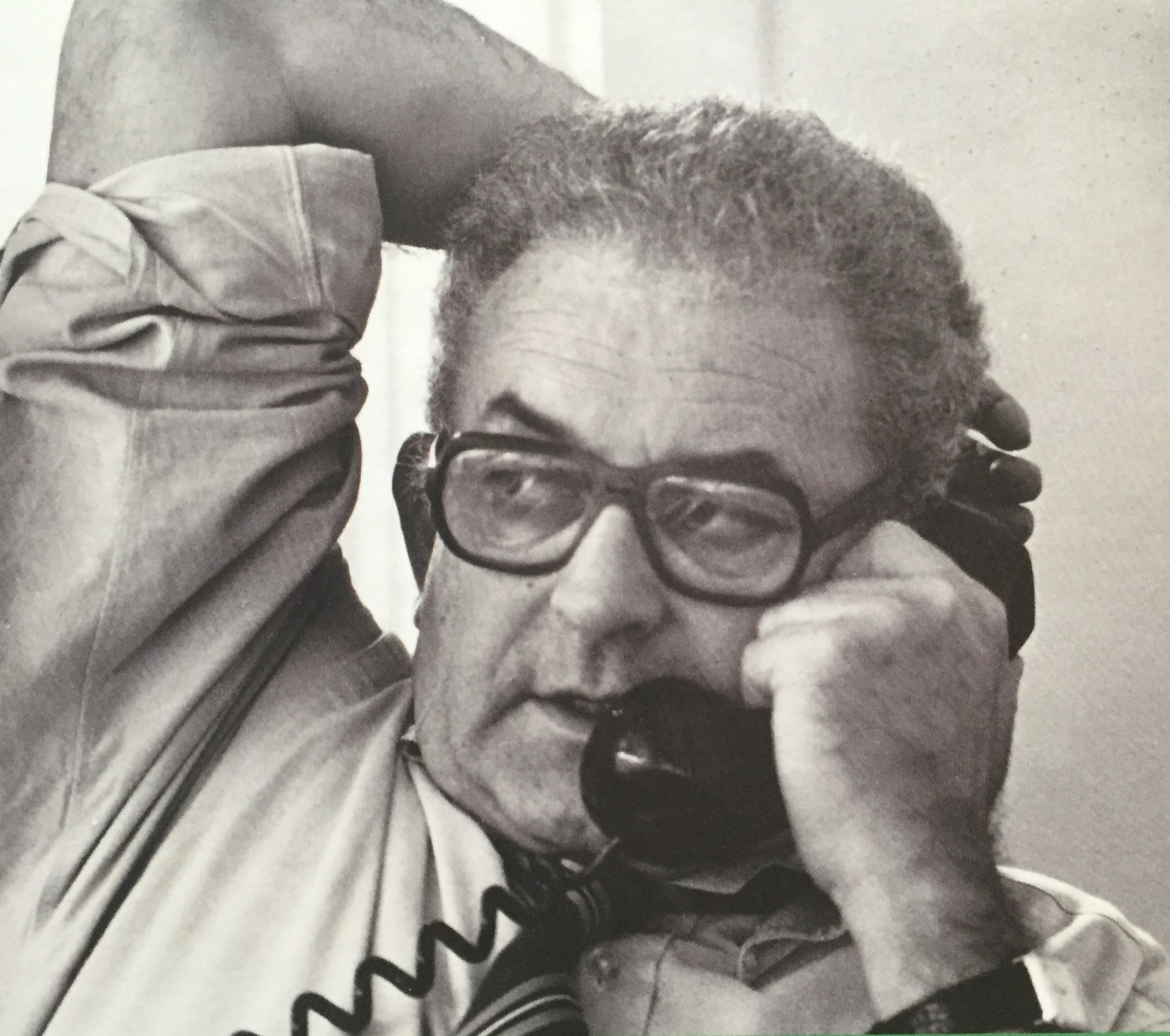
Bill Green, an ombudsman’s ombudsman, was not even sure what the job entailed when he was called on unexpectedly to unravel one of journalism’s most famous ethical failures.
Green was only weeks into the job as Washington Post ombudsman on Sept. 28, 1980, when the Post published “Jimmy’s World,” the story of an 8-year-old heroin addict with “needle marks freckling the baby-smooth skin of his thin brown arms.”
So compelling and detailed, the front-page story written by 26-year-old reporter Janet Cooke won the Pulitzer Prize for feature writing on April 13, 1981.
Almost immediately the story about the unnamed boy, and Cooke’s background that appeared when the prize was announced, started falling apart.
The story that followed is especially notable for two reasons. One is that falsehoods often fail sooner or later. The other is that Green, an editor of small-town newspapers who took a year’s sabbatical from Duke University to serve as the Post’s reader advocate, wrote a blistering report on the Post’s editorial lapses that is a model of journalism accountability. It set the standard for ombudsmen.
The nine-part report, starting on the front page and covering four full inside pages, showed the Post’s willingness to confront its flaws and admit them publicly.
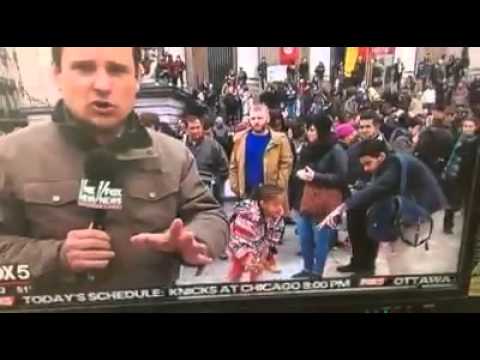
Fox News screen shot of Brussels photographer posing girl. Photo by James Pomerantz
By Casey Bukro
War is famously shrouded in a fog that journalists are supposed to penetrate.
Since war correspondents and photographers sometimes risk their lives in combat zones, you’d think they’d want to get it right. Otherwise, it’s just propaganda.
In that case, the fog just gets thicker. But it is a way to make a buck as media cut staff and rely on freelancers.
The recent Brussels bombings is an example. A 21-year-old Palestinian photographer triggered strong social media reactions. When a Fox News video showed him posing a girl at a makeshift memorial, an outcry arose against the unethical practice of staging photographs.
The Guardian, a British national newspaper, identified the photographer as Khaled Al Sabbah, who lives in Brussels and has won photography awards for his work on the Israeli-Palestinian conflict. The newspaper also quoted Michael Kamber, a former New York Times staff photographer and founder of the Bronx Documentary Center, after he saw the video.
“It’s one more example of a photographer doing something that destroys public trust in the media,” said Kamber.
Sources looking to go off the record often have little to contribute. (Stephen Rynkiewicz photo)
By Casey Bukro
After being seriously burned by false information from anonymous sources, the New York Times decided to be more cautious about accepting information from people who don’t want to be identified.
The Times issued new guidelines governing the use of anonymous sources, mandating that stories resorting to anonymity must be submitted to one of the paper’s top three editors for advance approval.
That’s a step in the right direction for a publication that long prided itself on knowing inside information, even if cloaked in anonymity.
A copy of the memo to the Times newsroom was forwarded to Politico anonymously. Hard to decide if that is ironic or hilarious.
The memo shows, among other things, that old habits at the publication known as “the Gray Lady” are hard to break. It begins by defending the use of anonymous sources as “sometimes crucial to our journalistic mission. But it also puts a strain on our most valuable and delicate asset: our trust with readers.”
The memo observed that readers “routinely cite anonymous sources as one of their greatest concerns about The Times’s journalism.”
Readers can see the practice as the Times “vouching for the information unequivocally – or worse, as carrying water for someone else’s agenda. As far as possible, we should explain the source’s motivation and how he or she knows the information.”
It appears that the Times is finally catching up on a rule generally accepted by many professional journalists: Information is only as good as its source. Credible and identifiable sources provide reliable information, or information that can be judged for reliability.
Departing from this rule can have serious consequences, as the Times public editor, Margaret Sullivan, pointed out. In several opinion page articles, she described how reliance on anonymous sources led to “two major front-page errors in a six-month period.”
One alleged a Justice Department criminal investigation against Hillary Rodham Clinton, which Sullivan called “fraught with inaccuracies.” The other involved jihadist social-media posts by one of the San Bernardino killers. The mass shooting killed 14 people and injured 22.
Too many Times articles rely on anonymous government sources, Sullivan wrote in December, 2015. She called for “systemic change” at The Times. “The Times needs to fix its overuse of unnamed government sources,” Sullivan wrote.
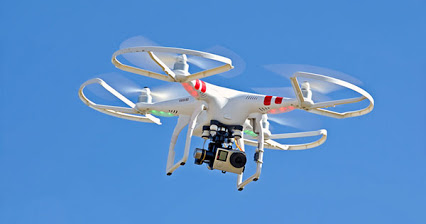
A flying drone with camera is an immersive journalism tool. (Columbia Journalism Review photo)
By Casey Bukro
Not many codes of ethics urge journalists to “take all possible measures to mitigate the odds of a crash.”
But the Professional Society of Drone Journalists code does that, and says its guidelines “should be viewed as a layer of additional ethical considerations atop the traditional professional and ethical expectations of a journalist in the 21st century.”
Drones can provide images and data for “immersion journalism”, according to a blog post that predicts virtual reality tools will allow audiences to experience the sights and sounds of news events as if actually there.
The door to this future is slowly opening as the Federal Aviation Administration works to strike a balance between assuring public safety and supporting the commercial drone industry.
The Killeen Daily Herald in Texas reports that the FAA has acted on more than 3,000 petitions seeking approval for U.S. drone operations.
Section 333 of the FAA Modernization and Reform Act of 2012 gives the FAA authority to grant certificates for the commercial use of small, unmanned aerial vehicles. Journalists already use drones to cover newsworthy events, the newspaper points out.
The FAA, meanwhile, is moving cautiously. Each month, it says, the FAA receives more than 100 reports from pilots and others who see what appear to be unmanned aircraft flying close to an airport or manned aircraft.
“It’s become a serious safety concern for the agency, and a potential security issue for the Department of Homeland Security,” the agency said in a statement. As a result, the FAA is working with other agencies to develop technology to detect and identify “rogue drones” and their operators.
A 2014 FAA report denies that the U.S. lags behind other countries in approving commercial drones, adding: “we want to strike the right balance of requirements for (unmanned aircraft systems) to help foster growth in an emerging industry with a wide range of potential uses, but also keep all airspace users and people on the ground safe.”
The Professional Society of Drone Journalists claims members from the Boston Globe, ESPN and Reuters in its global ranks, along with freelancers and academics. “Established in 2011, PSDJ is the first international organization dedicated to establishing the ethical, educational and technological framework for the emerging field of drone journalism,” its mission statement reads. “We develop small unmanned aerial systems (sUAS) for journalists, and explore best practices to deploy them for a variety of reporting needs, including investigative, disaster, weather, sports and environmental journalism.”
Its membership roster includes individuals with an interest in drones, and companies that manufacture them. So what is it primarily, a group that represents drone manufacturers or a drone advocacy group?
“I am under the impression it is an advocacy group,” said Mark LaBoyteaux, owner and operator of Hawkeye Media based in the Dallas-Forth Worth area. “But I haven’t heard from them for two or three years,” adding “I thought it evaporated.”
It started, he recalled, when a group of journalists who wanted to use drones for news photography sought permission from the FAA. Instead, the agency sent cease and desist letters to them.
“I got a letter from the FAA,” said LaBoyteaux. As a result, “they wanted to form a group that could work legally with the FAA and use photography for news gathering.”
LaBoyteaux uses five “multi-copters” for aerial photography and video photography. He understands that the FAA is relaxing its rules on drones “to let them be used for commercial purposes.”
On its website, the Professional Society of Drone Journalists espouses a “layered approach” to form its code of ethics, including traditional journalism ethics, privacy, sanctity of law and public spaces, safety and newsworthiness.
Drone operators must be adequately trained, according to the guidelines, and the equipment must be suitable for safe and controlled flight in adequate weather conditions.
Newsworthiness is the foundation of the group’s “hierarchy of ethics.” Drones should be used only after careful deliberation. “The investigation must be of sufficient journalistic importance to risk using a potentially harmful aerial vehicle,” the statement says. “Do not use a drone if the information can be gathered by other, safer means.”
The Poynter Institute notes that the FAA signed an agreement with CNN to test ways journalists can safely use drones in news gathering and reporting.
“Our aim is to get beyond hobby-grade equipment and to establish what options are available and workable to produce high quality video journalism using various types of (unmanned aerial vehicles) and camera setups,” CNN Senior Vice President David Vigilante says in a statement.
FAA Administrator Michael Huerta adds: “Unmanned aircraft offer news organizations significant opportunities. We hope this agreement with CNN and the work we are doing with other news organizations and associations will help safely integrate unmanned news gathering technology and operating procedures into the National Airspace System.”
With this kind of high-level cooperation, drone operators might declare they have liftoff.
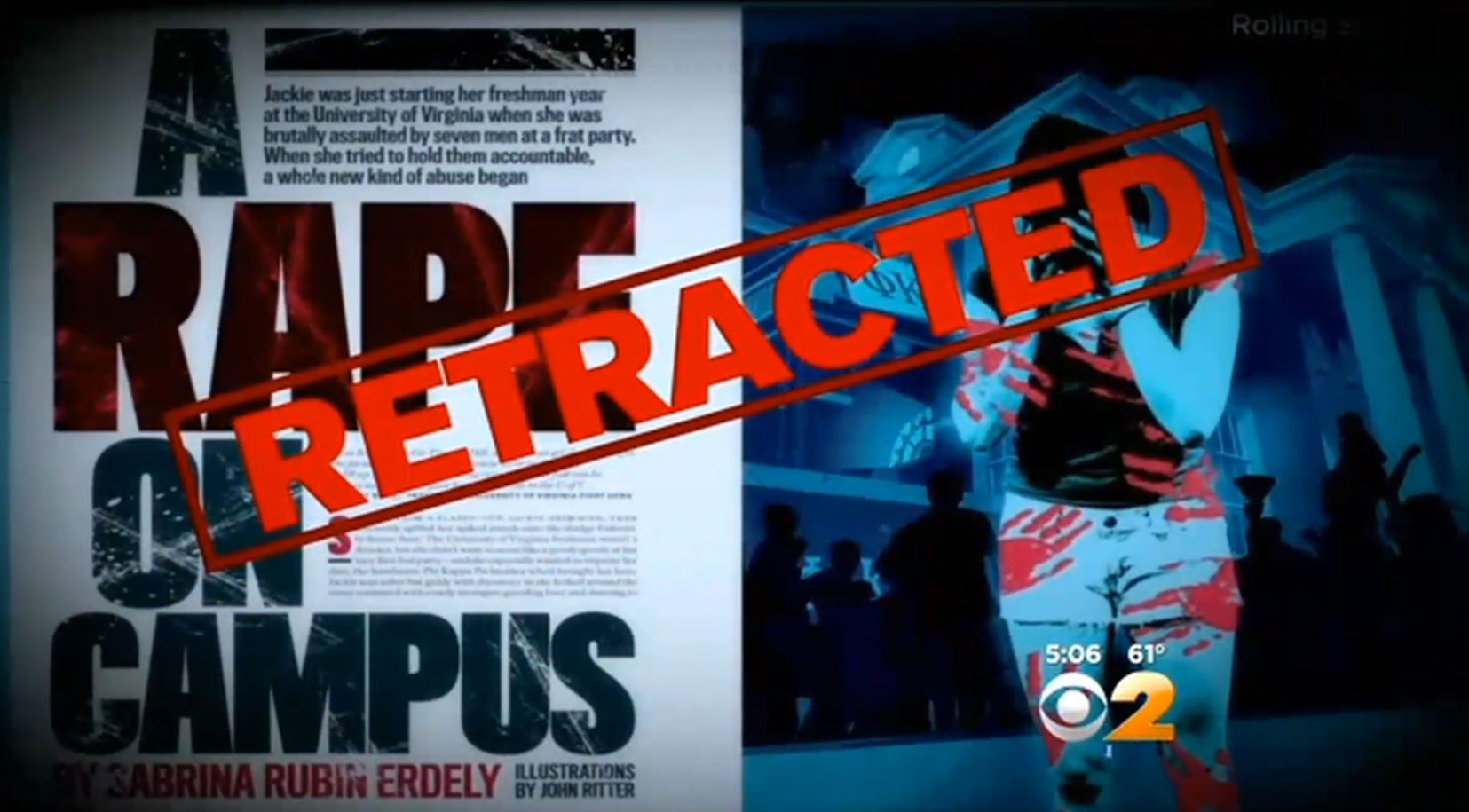
Rolling Stone retracted its 2014 article about an alleged campus rape. (Media Matters for America illustration)
By Casey Bukro
A ban on naming sexual assault victims has been one of the ironclad ethics rules in journalism. Why inflict more pain on an innocent person?
The Society of Professional Journalists code of ethics says: “Be cautious about identifying juvenile suspects or victims of sex crimes.”
Yet even this rule is coming into question as people decide what rules they want to follow.
For example, Stephen J.A. Ward, a media ethicist, points to the trial of Jian Ghomeshi, a former Canadian Broadcasting Co. radio host. Ghomeshi is charged with sexual misconduct involving three women in 2002 and 2003.
One woman insists on being identified. The others’ identities are protected under Canadian law.
“So what should newsrooms do if the complainant insists on being identified?” asks Ward. “It’s a complex legal and ethical decision.”
Ward described how identity bans work under Canadian law. But two trends complicate the issue.
“One trend is the growth of media beyond the mainstream journalism that was the original focus of the ban,” he writes. “Social media, bloggers and others may ignore the ban. The second trend is that some people want to be named” and “may use social media to identify themselves as a complainant.”
Once the name is ‘out there’ in the media world, it’s very difficult to erase.
One of the central rules in journalism ethics is minimizing harm. Ward reasons that this means explaining consequences, to make sure complainants give informed consent to the use of their names.
The problem prompted the Canadian Association of Journalists ethics committee to release guidelines. The committee suggests journalists take specific steps to ensure informed consent:
A journalist should explain that, once a complainant’s name is made public, other media likely will use the name too.
A journalist should explain that that the name likely will be used on social media, over which the journalist has no control. Individuals on Facebook, Reddit or other social sites will post comments. Some of them “can be vile.”
A journalist should explain that, once the name is “out there” in the media world, it’s very difficult to erase.
A journalist should not pressure complainants to make their names public.
A journalist should explain that, given the nature of search engines, the sex crime report might be the first thing that appears when someone does an Internet search of the complainant’s name. Has the complainant thought about the information being available indefinitely when applying for jobs, entering into relationships or having a family?
The guidelines report also advises journalists to give complainants a day or two to think about their decisions before making their identities public.
“Taking that time up front will almost certainly reduce the likelihood of ‘source remorse’ and the possibility of an unpublishing request later.”
The CAJ report also reminds journalists that they are obligated to tell the whole story, not just the complainant’s viewpoint. The 2014 Rolling Stone magazine story about an alleged campus rape turned out to be bogus because it was based on the allegations of one person. Sex crimes often involve conflicting viewpoints.
The Canadian ethics panel suggested, as an alternative to an “all-or-nothing approach,” considering refusing to share a story through social media channels, not archiving stories that name victims or removing names from a story. But these actions could raise more ethics concerns.
The Bill Cosby case is an example of the complications in alleged sex crimes. Controversy can simmer for decades. Journalists and authorities have been accused of protecting the popular entertainer. Some women kept silent in the belief nobody would believe them. Years later, some identified themselves as women who were allegedly drugged and sexually assaulted.
Years ago, sexual assault was a crime that people hesitated to talk about under social norms. That has changed. Television and the online media discuss and show sexual situations openly. It’s the new norm.
Still, it’s a good idea for journalists to keep in mind the golden rule: Minimize harm.
Normally, AdviceLine considers the Society of Professional Journalists’ code of ethics its highest source for guidelines and standards on ethics.
But we’re always willing to be open-minded about new and thoughtful ways to think about ethics and do the right thing in journalism.
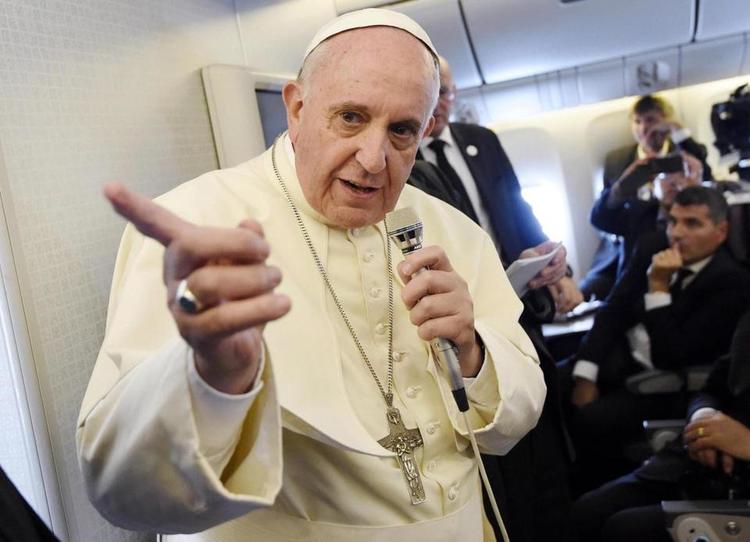
Take Pope Francis for example. The pontiff is unusually frank and quotable on his world tours, accompanied by media aboard the papal airliner. He gets involved in current and political issues that some popes might have shunned as too earthly, too secular.
On his way back to Rome from a six-day visit to Mexico, where he is known as Francisco, the pope weighed in on comments by Donald Trump, the Republican presidential hopeful. In a midair press conference, Reuters’ Phil Pullella asked for a response to Trump’s claim that the pope was a pawn in Mexico’s migration politics – an apparent reference to Trump comments on the pope’s trip airing on Fox Business. Pullella noted the candidate’s call to wall off the U.S.-Mexico border.
A transcript indicates the pope did not address Trump’s comments directly, but said that “a person who thinks only about building walls, wherever they may be, and not building bridges, is not Christian.”
Trump said the pope heard only one side of the story. In later comments, the pope clarified: “I say only that this man is not Christian if he has said things like that. We must see if he said things in that way and in this I give the benefit of the doubt.”
So now we have an ethical conundrum. If he is not sure what Trump said, and gives Trump the benefit of the doubt, are media free to tie the “not Christian” remark to Trump? Media reports on the event tend to say the link to Trump is stronger than the pope himself will admit. Trump has vowed to force Mexico to build a wall and increase deportations.
That night, on the PBS News Hour, John Allen, a Boston Globe reporter who covered the event, said it is possible that the pope does not know who Trump is, and was taking the word of reporters that Trump made the remark. Essentially, reporters coached the pope.
Moderator Judy Woodruff rightly pointed out that other politicians have asked for border walls, not just Trump. So was this a media-created conflict?
What should an ethical reporter do?
The answer might lie in the pope’s own comments during another in-flight press conference, when he touched on journalism ethics.
In the wake of the so-called Vatileaks scandal, in which the mainstream press reported on corruption in the Vatican, the pope was asked about his opinion of the importance of a free press in rooting out corruption.
“The professional press must tell everything, without falling into the three most common sins,” the pope responded. The sins he named were:
Misinformation – telling half the truth.
Calumny – dirtying another person, with or without the truth.
Defamation – to take away the good name of a person who has not done anything wrong.
“These are the three defects that are an attack against the professionally of the press,” the pope said. “We need professionally, what’s right. … And on corruption? To see the data well and say it. … If there is corruption, they should say it. And if a journalist, if they are truly professional, gets it wrong, he should excuse himself. Things go very well like this.”
Writer Terry Mattingly, reporting on that in-flight press conference, wrote: “To be honest, I think it would have been interesting to ask the pope to define the line that he sees between ‘calumny’ and ‘defamation.'”
Possibly all three “defects” apply in Trump case, since the controversy appears to stem from information fed to the pope, rather than from his own knowledge. This is a nuance that was not explained in many reports on the incident, although John Allen clarified that in his PBS News Hour appearance. And it could be argued that the pope was telling one side of the story.
The controversy did cast a shadow on the character of a political candidate, intended or not.
In the rough and tumble of American politics, even a pope may be dragged into the fray. It’s possible he was duped into commenting on something he was not familiar. Even a pope should be wary during election time in America.
The SPJ code of ethics says: “Take special care not to misrepresent or oversimplify in promoting, previewing or summarizing a story.”
Pitting the pope against Trump might have been a misrepresentation or oversimplification. How would you have handled the story?
All is fair in love, war and politics. But do they mix?
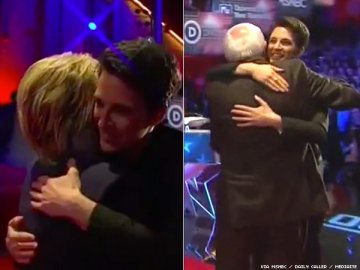
Critics say Rachel Maddow, MSNBC television host and political commentator, crossed a line when she hugged Democratic presidential contenders Bernie Sanders and Hillary Clinton after a televised debate.
Rachel Maddow hugs Hillary Clinton and Bernie Sanders.
Maddow says she’s a hugger, and probably will hug again if invited to host another debate regardless of political party.
Conservative Fox News analyst Howard Kurtz is among those who object. “She shouldn’t have been on that stage as moderator,” Kurtz writes on foxnews.com. “She is an unabashedly liberal commentator who rips the Republicans every night on her program. She should not have been put in that position.”
Kurtz acknowledges that Maddow is a smart lady, a Rhodes scholar with deep knowledge of the issues. But as Kurtz sees it, the hugs restrict MSNBC’s efforts to shed its left-wing label and rebrand itself as a news network.
Brit Hume, another political commentator, tweeted about the clutch play, saying “I don’t think I’ve ever seen a moderator do that before.”
Washington Post media critic Erik Wemple shrugs it off.
“Consider the hugs through the prism of journalism ethics,” writes Wemple. “Were they transparent? Yes, there’s a video of the hugs, which took place in front of the cameras; any clandestine backstage moderator-candidate hugging is strictly forbidden. Were they even-handed? Yes, both Sanders and Clinton received hugs of very comparable warmth, duration and hand-pats. Were they prejudicial? Nah, coming at the end of the event, it’s hard to say that the affection received by Maddow influenced the questions, which were solid.
“So, that’s the verdict, considering that there doesn’t appear to be a hug provision in the Society of Professional Journalists’ code of ethics.”
True, the code does not outlaw hugging specifically. But it does warn against conflicts of interest, “real or perceived.” And it urges journalists to “remain free of associations and activities that may compromise integrity or damage credibility.”
Those tenets apply to this case, which is why some journalists might do a double-take at Maddow’s embrace.
In a later blog post, Wemple returns to the debate-ending squeeze. “The industry’s orthodoxy dictates that those with opinions shouldn’t be running such straight-news events. Count me out of that strain of hollow thought. We’ll take Maddow over some ‘objective’ drone every time,” he writes.
Which is to say journalism standards and customs change over time. Lines are drawn and redrawn. And journalists will agree or disagree. It’s the nature of ethics.
That Herman Hupfeld song from the movie “Casablanca” comes to mind, “As Time Goes By.”
“You must remember this, a kiss is just a kiss, a sigh is just a sigh. The fundamental things apply as time goes by.” Nothing there about hugs.
In your view, was Maddow wrong? Leave a reply below.
 Ethics AdviceLine for Journalists