Category Archives: Minimizing Harm

GamerGate Ethics: It’s Not About Scoring Points

Grand Theft Auto 5
Off-the-rails video mayhem in Grand Theft Auto 5 (Rockstar Games)

What’s the point of video game debate? Consumer reviews pose valid ethical issues, but not this one.

By Stephen Rynkiewicz

Critics are prepared to justify their opinions, but shouldn’t be forced to defend their livelihoods, much less their lives. Yet that’s the challenge now facing video game reviewers, and it’s a struggle that tests the maturity of their industry.

Threats against cultural critic Anita Sarkeesian brought the issue mainstream attention. An anonymous email warned Utah State University administrators of a shooting massacre at her speech on women in video games. She canceled the appearance.

It’s hard not to identify with that dilemma. But when I circulated the New York Times report on Sarkeesian’s cancelation, the Twitter response was harsh. “Oh boo hoo,” one wrote, “those terrible, count them, ZERO, attacks on hated busybody con artists.” That suggests the level of the “GamerGate” debate.

No regrets from this editor if the mayhem stays at zero. I’m trained to keep writers safe. Mostly reporters want an editor to check their facts and their logic; reviewers need a sounding board. We may even disapprove of what our critics say. Yet editors defend their right to say it. Must we defend to the death?

Continue reading GamerGate Ethics: It’s Not About Scoring Points

Three Ethics Takeaways From ONA Conference

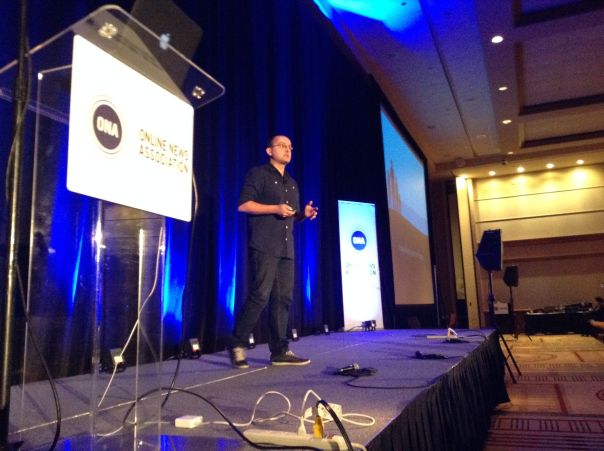
Alberto Cairo
Alberto Cairo of the University of Miami says ethics have not kept pace with data visualization techniques. (Stephen Rynkiewicz photo)

By David Craig

The Online News Association annual conference, which I attended September 24-27 in Chicago, always provides great updates on trends and issues in digital journalism. But it’s also a great place to hear about ethical challenges, both new and continuing.

Ethical issues were the focus of three sessions, including a challenge session in which audience members had to react quickly to ethical scenarios on topics such as use of user-generated content. But ethics also came up in sessions that were primarily about other topics.

Here are three ethics takeaways from the conference:

1. Content that disappears will create new ethical challenges. Amy Webb, founder of Webbmedia Group, delivered her annual talk on “10 Tech Trends for Journalists.” One of them was “ephemeral content,” an increasingly popular kind of social media communication.

Webb said Snapchat, an app developed to share photos that’s popular with young people, provided a way to send private content that users might not want to stay around, but “it’s also a way to clear up our cluttered social streams.” She said other companies are providing messaging services with content that disappears, appears anonymously or is even encrypted. She predicted that most messaging apps will have some kind of means of making content ephemeral in the next 24 months.

Ephemeral content is relevant to journalism because some news organizations including The Washington Post are experimenting with it. But Webb pointed to an ethical difficulty: “Ephemeral content can be used for publishing news. But it can’t be corrected, because no record is left.”

This kind of communication raises questions of accountability for the accuracy of content because once it’s gone, there’s no way to amend a false message or even verify what the message said.

“Talk internally about the implications,” Webb suggested to news organizations.

Even for journalists who don’t use this kind of content, the discussion points to ongoing questions about what it means to ethically handle incorrect content in social media messages.

2. Algorithms shape the truth that people learn about the world and point to new ethical obligations for journalists. Kelly McBride, vice president for academic programs at the Poynter Institute for Media Studies, and Nick Diakopoulos, a journalism professor at the University of Maryland and an expert in computational journalism, presented a session titled “Algorithms are the New Gatekeepers.”

McBride said algorithms, because they shape how news is distributed and to whom, have a powerful influence on what gets attention in the marketplace of ideas. As one of the presentation slides showed, they also affect a huge number of other areas of life including search rankings, online recommendations, advertising and relationships.

Diakopoulos talked about the power of algorithms in influencing the information we receive because of their ability to prioritize, classify, associate and filter it. He argued that the power they carry suggests new responsibilities – and opportunities – for journalists in reporting because they can help hold algorithms accountable. Stories might address issues including discrimination, mistakes that deny service, censorship, illegal activity or false predictions.

This kind of reporting isn’t easy. He pointed to several possible approaches to “auditing” algorithms – reviews of computer code, surveys of users about their experience, analysis of input and output, having users report data and (with ethical problems he acknowledged) impersonating users with programs.

Despite the difficulties, the social and economic impact of algorithms make it important for journalists to try new ways of reporting.

3. The power and availability of data visualization tools call for increasing attention to the ethics of visualization messages. Alberto Cairo, a professor at the University of Miami who teaches on informational graphics and data visualization, gave a session called “The Journalist, the Artist and the Engineer: The Ethics of Data Visualization.”

Cairo argued that the core goal of journalism ethics is to improve the public’s understanding of issues “relevant for their conducting good lives” while minimizing any potential harm. He said tools to create interactive charts, maps and other informational graphics are becoming more popular and widely available but that ethics is not keeping pace. He said that helping the public understand what good, ethical visualizations look like can help to better society and avoid the impact of misleading messages.

Even though great data visualizations are beautiful as well as functional, Cairo said, they must hold to a high standard of truthfulness that doesn’t oversimplify or distort the information being represented. Using the example of a graphic from the National Cable Television Association, he talked about going from showing things that are true but may leave out important information to showing a picture that’s more complicated but also truer and more accurate.

Cairo urged the audience not to hide complexity from the public or point to patterns that really aren’t there. In doing so, he is rightly pointing to a standard of care in visualization that is as high as the standards used in good investigative writing.

Images of War


By Casey Bukro

James Foley was an American photojournalist who captured the gruesome images of savage warfare, until he became one of those images himself.

Foley, 40, dressed in prisoner orange with a shaved head, is seen kneeling next to a masked, black-clad man holding a knife. Kidnapped in Syria almost two years ago, Foley seems to grimace as the masked man clutches his shirt from behind.

A video posted on YouTube, then taken down, reportedly shows Foley decapitated, his bloody head detached from his body and resting on his back. Two U.S. officials said they believe the video is authentic.

Journalistically, one of the issues in reporting on Foley is whether the grim photo, which seems to show the journalist in the last moments of his life, should have been published.

The New York Post and the New York Daily News gave the photo front-page exposure, causing Washington Post reporter Abby Phillip to ask if the tabloids had gone “too far by printing gruesome images of James Foley’s execution.”

The Society of Professional Journalists code of ethics encourages sensitivity in the use of photographs involving those caught up by tragedy or grief, and “avoid pandering to lurid curiosity.”

For tabloids, that can be a challenge. The rule seems to be the more shocking, the better, and big images are best

This is not the first time the New York Post is seen as going “too far.” On Dec. 4, 2012, it published a cover photo of a man desperately trying to climb up on the platform of the New York City subway after a panhandler allegedly pushed him onto the tracks.

The man in the photo is moments from death as he looks at the train bearing down on him.

The photo appeared with the words, “this man is about to die,” and “doomed.” It caused outrage among those who thought it was heartless to publish such a photo. Some thought the photographer should have helped the doomed man, instead of taking his picture.

Shock value has always been a tool of the trade for tabloid journalism, and, to some extent its younger media relative, online journalism.

What does it mean these days to “go too far”? Is that idea passé?

There was a time when the personal lives of American presidents were off limits. Clearly, rules change.

What do you think?  Is shock value just a hangover from tabloid journalism and outmoded, or justified at a time when movies and television trade in sex and sensationalism? Are we just old-fashioned when we cringe from photos of men about to die?

Journalists from three organizations, including SPJ, are pondering writing or rewriting codes of ethics. What should they say about shock value in the news?

Anon Again


By Casey Bukro

Anonymous sources — used by media and by government officials — came up again in a New York Daily News piece by James Warren.

Warren used a press briefing by Josh Earnest, the new White House press secretary, to illustrate how Earnest and a reporter dueled, trading accusations of withholding sources. Back and forth they went, parry and thrust.

Warren also comments on the value of White House news briefings, and whether they actually produce news.

“It has been a fairly informative ritual at times evolved (perhaps partly as a result of the cameras) into an hour or so of premeditated evasions by the spokesman; a bit too much prosecutorial posturing by some of the reporters; and, ultimately, rhetorical stand-offs in which there’s little advancement in public understanding of important matters.

Actually, Warren noted, if a White House reporter’s annual salary depended on legitimate stories produced by the briefings, he’d “be eligible for unemployment compensation.”

But the bulk of Warren’s story deals with the give-and-take between Earnest and a reporter, who was asking for more on-the-record sources from the White House. That would depend, said Earnest, on a case-by-case evaluation and ground rules “that will serve your interests and the White House interest the best.”

Warren called the “spitball fight” hypocritical.

“The Washington media, like media at other levels of journalism, is often involved in a mutual self-protection racket with the people we cover,” he wrote. “It can be at the White House, City Hall in Chicago or a county board in Texas. The dynamic is roughly similar. Too many reporters are manipulated with scarcely a qualm.”

About.Com Media describes the dangers of using anonymous news sources and offers five questions to ask yourself before trusting anonymous sources.

The site points out that inexperienced reporters might believe that using anonymous sources “make news stories sound more important,” but the practice presents “many ethical and legal dangers.”

Taking a Devil’s Advocate approach, New York News & Politics explored whether the Watergate investigation leading to President Nixon’s resignation could have been possible without  W. Mark Felt, later identified as the “Deep Throat” confidential informant.

The story touches on the working habits of Seymour Hersh and Jayson Blair, with comments from Bob Woodward.

“Journalism exists to get us closer to all sorts of truth, and anonymous sources are essential to the endeavor,” concludes the author, Kurt Andersen. “Even now, they provide more social benefit than they (exact) in moral costs.”


Handling Rumors on Social Media

By David Craig

How should journalists deal with rumors on social media?

Answering this question in practice isn’t as simple as it might seem. A good discussion of the topic broke out Friday during the latest #EdShift Twitter chat on PBS MediaShift.

The biweekly chats draw in both journalists and journalism professors to talk about topics important to the future of journalism education. This one focused on ethical issues on social media. Excellent comments, including resources for good ethical practice, emerged on several topics. But the most intense debate centered on rumors.

Steve Fox, a journalism professor at the University of Massachusetts, took this view:

Fox said the approach used by Andy Carvin, formerly of NPR and well-known for his engagement with Twitter sources during Arab Spring, can’t be generalized to other reporting. But Carvin, who joined in the discussion, said that if journalists are just passing along unverified rumors, that’s the wrong way to work. He posted links to several tweets he wrote after the school shootings in Newtown, Connecticut, to show the approach he takes to verifying information:

With this approach, Carvin challenges assumptions and highlights the likelihood that early reports are wrong – whether they come from individuals or news media.

The research he’s been doing as a fellow at the Tow Center for Digital Journalism at Columbia University also provides a caution for journalists using law enforcement sources.

Where does all of this leave us on the question of how journalists should handle rumors on social media?

I share Fox’s caution on any communication by journalists about rumors. In ethical terms, minimizing harm – a mainstay of ethics including the Society of Professional Journalists code – calls for great care because of the potential of false information to do damage.

But in the social media sphere, where the public is immediately awash in good and bad information, journalists often best meet another duty – seeking truth – by aggressively questioning rumors openly in real time. (For another case study on this, see a 2011 blog post by Daniel Victor, now a social media editor at The New York Times, about two journalists on Twitter in the middle of a shooting scare in Philadelphia.)

In another tweet,  Carvin said that if a rumor spreads on social media, journalists’ duty is  “to acknowledge it, pick it apart, prove/debunk it.”

Well-said. That means being ethical on social media involves not just asking hard questions but asking them in the open.


Olympic Tears

By Casey Bukro

Olympic skier Bode Miller cried as NBC’s Christin Cooper interviewed him, asking him a string of questions about the influence Miller’s dead brother might have had on the skier’s bronze metal performance in the race he had just finished.

Midway through the interview, tears streaming down his face, stammering at times, Miller bowed his helmeted head and fell silent. Cooper placed a hand on Miller’s arm and said: “Sorry.”

The media and the world in general have come down hard on Cooper,  a former Olympic skier herself in the 1984 games, for “pushing too hard” in the Miller interview.

In the aftermath of this furor, Miller proved to be a class act. He tweeted, “please be gentle w christen cooper, it was crazy emotional and not at all her fault.” In another tweet, he said “she asked questions that every interviewer would have, pushing is part of it, she wasn’t trying to cause pain.”

Miller has a point. It is the nature of television to go for the visual and the emotional. Cooper noted that Miller looked to the sky moments before starting his medal-winning Alpine Super-G run, implying he might be thinking about his brother Chelone, who died at the age of 29 last year after suffering a seizure. Miller said later there was some truth to that.

Cooper is one of those attractive sport figures turned broadcasters. Without a background in professional journalism, there is reason to believe Cooper simply does not understand or did not have the depth of experience to learn how far to go. She is co-founder of a restaurant in Bozeman, Montana.

There are boundaries in good taste and ethics that professional journalists learn to recognize, or should learn to recognize.

At least credit Cooper for saying “sorry,” perhaps moved by seeing how emotionally distraught Miller became by her questions about Chelone.

Television puts attractive but nonprofessional commentators in sensitive situations at its own peril. That might be one of the lessons of the Sochi Olympics in Russia.

Although much of the criticism rained down on Cooper, nothing was said about the excessive time NBC’s camera followed Miller after he walked away from Cooper, then slumped down weeping against a low wall until his wife came to comfort him. It was too much.

The Cooper interview has been timed by the New York Times at 75 seconds. But the camera lingered on Miller far longer after he ended the interview by walking away.  At that point, the interview was over. Miller should have been left alone in his private grief, instead of being hounded by the camera.

Maybe it was NBC’s idea of good TV, but it was  a bad way to treat a human being.

Ombudsmen a Global Growth Industry

By Casey Bukro

The Washington Post’s decision early this year to dump its ombudsman got a lot of attention, but a global growth in the ranks of ombudsmen as a step toward development has gone largely unnoticed.

“This growth reflects a belief in young or fragile democracies that strong media play a critical role in development,” reports “themediaonline,” most notably in Latin America.

“Themediaonline” report was based on “Giving the Public a Say: How News Ombudsmen Ensure Accountability, Build Trust and Add Value to Media Organizations” It was published by fesmedia Africa, a media project of the Friedrich-Ebert-Stiftung in Namibia, Africa. FES is a nongovernment, nonprofit foundation that promotes democratization and good governance.

An Argentine academic said the work of ombudsmen “demands our attention.”

In Africa, according to the report, ombudsmen organizations play an important role in fending off government interference. Instead of working for news media, ombudsmen in other parts of the world might operate as voluntary associations.

Africa has become a hotbed of ombudsman activity.

Complaints to a press ombudsman in the Johannesburg area jumped 224 percent since 2009, according to a report at the South Africa Editors’ Forum at Umhlanga, Africa.

Johan Retief, deputy press ombudsman of Print Media South Africa, said his organization received 151 complaints from aggrieved newspaper readers and newsmakers in 2009, and the tally is expected to reach 490 in 2013. PMSA is described as a nonprofit voluntary association with a membership of 700 newspapers and magazines in four languages.

Greater numbers of complaints to the ombudsman organization have been laid to growing public awareness of the organization’s public advocate role and its effectiveness in dealing with complaints about inaccurate or unfair newspaper reporting, according to IOLnews.

The newspaper industry’s previous system of self-regulation came under attack as “toothless,” and the governing African National Congress threatened to create a statutory tribunal to hear complaints. That was avoided by a stronger stance by the ombudsmen.

For example, Press Ombudsman Retief ordered the Daily Sun newspaper to publish a front page apology for front page color photos of the bodies of people killed in mob attacks.

Complainants said the pictures were insensitive, dehumanizing, inconsiderate, caused discomfort to society and lacked compassion, according to a report in the Mail & Guardian.

The photos published in October and November also raised concerns that they exposed society, including children, to extreme violence and desensitized people to violent crimes.

News or Painful Reminders?

By Casey Bukro

News media were divided on whether the the 911 audio recordings in the Newtown, Conn. shootings a year ago that left 26 dead were newsworthy.

That might say something about the ethical sophistication with which the media are judging the news.

Adam Lanza, 20, went to the Sandy Hook Elementary School on December 14, 2012, and fatally shot 20 children and six educators before killing himself. Earlier, Lanza had killed his mother at home.

A year after the shootings, a Connecticut judge ruled that the 911 audio recordings of the event should be released.

“There’s still shooting going on. Please!” said a caller, identified as Custodian Rick Thorne, who was among those  who could be heard pleading for help.

CNN and Fox News broadcast parts of the recordings. CBS said it would use some audio clips. ABC and NBC decided against broadcasting or posting any of the recordings.

Many local residents and officials were against broadcasting the clips.

“I don’t understand the reasoning for the general public to hear them,” said Kaitlin Roig-DeBellis, a Sandy Hook first-grade teacher who survived the attack. “The families, they’ve already experienced such immeasurable pain and loss and sadness.”

These are the sort of decisions confronting news organizations at most disasters, weighing the benefit and harm of reporting details, sights and sounds.

The Sandy Hook 911 phone calls reveal the voices of scared callers, a calm and efficient 911 dispatcher and shots in the background. There are no screams or voices of children.

Jeffrey Toobin, CNN’s senior legal analyst, said it could be argued that the audio reports served a public service by showing how the 911 call-taker handled the calls.  Most of the callers were calm. Toobin believed the contents of the tapes were not as disturbing as the event they represented.

The shootings also were a major event in U.S. history, coming at a time when Congress was considering gun-control measures.

The Society of Professional Journalists code of ethics encourages journalists to “minimize harm.”

Some local residents always are likely to see what the media do as intrusive.

Reuters reported that a hand-painted sign had been fastened to telephone pole saying:  “Vulture media, you got your tapes. Please leave.”

Eventually, the reporters do leave. Seldom is any thought given to the emotional toll they take with them after seeing the slaughter of children.

An Unattended Death Puts Newsroom to Test

By Lee Anne Peck

Should a news organization publish a dead man’s earlier prison sentence? A 36-year-old man, Kevin Benham, was discovered drowned by hikers in a wilderness area. The hikers tried to revive him but were unsuccessful. Benham’s death was ruled “unattended, ” and the coroner reported the death was not a suicide.

Benham had Huntington’s Disease, which is a hereditary, degenerative brain disorder; this disease has no cure. Take note: The disease also slowly diminishes a person’s ability to reason, walk and talk.  Benham’s biological mother and two brothers died from Huntington’s. The coroner noted that Benham most likely died from the disease.

As a reporter from the Adriondack Daily Enterprise began researching background information for a story and obituary on Benham, he came across information that Benham had served eight years in an Arizona prison for kidnapping a woman. He was also listed as a sexual predator. Benham’s lawyer had told the court about his client’s disease and tried to explain this is why Benham had kidnapped the girl.

After Benham served his sentence, he had returned home a year ago from Arizona.

Managing Editor Peter Crowley and his staff struggled with whether to print that information in the Sept. 26, 2013, afternoon edition  of the newspaper.  The story had already been published online without the prison sentence.

When I talked with Crowley, we discussed what his staff’s professional values were.  What good would printing the information do if Benham was already gone? What harm would happen to those who were left (his adopted family)?

The rival paper, The (Plattsburgh) Press Republican, did print the prison sentence and also reported that Benham had been registered locally as a sex offender.

In the end, the Daily Enterprise never did print the prison sentence information. I told Crowley I agreed with him:  The reporting of the prison sentence would serve no purpose at this point.

See how two competing newspapers covered this same story:

Link to Adirondack Daily Enterprise:
http://www.adirondackdailyenterprise.com/page/content.detail/id/539095/Police-identify-local-man-who-died-in-High-Peaks.html?nav=5008
The Press Republican of Plattsburgh link:
http://pressrepublican.com/0100_news/x1442571330/Saranac-Lake-man-drowns-in-Marcy-Brook

Pitfalls of Identifying Bystanders as Bombers

By Casey Bukro

Stupidity is not a crime, and ethical lapses usually will not land you in jail.

But they have consequences, as the New York Post learned when two men sued the tabloid newspaper for showing them in a front-page photo at the height of the search for Boston Marathon Bombing suspects, with a “Bag Men” headline.

CNN reported that the men, 16 and 24-years old, accused the Post of libel, negligent infliction of emotional distress and invasion of privacy for showing them standing next to each other in the April 18 edition. Also displayed in large letters on the photo were the words: “Feds seek these two pictured at Boston Marathon.” The photo appeared three days after the Boston bombing, making it appear that the FBI were searching for them. One of them wore a backpack.

Post editor Col Allan said the Post did not identify the men as “suspects.”

Huffington Post reported outrage at the use of the photo, with some calling it “a new low” and “appalling.”

Later that day, authorities released photos of Boston bombing suspects Tamerlan and Dzhokhar Tsarnaev.

NBCNEWS.com reported that the two innocent men were stunned to see themselves pictured on the front page of the tabloid and one of them suffered a panic attack.

Minimize harm, advises the Society of Professional Journalists code of ethics. And be judicious, it says, about naming criminal suspects before they are charged. Though the two men were not  named by the Post, it’s an apt comparison when showing their faces.

The New York Post photo is considered an example in a series of errors and false reports that were rampant during the frenzy of trying to learn motives for the bombing, and who did it.

Crowd sourcing, it turned out, was not as valuable as its supporters might have supposed. Authorities essentially told the public they were not interested in the flood of iPhone photos that were offered of people and things considered suspicious. Instead, authorities zeroed in on the Tsarnaev brothers by using highly sophisticated identification technology.

There’s one more questionable thing about that New York Post photo, and that’s the use of the words “Bag Men.” You don’t have to be from Chicago or New York to know “bag man” is slang for a person who collects money for racketeers, or a mob errand boy.

It was bad enough that two innocent men were linked falsely with the Boston bombing. It got worse when they were tainted with language that implied criminal activity. Words hurt. They also can get you sued.