Gawker’s slogan: “Today’s gossip is tomorrow’s news.” Gawker.com image.
By Casey Bukro
On the Chicago police beat, which I covered at the City News Bureau of Chicago, legend was that police sometimes arrested suspicious characters for mopery with intentions to gawk.
By definition, a gawker is a person who stares openly at someone or something. To gawk is to gape, stare or rubberneck without trying to hide that you’re doing it. A gawker also can be an awkward or clumsy person.
So when Financial Times reporter Nick Denton launched Gawker.com in 2003, I figured I knew what to expect. The website described itself as a media news and gossip blog, one of its goals being to “afflict the comfortable.” Gawker Media became a network of blogs, including Gizmodo, Deadpan, Jezebel and Lifehacker.
Farhad Manjoo, in the New York Times, called Gawker Media “the first publisher that understood the pace, culture and possibilities of online news. And it used that understanding to unleash a set of technical, business and journalistic innovations on the news industry that have altered how we produce, consume and react to media today.” Continue reading Bankruptcy Ends Gawker’s Stare→
Zenith, an alternative paper in Duluth, Minnesota, faced an ethical dilemma reporting on water quality.
By Casey Bukro
Ethics is not only a matter of what a journalist should do, but also what she should not.
That was the dilemma facing Jennifer Martin-Romme, co-owner with her husband Taylor of the Zenith News in Duluth, Minnesota.
Back in 2012, a trusted source leaked a report to Martin-Romme showing that the drinking water wells of eight families in northern St. Louis county were tainted with manganese, a chemical that in high concentrations potentially could cause nerve and brain damage, especially in children.
“It seems almost impossible to publicize this information without identifying the affected individuals,” Martin-Romme said when she called Ethics AdviceLine for Journalists for guidance. “Even if they weren’t named, this pollution is fairly contained geographically in a low-population rural area. It would be easy to identify them and such a story is essentially branding them as at-risk for mental deficiencies or retardation. The negative impact that could have on their lives is obvious and enormous. What do I do? Help!”
Today, lead in the Flint, Michigan water supply has made water safety a national concern. This follow-up story reports the outcome of her dilemma, and whether the call to AdviceLine was helpful. Since it started taking calls from journalists in 2001, AdviceLine has handled more than 900 inquiries. Periodically, we contact journalists who called us to learn the rest of the story.
Toronto Star Reporter Raveena Aulakh died by suicide. Toronto Star photo.
By Casey Bukro
Writing about suicides can make journalists squirm.
In part, it’s because the topic long was considered taboo or loaded with restrictions on the proper course of action. When I was a reporter and editor at the Chicago Tribune, one of the fears was that a story about someone who took his own life might trigger suicidal thoughts in others. A stigma was attached to suicides and it seemed best to avoid being too intrusive for the sake of the family.
These memories flooded back upon reading about the contortions that the Toronto Star staff suffered while trying to honor instructions left by Star reporter Raveena Aulakh, before she ended her life. She was the paper’s global environment reporter.
“Please don’t talk about me. Please don’t let anyone write about me,” she wrote, not even an obituary in the Star. Her family expressed similar wishes and the Star wanted to respect them.
But the Star could not. An investigation revealed that Aulakh was distraught over a broken relationship with her senior editor. She also revealed in emails that the senior editor was having a relationship with the Star’s female managing editor. Both lost their newsroom jobs. One left the newspaper.
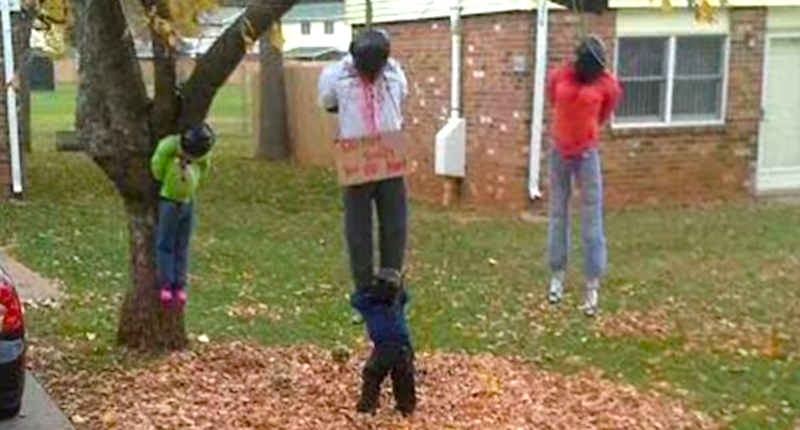
Halloween display at Fort Campbell taken down after complaints. Contributed photo from clarksvillenow.com.
By Casey Bukro
Lynching is no joking matter in the United States. News manager Robert Selkow found himself in the middle of a controversy over a Halloween display featuring three figures hanging from a tree.
“I got a photo on a smartphone,” recalled Selkow, who is site manager and news director of clarksvillenow.com, an online hyperlocal website affiliated with six radio stations serving Middle Tennessee and southern Kentucky. “It looked like a scene out of (the movie) ‘Mississippi Burning,’ black figures being hanged.”
He said it turned out to be “the most powerful image we ever published.”
Selkow contacted Ethics AdviceLine for Journalists in facing this sensitive issue, and agreed to discuss details of the case publicly.
The offensive Halloween display was in the residential area of the Fort Campbell military base on the Kentucky-Tennessee border near Clarksville.
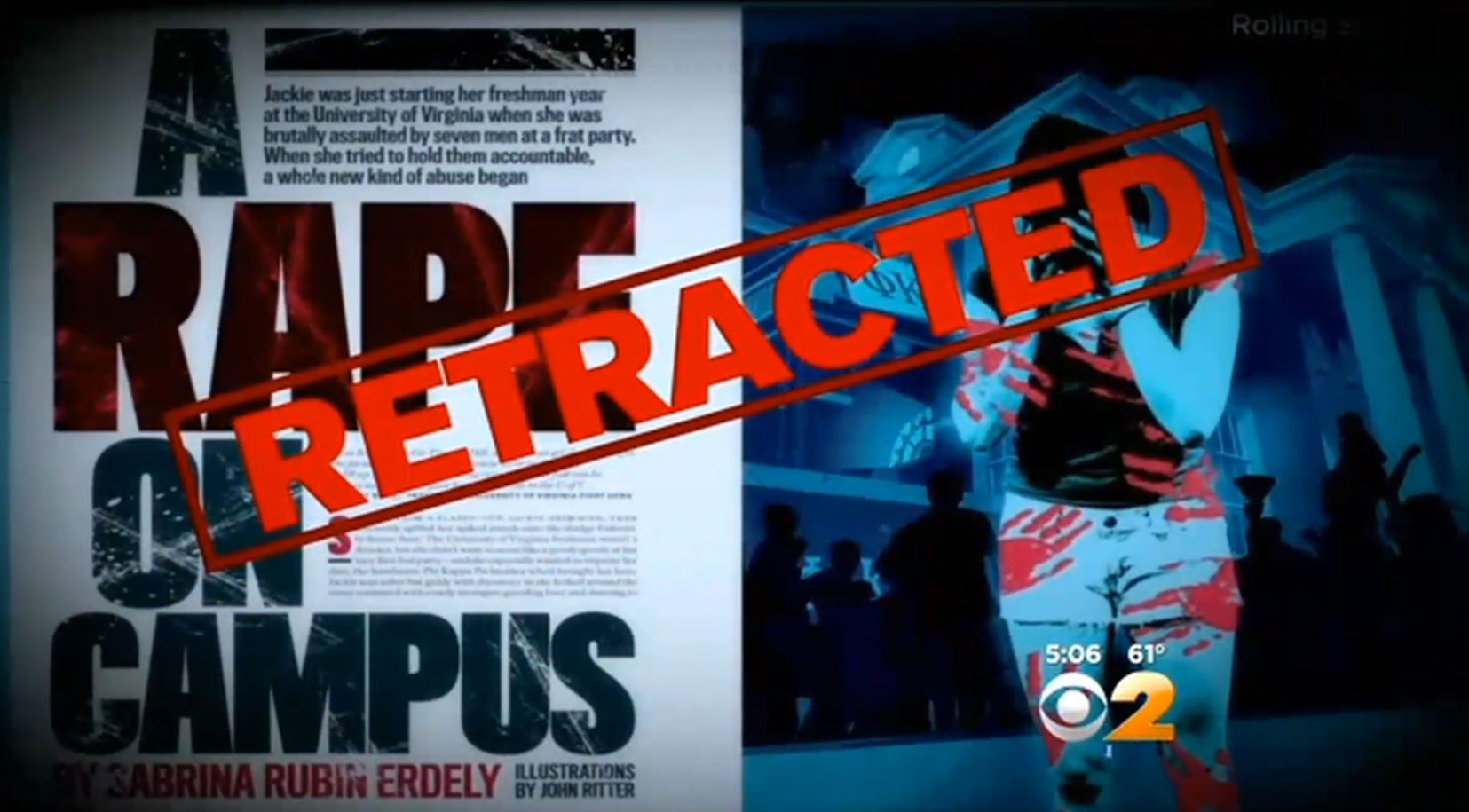
Rolling Stone retracted its 2014 article about an alleged campus rape. (Media Matters for America illustration)
By Casey Bukro
A ban on naming sexual assault victims has been one of the ironclad ethics rules in journalism. Why inflict more pain on an innocent person?
The Society of Professional Journalists code of ethics says: “Be cautious about identifying juvenile suspects or victims of sex crimes.”
Yet even this rule is coming into question as people decide what rules they want to follow.
For example, Stephen J.A. Ward, a media ethicist, points to the trial of Jian Ghomeshi, a former Canadian Broadcasting Co. radio host. Ghomeshi is charged with sexual misconduct involving three women in 2002 and 2003.
One woman insists on being identified. The others’ identities are protected under Canadian law.
“So what should newsrooms do if the complainant insists on being identified?” asks Ward. “It’s a complex legal and ethical decision.”
Ward described how identity bans work under Canadian law. But two trends complicate the issue.
“One trend is the growth of media beyond the mainstream journalism that was the original focus of the ban,” he writes. “Social media, bloggers and others may ignore the ban. The second trend is that some people want to be named” and “may use social media to identify themselves as a complainant.”
Once the name is ‘out there’ in the media world, it’s very difficult to erase.
One of the central rules in journalism ethics is minimizing harm. Ward reasons that this means explaining consequences, to make sure complainants give informed consent to the use of their names.
The problem prompted the Canadian Association of Journalists ethics committee to release guidelines. The committee suggests journalists take specific steps to ensure informed consent:
A journalist should explain that, once a complainant’s name is made public, other media likely will use the name too.
A journalist should explain that that the name likely will be used on social media, over which the journalist has no control. Individuals on Facebook, Reddit or other social sites will post comments. Some of them “can be vile.”
A journalist should explain that, once the name is “out there” in the media world, it’s very difficult to erase.
A journalist should not pressure complainants to make their names public.
A journalist should explain that, given the nature of search engines, the sex crime report might be the first thing that appears when someone does an Internet search of the complainant’s name. Has the complainant thought about the information being available indefinitely when applying for jobs, entering into relationships or having a family?
The guidelines report also advises journalists to give complainants a day or two to think about their decisions before making their identities public.
“Taking that time up front will almost certainly reduce the likelihood of ‘source remorse’ and the possibility of an unpublishing request later.”
The CAJ report also reminds journalists that they are obligated to tell the whole story, not just the complainant’s viewpoint. The 2014 Rolling Stone magazine story about an alleged campus rape turned out to be bogus because it was based on the allegations of one person. Sex crimes often involve conflicting viewpoints.
The Canadian ethics panel suggested, as an alternative to an “all-or-nothing approach,” considering refusing to share a story through social media channels, not archiving stories that name victims or removing names from a story. But these actions could raise more ethics concerns.
The Bill Cosby case is an example of the complications in alleged sex crimes. Controversy can simmer for decades. Journalists and authorities have been accused of protecting the popular entertainer. Some women kept silent in the belief nobody would believe them. Years later, some identified themselves as women who were allegedly drugged and sexually assaulted.
Years ago, sexual assault was a crime that people hesitated to talk about under social norms. That has changed. Television and the online media discuss and show sexual situations openly. It’s the new norm.
Still, it’s a good idea for journalists to keep in mind the golden rule: Minimize harm.
Normally, AdviceLine considers the Society of Professional Journalists’ code of ethics its highest source for guidelines and standards on ethics.
But we’re always willing to be open-minded about new and thoughtful ways to think about ethics and do the right thing in journalism.
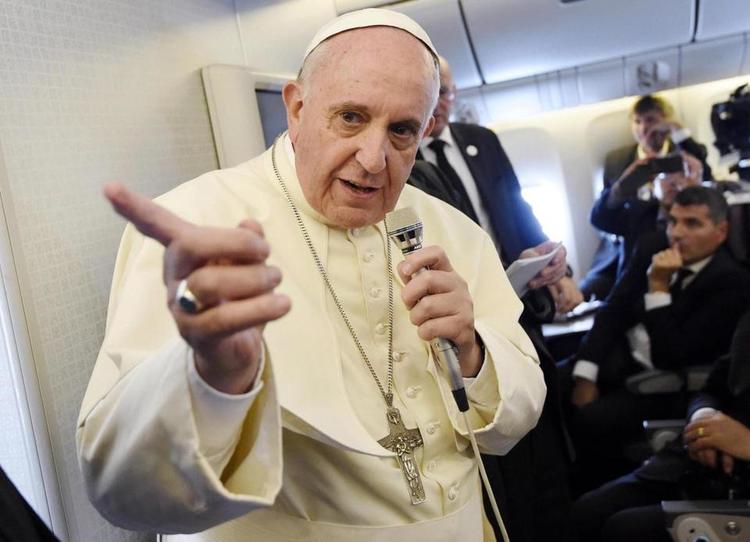
Take Pope Francis for example. The pontiff is unusually frank and quotable on his world tours, accompanied by media aboard the papal airliner. He gets involved in current and political issues that some popes might have shunned as too earthly, too secular.
On his way back to Rome from a six-day visit to Mexico, where he is known as Francisco, the pope weighed in on comments by Donald Trump, the Republican presidential hopeful. In a midair press conference, Reuters’ Phil Pullella asked for a response to Trump’s claim that the pope was a pawn in Mexico’s migration politics – an apparent reference to Trump comments on the pope’s trip airing on Fox Business. Pullella noted the candidate’s call to wall off the U.S.-Mexico border.
A transcript indicates the pope did not address Trump’s comments directly, but said that “a person who thinks only about building walls, wherever they may be, and not building bridges, is not Christian.”
Trump said the pope heard only one side of the story. In later comments, the pope clarified: “I say only that this man is not Christian if he has said things like that. We must see if he said things in that way and in this I give the benefit of the doubt.”
So now we have an ethical conundrum. If he is not sure what Trump said, and gives Trump the benefit of the doubt, are media free to tie the “not Christian” remark to Trump? Media reports on the event tend to say the link to Trump is stronger than the pope himself will admit. Trump has vowed to force Mexico to build a wall and increase deportations.
That night, on the PBS News Hour, John Allen, a Boston Globe reporter who covered the event, said it is possible that the pope does not know who Trump is, and was taking the word of reporters that Trump made the remark. Essentially, reporters coached the pope.
Moderator Judy Woodruff rightly pointed out that other politicians have asked for border walls, not just Trump. So was this a media-created conflict?
What should an ethical reporter do?
The answer might lie in the pope’s own comments during another in-flight press conference, when he touched on journalism ethics.
In the wake of the so-called Vatileaks scandal, in which the mainstream press reported on corruption in the Vatican, the pope was asked about his opinion of the importance of a free press in rooting out corruption.
“The professional press must tell everything, without falling into the three most common sins,” the pope responded. The sins he named were:
Misinformation – telling half the truth.
Calumny – dirtying another person, with or without the truth.
Defamation – to take away the good name of a person who has not done anything wrong.
“These are the three defects that are an attack against the professionally of the press,” the pope said. “We need professionally, what’s right. … And on corruption? To see the data well and say it. … If there is corruption, they should say it. And if a journalist, if they are truly professional, gets it wrong, he should excuse himself. Things go very well like this.”
Writer Terry Mattingly, reporting on that in-flight press conference, wrote: “To be honest, I think it would have been interesting to ask the pope to define the line that he sees between ‘calumny’ and ‘defamation.'”
Possibly all three “defects” apply in Trump case, since the controversy appears to stem from information fed to the pope, rather than from his own knowledge. This is a nuance that was not explained in many reports on the incident, although John Allen clarified that in his PBS News Hour appearance. And it could be argued that the pope was telling one side of the story.
The controversy did cast a shadow on the character of a political candidate, intended or not.
In the rough and tumble of American politics, even a pope may be dragged into the fray. It’s possible he was duped into commenting on something he was not familiar. Even a pope should be wary during election time in America.
The SPJ code of ethics says: “Take special care not to misrepresent or oversimplify in promoting, previewing or summarizing a story.”
Pitting the pope against Trump might have been a misrepresentation or oversimplification. How would you have handled the story?
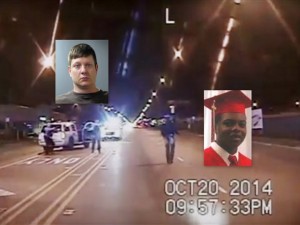
Chicago Police Officer Jason Van Dyke shot 17-year-old Laquan McDonald 16 times, and every second of that fatal shooting was recorded by a police car dashboard camera in the middle of a Chicago street.
That video has been broadcast countless times, showing every twitch of the body and what appear to be puffs rising from McDonald’s body as bullets strike.
Chicago police officer Jason Van Dyke and Laquan McDonald.
It’s gruesome, but it shows exactly what happened. The video is compelling evidence to disprove early police accounts that McDonald, who was black, was walking toward police with a knife in his hand and menacing police.
The video indicates that McDonald was walking away from police when Van Dyke, who is white, opened fire with a barrage that caused McDonald to twirl around, drop on his backside and roll to his right. Van Dyke kept shooting as McDonald lay in the street Oct. 20, 2014.
An autopsy confirmed that McDonald was shot 16 times. Van Dyke was indicted on six counts of first-degree murder and one count of official misconduct.
Police misconduct in shooting deaths in the United States is a major story propelled by television, a visual medium.
The use of phone video or dashboard cameras are recent developments that make it possible to show what happened, rather than rely on police or witness accounts. Technology is playing a bigger role in proving guilt or innocence.
But how many times is it necessary to show McDonald striding toward police, then falling to the ground as Van Dyke shoots him? Sometimes the whole scene is broadcast, sometimes it is edited so that it shows McDonald walking toward police.
Since all the Ethics AdviceLine for Journalists consultants teach on campuses across the country, it seemed logical to ask them how they and their students reacted to events that played out at the University of Missouri over press freedoms and protests over racial tensions.
An earlier AdviceLine blog post focused on what appeared to be an attack on First Amendment press freedoms when faculty member Melissa Click attempted to banish two student photographers from the protest scene, for which she later apologized.
Hugh Miller, assistant professor of philosophy at Loyola University Chicago, took what he called a contrarian view.
“I disagree,” said Miller, citing a lawyer friend who pointed out that the First Amendment of the U.S. Constitution “is a restriction imposed upon the state, not upon individuals…. It imposes no restrictions on individuals.
“Reporters are perfectly free to jam a microphone in my face – no government authority can prevent them from doing so. And I am perfectly free to tell such reporters to get stuffed if I don’t want to talk or have them around. In so doing I do not violate the First Amendment. The First Amendment is not, IMHO [in my humble opinion], a license for journalists to demand, and get, access to coverage.
“Whether the contested access is on public property makes little difference to the First Amendment issue (though it may be important in a property rights sense). Nor does the First Amendment impose duties or obligations upon individuals to afford journalists the opportunity to cover them.
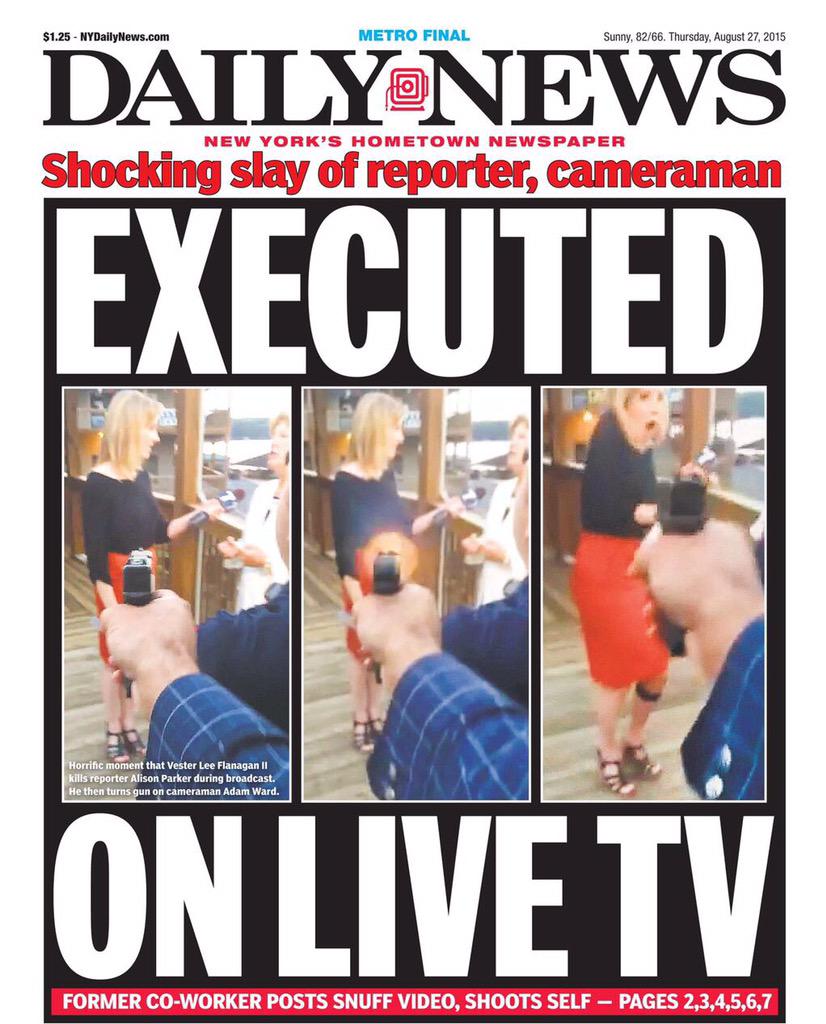
Killing the messenger takes new meaning when you see it live, in living color, as happened in the deaths of a Virginia television news reporter and her cameraman.
WDBJ correspondent Alison Parker was conducting an on-air interview in a Moneta, Va., shopping center when she and the photographer, Adam Ward, were shot and killed by a disgruntled former colleague who also videotaped the attack and put it on social media.
The New York Daily News gave the murders front-page display, in very graphic detail than some TV outlets shunned.
Killings on video are increasingly common these days. Journalists are among those targeted now, becoming victims and not just reporters of events. Parker and Ward’s names are now added to a list that included James Foley and Daniel Pearl.
Tech-savvy killers use social media and the internet these days to show their crimes.
The Islamic State group released a video in 2014 showing Foley, clad in an orange gown, kneeling on the ground next to a man dressed in black holding a knife. Foley makes a short statement and then is decapitated.
In 2002, Pearl, a correspondent for The Wall Street Journal, disappeared while on assignment in Karachi, Pakistan. Video shown around the world via the Internet showed Arab extremists cutting his throat, then decapitating the reporter.
In this world of social media, terrorists don’t need reporters to tell their message. Terrorists can do that themselves now, and one way of doing that is killing reporters.
Charlie Hebdo, the French satire newspaper, published a cartoon of a drowned 3-year-old boy and showed why codes of ethics should warn against satirical cruelty.
Satire can be cruel, inspiring or infuriating. Maybe all at once. But are there limits to this form of freedom of expression?
Charlie Hebdo clearly touched a nerve by joking about the boy lying facedown in the surf of a Turkish beach, after drowning with his mother and a brother while attempting to flee war-torn Syria, becoming a stark symbol of Europe’s growing migrant crisis.
The cartoon was based on photos of the boy, first described as Aylan Kurdi and corrected later as Alan Kurdi.
“The haunting photograph of 3-year-old Aylan Kurdi, the Syrian boy whose lifeless body washed up on a Turkish beach last week, has been inescapable; even if you’ve just seen it once, it’s an image you can’t forget,” wrote Carolyn O’Hara, managing editor of The Week magazine.
O’Hara compared it with other grim photos of the past that forced the world to confront some tragic realities, such as the the 1972 photo of a naked Vietnamese girl screaming in agony from napalm burns, the 1993 image of a vulture stalking a starving Sudanese toddler and the hooded Abu Ghraib prisoner with outstretched arms.
It could be argued that these images served a greater purpose. Can the same be said about Charlie Hebdo?





 Ethics AdviceLine for Journalists