Category Archives: Online News

Ombudsman Target of Sex Abuse Probe

Ombudsman is target of sex abuse probe: Alan Stamm reports that Jack Lessenberry, ombudsman at The Blade in Toledo, is under investigation for alleged misbehavior at a Memphis newspaper and at Wayne State University, where he taught.

Lessenberry has called sexual harassment “a national buzzword” and “the current crime the nation is fixated on.”


How The Internet Found Its Voice

How the internet found its voice: Lyz Lenz analyzes the rise of internet writing.

“It comes as no surprise that finding and creating a cohesive understanding of internet writing is just as dubious, problematic and maddening as the internet itself,” she writes.

“The internet, with its irreverence and short attention span, is a perfect vehicle for crassly delightful send-up humor.”


Guarding Against Deepfakes

Guarding against deepfakes: Nicholas Diakopoulos writes that a media synthesis algorithm generates convincing but fake video.

“Dire as the case may be, it could offer a great comeback opportunity for mainstream media,” writes Diakopoulos. Trained journalists can act as validators and assessors of mediated reality the public can trust.


Facebook Trust Guidelines

Facebook guide to what to read, trust and share in News Feed:

Based on research, “we’re making it easy for people to view context about an article, including the publisher’s Wikipedia entry, related articles on the same topic, information about how many times the article has been shared on Facebook, where it has been shared, as well as an option to follow the publisher’s page,” write Taylor Hughes, Jeff Smith and Alex Leavitt.

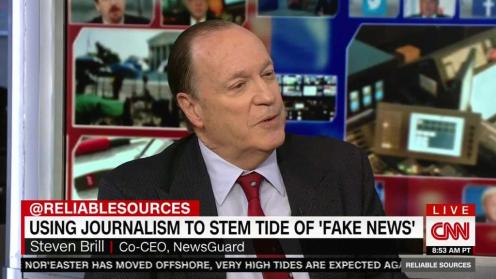
NewsGuard Fights Fake News


By Casey Bukro

NewsGuard Technologies is recruiting veteran journalists to fight fake news by color-coding 7,500 news and information websites and video channels in the United States green, yellow and red.

A red rating goes to purveyors of consistently and intentionally false information or propaganda.

Now in the process of recruiting and training qualified journalists to be NewsGuard analysts, the enterprise, based in New York and Chicago, will begin operating in time for the mid-term elections in November.

The 7,500 news sources targeted account for 98 percent of the news articles read and shared in the English language online in the United States. After launching in the U.S., NewsGuard will expand to serve billions of people globally who get news online.

“Our goal is to help solve this (fake news) problem now by using human beings – trained, experienced journalists – who will operate under a transparent, accountable process to apply basic common sense to a growing scourge that clearly cannot be solved by algorithms,” said co-founder Steven Brill, longtime journalist and media entrepreneur.

The founders raised $6 million to launch NewsGuard.

In addition to color-coding websites or online publications, NewsGuard plans to issue Nutrition Labels that will explain the history of the site, what it attempts to cover, who owns it and who edits it. The labels also will reveal financing, notable awards or mistakes, whether the publisher upholds transparency standards or repeatedly is found at fault.

Two NewsGuard analysts will independently review and rate each site or online publication. One will draft the Nutrition Label and the other will edit it. The public can access these reviews to see why publishers got the green, yellow or red ratings.

Any disagreement between the two analysts is resolved by NewGuard’s senior editorial officers, including Brill, cofounder Gordon Crovitz, former Wall Street Journal publisher, James Warren, former Chicago Tribune managing editor and Eric Effron, former Legal Times editor and publisher.

Warren is NewsGuard’s executive editor and Effron is managing editor.

The lead investor in NewsGuard, among 18 investors, is Publicis Groupe, based in Paris. It is a French multinational advertising and public relations company, and the oldest and one of the largest marketing and communications companies in the world, by revenue.
Embedding And Linking Challenged

Embedding and linking challenged: Eriq Gardner says a judge’s surprising decision on the use of a Tom Brady photo could disrupt the way news outlets use Twitter.

“Many of these cases involved some application of the so-called ‘server test,’ where the direct liability of a website publisher for copyright infringement turns on whether the image is hosted on the publisher’s own server or is embedded or linked from a third party server,” he writes.

Is Buying Twitter Followers Unethical?

Is buying Twitter followers unethical?

News organizations rarely confronted that question before, writes Paul Fahi. The New York Times found the practice is widespread, and the Chicago Sun-Times suspended its movie critic for padding his follower count.

A critic says a falsified follower count is like a newspaper inflating its circulation figures.