Category Archives: Accuracy

Rape, Cosby and UVA

A story in Rolling Stone featured the alleged gang rape of a University of Virginia student, launching calls for reform and more attention to the issue of sexual assaults on campus. Recent reporting by the Washington Post, however, has raised doubts about the veracity of the story.
Fraternity house named in alleged rapes (Ryan M. Kelly, The Daily Progress/AP file)

How aggressively did journalists pursue the facts?

By Casey Bukro

Rape became big news with allegations against Comedian Bill Cosby and an explosive Rolling Stone story describing a gang rape of a co-ed at a fraternity house on the University of Virginia campus, for which editors later apologized for “discrepancies.”

Both rape stories raised questions about how journalism works in America and whether it can be trusted.

Where were the editors while these stories were being covered? Tough editors ask tough questions, and demand answers from their own reporters about how they got the story and whether it’s supported by hard investigation.

Media are accused of failing to dig into serial rape accusations over decades against Cosby, who was seen as a popular father figure as he was portrayed on his television show.

About 20 women have accused Cosby of drugging them, and often raping them. But he has not answered to what he calls “innuendos.” Some of the accusers have been challenged. Cosby’s most recent comment is that his wife is dealing well with the controversy.

Pushing back, Cosby’s lawyer accuses a reporter of deception, and his wife, Camille, contends the media failed to take a close look at her husband’s accusers.

The Rolling Stone gang rape story by Sabrina Rubin Erdely is based on a single source, a woman identified only as “Jackie,” who claimed she was lured to a 2012 fraternity party by a man named “Drew,” and raped by seven men. The Washington Post described the story.

Good reporting usually involves getting all sides of the story. Erdely admitted that she made a deal with Jackie that no attempt would be made to find and interview anyone else involved in the alleged rape, or knew about it.  And her editors allowed her to get away with a violation of a basic tenet of good reporting – getting multiple sources to verify the accuracy of the story

The editors allowed this unusual dispensation from careful reporting because the story was “sensitive.” Yes, rape is a sensitive issue, but not a reason to suspend professional standards in reporting. Sensitive stories require more careful reporting, not less.

The Society of Professional Journalists code of ethics urges caution in reporting sex crimes.

The story was widely reported and put a spotlight on campus rape. Then came questions about its accuracy. The accused fraternity had no party on the night the rape allegedly happened, and issued a statement saying that sexual assault was not “part of our pledging or initiation process.” It appeared to be fabricated and continues to be called into question from many sources.

Media followed the story as a lesson in journalism and ethics. A defamation suit against Rolling Stone is a possibility.

Rolling Stone’s managing editor, Will Dana, issued a statement:  “In the face of new information, there now appear to be discrepancies in Jackie’s account, and we have come to the conclusion that our trust in her was misplaced.”

Other media noticed the discrepancies. Pittsburgh Post-Gazette Columnist Jack Kelly calls the story “an unforgivable breach of journalism ethics” and thinks the fraternity house should sue Erdely and Rolling Stone for libel.

Rolling Stone editors believed Jackie was credible, according to Leslie Loftis in the Columbia Journalism Review,  because of a bias – a willingness to believe Jackie because “everyone knows that there is an epidemic of rape on campuses around the country….”

It’s what you know, or want to believe, that can set a trap.

The editors at the Washington Post wanted to believe one of their bright and upcoming reporters, Janet Cooke. She wrote “Jimmy’s World,” a story about an 8-year-old heroin addict in a family of addicts. Narcotics addiction was a big issue in 1980.

That story was so good, it won a Pulitzer Prize in 1981.

Then came the questions. A Washington Post editor asked Cooke to get in a car and go with him to identify where Jimmy lived. They drove around and could find no Jimmy. Cooke eventually admitted she invented Jimmy.

Cooke said the Post’s high-pressure newsroom corrupted her judgement. She said she had heard about somebody like Jimmy. She decided to write the story, based on anonymous sources, to satisfy her editors, she said.

The Post’s ombudsman wrote a long critique on the “Jimmy’s World” story, and found that the editors bore heavy responsibility, adding that “everybody who touched this journalistic felony was wrong.”

Good editors are supposed to do the hard work of keeping stories honest.

“Don’t tell me what you think, chum. Tell me what you know!” said a fabled, crusty editor at the former City News Bureau of Chicago, once called the Devils Island of Journalism. He grilled his reporters as vigorously as he expected his reporters to grill their sources.

3 Ethical Pressure Points for Journalists on Twitter

Twitter shades of gray

Shades of gray: Rumor, intent and context in reporting on social media

By David Craig

This post is a condensed version of an article I wrote on the website Mediamorals.org.

For many journalists and news organizations, Twitter has shifted in a few years from being an oddity and add-on to a key tool for gathering and reporting news.

The thinking about ethics and best practices in journalistic use of Twitter has sharpened and evolved since the platform’s early days. But the ethical challenges persist, and the boundaries of best practices are difficult to nail down. Here, I will look at three continuing ethical pressure points for journalists using Twitter.

Handling unverified information

The continuous flow and immediate spread of information on social networks make this part of journalists’ work, which has always been challenging, more difficult. The consequences of incorrect information – whether about individuals, companies or governments – can be devastating and global. And with journalists occupying only a small space in the larger network of information flow, the pressure to pass on and amplify information prematurely becomes much greater.

My interactions with journalists, tracking of Twitter discussion, and reading suggest that journalists’ understanding of best practices with unverified information sits on a continuum from not tweeting until verified to acknowledging on Twitter while simultaneously checking. (For contrasting perspectives, see this AdviceLine post.)

The notion of reporting information in the process of being verified is in line with what City University of New York journalism professor and blogger Jeff Jarvis calls “process journalism,” which emphasizes being transparent about what one does and does not know, rather than waiting for a final finished product – which he argues is never perfect itself. I think the key challenge with this approach – and the lingering question for journalists – is how to be transparent in the midst of the larger network flow while maintaining truthfulness and minimizing harm.

What is the proper balance among these principles? Transparency alone doesn’t guarantee truthful information. Focus on minimizing harm alone can keep reports out of the public eye, even though members of the public might be able to help corroborate or dismiss them in an open network. Paying attention to the importance of the truth that is being reported alongside the extent of the harm that may result – a common balance in journalism ethics – helps in sorting out whether to transparently acknowledge unverified information on Twitter.

Beyond this, it’s important to use all available resources to verify content. As BBC News social media editor Chris Hamilton has told me, that means making the most of both technical tools such as Google Earth and reverse-image searches to check content shared through tweets and other means. But it also means using critical thinking to look for evidence of falsity and ask questions of human sources.

Navigating boundaries between personal and professional identities

The dual and overlapping uses of social media for personal and professional purposes create ambiguity about the identity of journalists using Twitter and other social platforms. One can signal intentions to some extent with a Twitter profile listing professional affiliations alongside some personal information, but not everyone will see the profile or the larger context of the kinds of things being tweeted.

I don’t think it’s necessary or helpful to agonize over whether journalists should offer routine tidbits about their personal lives in the same feeds they use for their journalism. As some journalists argue, doing that just shows they are human like their audiences. This may serve to increase rather than diminish their credibility. The bigger issue becomes how to handle opinion, especially opinion associated with what one is writing about.

Kelly Fincham, a professor at Hofstra University on Long Island, New York, studied a number of major news organizations’ social media policies for a chapter in Ethics for Digital Journalists, a book I co-edited. She found that although there were “some small signs” that “opposition to transparency about viewpoints is weakening,” overall the guidelines still warn against stating opinions on social media.

In the guidelines she studied, Fincham found that there has been a substantial shift since early days, from the expectation of separate Twitter profiles for personal and professional activity to a consensus that journalists should have single accounts. But single accounts do leave open the possibility that different people coming from one’s personal or professional worlds will assume different things about the intent of the account holder.

There is no foolproof way to navigate the challenges that come from the ambiguity of professional versus personal on Twitter. In ethical terms it’s important to be transparent by signaling the scope of the social world represented by including both professional and personal elements in the profile, or only professional elements if the focus will really be limited to those.

Providing context and narrative structure

From my own use of Twitter, I have seen how difficult it is to include structure and context. The character length limit makes it challenging to provide context for the meaning and significance of individual words. Other challenges involve connecting multiple tweets in a coherent way, especially given that many people get thousands of tweets a day and move in and out of the platform. It’s almost guaranteed that some followers will miss some tweets. From an ethical standpoint, this means that the truth users take away from these messages is fragmented and often missing some of the intended pieces.

Journalists have had several years of Twitter use to gain experience looking for ways to provide context and a coherent narrative. Jonathan Hewett, in another chapter in Ethics for Digital Journalists, notes the simple approach of numbering each segment of a series of related comments, in ways such as “1/3,” “2/3,” etc. (if the number is known). Parallel wording can also help, as he noted in an example of multiple tweets introduced by “Survivor of boat sinking:” or, in subsequent tweets, simply “Survivor.” He said BBC journalist Dominic Casciani has been trying “signposting” of tweets – “alerting users at the start of the day to what he’ll be covering later, for example, or providing a reminder of key points to add context and/or to help those who have not been following the story.”

Twitter hashtags also can help to provide context by keeping related tweets connected with one another.

On a larger scale, Storify has enabled journalists and others to combine tweets and other social posts in a single document and, if desired, add explanatory sentences of introduction and connection. But the tweets can end up in different contexts than the originals did by being selected for inclusion when related tweets were not.

All of these approaches using Twitter and related tools provide means to meet the ethical goal of truth telling to the greatest extent possible within the format.


Cosby: When The Media Watchdogs Bark, Or Not


By Casey Bukro

The serial rape allegations against Comedian Bill Cosby have reached the stage where people are asking why the media failed to report them when they happened.

It’s complicated and messy, in part because Cosby denies the allegations and calls them “innuendos” from the distant past which he will not dignify with a response.

The public often blames the media for hounding celebrities, sometimes to the point of ruining their reputations. Other times, the media are accused of promoting popular celebrities to the point of being a cheering section.

Both true.

It could be argued that Cosby got the cheering section treatment for decades. But now that’s changing and causes observers to wonder if media watchdogs failed, professionally and ethically.

Especially troubling are media reports that, in exchange for an exclusive interview, Cosby made a deal with the National Enquirer to delay a story about a new rape accusation while the civil suit in another rape case was going on. That strikes to the heart of media responsibility to report the facts, and whether the media did that in Cosby’s case.

The Columbia Journalism Review  says the press is responsible for ignoring Cosby rape allegations, pointing out that People Magazine published an article in 2006 about five women who accused him of rape.

About 20 women have accused Cosby of assaults, most dating to the 1970s and 1980s.

From a wider perspective, rape is one of those issues where the media tend to reflect societal attitudes, which includes the issue of privacy for both public and private figures. And all of that is changing fast. Media always had a responsibility to lead public opinion, not just follow it.

Not so long ago reporters ignored the private peccadillos of powerful figures in the belief that what they did in private was their business, not the public’s. Their silence was called “a gentleman’s agreement.”

Think President John F. Kennedy and President Dwight D. Eisenhower.

Kennedy was a known cavorter, but the White House press corps ignored it, in part to stay in the president’s good graces.

Rumor had it that Eisenhower had an affair with his war-time chauffeur, Kay Summersby, who confirmed it in 1975 in a memoir titled “Past Forgetting: My Love Affair with Dwight D. Eisenhower,” before she died. The rumors stayed mostly under wraps until the memoir appeared.

But rape is far more complicated. In the past, police departments sometimes minimized it as a he said/she said sort of thing. Women were sometimes twice victimized by rape and then accused of bringing it upon themselves. Sometimes they were ashamed to talk about it, especially when alcohol was involved.

It is a topic coming out of the shadows as women are more inclined to talk about it, and the media more inclined to report on it partly as a result of that openness and changing social views. That comes at a time when other sensitive issues, such as gay rights and abortion, are discussed more openly.

The Cosby accusations  stretch over decades, enough time to show how differently the issue is treated, then and now.

The case against Cosby snowballed recently after supermodel Janice Dickinson publicly accused the entertainer of drugging then raping her in 1982 when she met with him, hoping he would help advance her career. Dickinson is one of about 20 women who tell similar stories, one of whom was 15 years old at the time.

Nostalgia is another time-related thing.

Entertainment is a fantasy, just as Cosby as Cliff Huxtable was a fantasy. But it was a fantasy that the public desperately wanted to believe, wrote Vox.com’s Amanda Taub. They wanted to keep happy childhood memories of the Cosby show.


Is Lack of Attribution Plagiarism?


Fareed Zakaria (Getty photo)

By Casey Bukro

Fareed Zakaria finds himself the target of anonymous bloggers who accuse him of plagiarism.

Zakaria says he is not a plagiarist, but media carrying his columns on international affairs — Newsweek, The Washington Post and Politico — have posted corrections or editor’s notes advising readers that Zakaria had not sufficiently attributed sources for material in some of his columns.

Now take a step back for a minute to ponder how the case underscores differences in the way journalism works now, compared with just a few years ago.

In the past, even a whiff of plagiarism was a firing offense. The hammer came down hard in most cases. Mike Barnicle was fired from the Boston Globe for plagiarism. Jayson Blair was booted from the New York Times for similar offenses, plagiarism and fabrication.

And some editors in the past would dismiss information from anonymous sources as lacking credibility unless identity and motivation were known.

In the Zakaria case, the sources are bloggers known only as BlippoBlappo and CrushingBort who consider themselves plagiarism watchdogs at Our Bad Media. They cited 50 examples of what they considered insufficient attribution in Zakaria’s columns. They describe themselves as two young men who are not journalists.

Zakaria also appears on CNN in a program focusing on international affairs. He is widely respected and seen or read on multiple platforms. And that’s part of the problem, say the anonymous plagiarism sleuths. They say Zakaria is treated with a deference that is not shown to minor league journalists. He continues to write columns for media that attached warnings to some of his past columns.

Maybe that makes what he did correctable or excusable. Another new slant on journalism as it is done today, when the focus is more on finance and new business models. And maybe some editors believe lack of attribution is not plagiarism.

The Columbia Journalism Review points out that “outcry within the journalistic community, meanwhile, has been unexpectedly mute, with many discussions focused on the semantic question of whether Zakaria’s mistakes constitute what some news organizations consider an unforgivable sin.”

Zakaria admitted to a “mistake” in 2012, but said that for the most part he uses information that is generally or widely known.

In tweaking its code of ethics, the Society of Professional Journalists this year added “always attribute” to a long-time admonition to “never plagiarize.”

National Public Radio’s Robert Siegel began a segment on Zakaria by pointing out that The Washington Post was the fifth news organization to say “that work it has published by Zakaria appears to have attribution problems.”

NPR media correspondent David Folkenflik said the anonymous bloggers argue that “he’s done so much lifting unattributed characterizations of other people’s reporting that it amounts to plagiarism.”

Folkenflik went on to say that other critics insist Zakaria “is getting away with stuff that others wouldn’t be allowed to do who are more junior, who don’t have the brand-name recognition that he does…”

Dylan Byers of Politico.Com also outlined the campaign waged by the anonymous “plagiarism detectives,” and reported that Zakaria, in an email to Politico, argued “that he simply cited the same facts as others, which did not constitute plagiarism.”

Others say it’s a troubling pattern.

Writer Lloyd Grove wondered if Zakaria can survive the firestorm.

CNN, however, said it stands by Zakaria.

Cited Out of Context: Reporting Data With Integrity

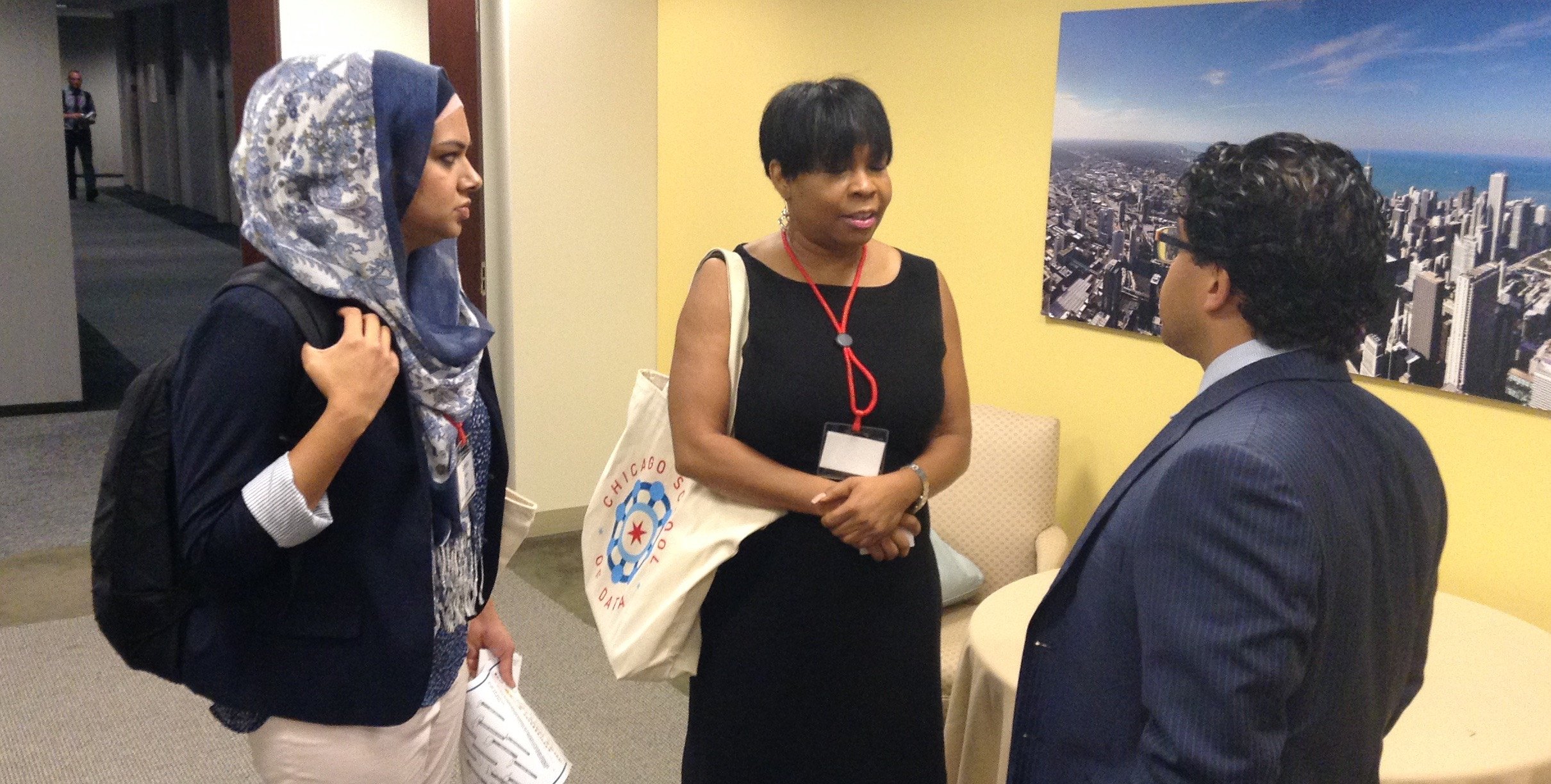
 Samia Malik (left) compares notes with technologists at the Chicago School of Data conference.

Samia Malik (left) compares notes with technologists at the Chicago School of Data conference.

A Medicare database, second-hand stats and social-science findings shed light on how to handle data with care.

By Stephen Rynkiewicz

Journalists look for reassurance in data, as a way to validate what their sources tell them. Scientists aren’t so sure – they joke about “data” being the plural of “anecdote.” Two sources are better than one, except when they’re both wrong.

“You can really jump to the wrong conclusions if you don’t have an understanding of the background of the data,” says Matthew Roberts, informatics manager for Chicago’s health department.

Researchers make a familiar complaint about their data: Getting quoted out of context. The issue’s playing out in a Medicare database of payments doctors took from medical suppliers. Both groups found errors in the data, and payments on research in progress were withheld.

Before the site launched, Roberts told the Chicago School of Data conference that news media inspecting the raw data were among the first to jump to conclusions.

“They just made some wrong guesses about what the data meant,” he said. The final Medicare database gives companies a chance to comment — to give details that could suggest a productive partnership rather than a conflict of interest.

Continue reading Cited Out of Context: Reporting Data With Integrity

Three Ethics Takeaways From ONA Conference

Alberto Cairo
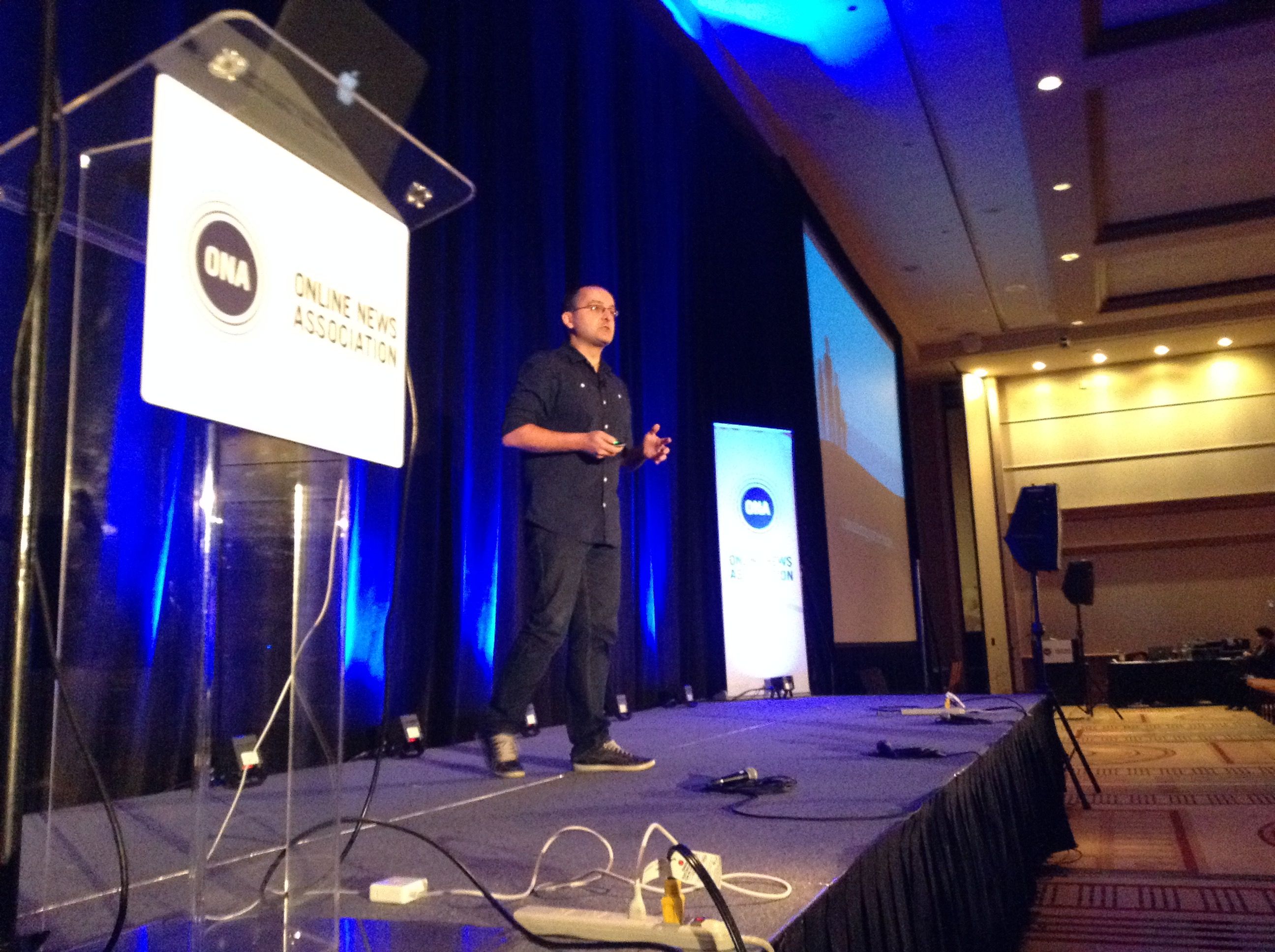
Alberto Cairo of the University of Miami says ethics have not kept pace with data visualization techniques. (Stephen Rynkiewicz photo)

By David Craig

The Online News Association annual conference, which I attended September 24-27 in Chicago, always provides great updates on trends and issues in digital journalism. But it’s also a great place to hear about ethical challenges, both new and continuing.

Ethical issues were the focus of three sessions, including a challenge session in which audience members had to react quickly to ethical scenarios on topics such as use of user-generated content. But ethics also came up in sessions that were primarily about other topics.

Here are three ethics takeaways from the conference:

1. Content that disappears will create new ethical challenges. Amy Webb, founder of Webbmedia Group, delivered her annual talk on “10 Tech Trends for Journalists.” One of them was “ephemeral content,” an increasingly popular kind of social media communication.

Webb said Snapchat, an app developed to share photos that’s popular with young people, provided a way to send private content that users might not want to stay around, but “it’s also a way to clear up our cluttered social streams.” She said other companies are providing messaging services with content that disappears, appears anonymously or is even encrypted. She predicted that most messaging apps will have some kind of means of making content ephemeral in the next 24 months.

Ephemeral content is relevant to journalism because some news organizations including The Washington Post are experimenting with it. But Webb pointed to an ethical difficulty: “Ephemeral content can be used for publishing news. But it can’t be corrected, because no record is left.”

This kind of communication raises questions of accountability for the accuracy of content because once it’s gone, there’s no way to amend a false message or even verify what the message said.

“Talk internally about the implications,” Webb suggested to news organizations.

Even for journalists who don’t use this kind of content, the discussion points to ongoing questions about what it means to ethically handle incorrect content in social media messages.

2. Algorithms shape the truth that people learn about the world and point to new ethical obligations for journalists. Kelly McBride, vice president for academic programs at the Poynter Institute for Media Studies, and Nick Diakopoulos, a journalism professor at the University of Maryland and an expert in computational journalism, presented a session titled “Algorithms are the New Gatekeepers.”

McBride said algorithms, because they shape how news is distributed and to whom, have a powerful influence on what gets attention in the marketplace of ideas. As one of the presentation slides showed, they also affect a huge number of other areas of life including search rankings, online recommendations, advertising and relationships.

Diakopoulos talked about the power of algorithms in influencing the information we receive because of their ability to prioritize, classify, associate and filter it. He argued that the power they carry suggests new responsibilities – and opportunities – for journalists in reporting because they can help hold algorithms accountable. Stories might address issues including discrimination, mistakes that deny service, censorship, illegal activity or false predictions.

This kind of reporting isn’t easy. He pointed to several possible approaches to “auditing” algorithms – reviews of computer code, surveys of users about their experience, analysis of input and output, having users report data and (with ethical problems he acknowledged) impersonating users with programs.

Despite the difficulties, the social and economic impact of algorithms make it important for journalists to try new ways of reporting.

3. The power and availability of data visualization tools call for increasing attention to the ethics of visualization messages. Alberto Cairo, a professor at the University of Miami who teaches on informational graphics and data visualization, gave a session called “The Journalist, the Artist and the Engineer: The Ethics of Data Visualization.”

Cairo argued that the core goal of journalism ethics is to improve the public’s understanding of issues “relevant for their conducting good lives” while minimizing any potential harm. He said tools to create interactive charts, maps and other informational graphics are becoming more popular and widely available but that ethics is not keeping pace. He said that helping the public understand what good, ethical visualizations look like can help to better society and avoid the impact of misleading messages.

Even though great data visualizations are beautiful as well as functional, Cairo said, they must hold to a high standard of truthfulness that doesn’t oversimplify or distort the information being represented. Using the example of a graphic from the National Cable Television Association, he talked about going from showing things that are true but may leave out important information to showing a picture that’s more complicated but also truer and more accurate.

Cairo urged the audience not to hide complexity from the public or point to patterns that really aren’t there. In doing so, he is rightly pointing to a standard of care in visualization that is as high as the standards used in good investigative writing.

Plagiarism: A Renaissance for Attribution

he Young St. John the Baptist
Piero di Cosimo, “Young St. John the Baptist” (Metropolitan Museum of Art)

When New York Times critic Carol Vogel previewed an artist’s retrospective, readers were quick to question her report.

By Stephen Rynkiewicz

Renaissance artists might have struggled with the idea of plagiarism. Florentine salons respected tradition and uniformity, and apprentices in Piero di Cosimo’s studio learned by imitating the master. National Gallery of Art curator Gretchen Hirschauer told New York Times critic Carol Vogel that Piero’s work entered American collections partly by accident. It was attributed to other artists.

But the concept of plagiarism has evolved. When Vogel previewed Hirschauer’s retrospective of Piero’s work, a few readers were quick to question her report. It started with a list of Piero’s peculiarities, citing contemporary Giorgio Vasari, who’s still studied in paperback. But the wording was close to an even more common source, Wikipedia. The print passage is shortened online, and ombudsman Margaret Sullivan suggests Times editors might take further steps if a pattern emerges.

The word plagiarism first appears during the Reformation. The Random House Dictionary defines it as “to use the words or ideas of another person as if they were your own words or ideas.” Universities have moved beyond the Renaissance academy, with rules against copying and paraphrasing. The Society of Professional Journalists ethics code simply says, “Never plagiarize.

Yet the practice continues. Evidence of plagiarism in Sen. John Walsh’s Army War College research puts him under pressure to withdraw from the November election. Repeated instances on the website BuzzFeed got a producer fired last month. And delegates to SPJ’s 2014 convention will consider adding another ethics directive: “Always attribute.

Continue reading Plagiarism: A Renaissance for Attribution

Anon Again


By Casey Bukro

Anonymous sources — used by media and by government officials — came up again in a New York Daily News piece by James Warren.

Warren used a press briefing by Josh Earnest, the new White House press secretary, to illustrate how Earnest and a reporter dueled, trading accusations of withholding sources. Back and forth they went, parry and thrust.

Warren also comments on the value of White House news briefings, and whether they actually produce news.

“It has been a fairly informative ritual at times evolved (perhaps partly as a result of the cameras) into an hour or so of premeditated evasions by the spokesman; a bit too much prosecutorial posturing by some of the reporters; and, ultimately, rhetorical stand-offs in which there’s little advancement in public understanding of important matters.

Actually, Warren noted, if a White House reporter’s annual salary depended on legitimate stories produced by the briefings, he’d “be eligible for unemployment compensation.”

But the bulk of Warren’s story deals with the give-and-take between Earnest and a reporter, who was asking for more on-the-record sources from the White House. That would depend, said Earnest, on a case-by-case evaluation and ground rules “that will serve your interests and the White House interest the best.”

Warren called the “spitball fight” hypocritical.

“The Washington media, like media at other levels of journalism, is often involved in a mutual self-protection racket with the people we cover,” he wrote. “It can be at the White House, City Hall in Chicago or a county board in Texas. The dynamic is roughly similar. Too many reporters are manipulated with scarcely a qualm.”

About.Com Media describes the dangers of using anonymous news sources and offers five questions to ask yourself before trusting anonymous sources.

The site points out that inexperienced reporters might believe that using anonymous sources “make news stories sound more important,” but the practice presents “many ethical and legal dangers.”

Taking a Devil’s Advocate approach, New York News & Politics explored whether the Watergate investigation leading to President Nixon’s resignation could have been possible without  W. Mark Felt, later identified as the “Deep Throat” confidential informant.

The story touches on the working habits of Seymour Hersh and Jayson Blair, with comments from Bob Woodward.

“Journalism exists to get us closer to all sorts of truth, and anonymous sources are essential to the endeavor,” concludes the author, Kurt Andersen. “Even now, they provide more social benefit than they (exact) in moral costs.”


Vanishing Facts, Finding Truth


By Casey Bukro

Looks like this new generation of online and social media writers don’t care much about fact-checking, favoring speed over accuracy.

Though that might be obvious from reading  the internet, a survey by the Dutch company ING seems to prove the point.

It found that only 20 percent of international journalists questioned bothered to check their facts before publishing.

Forty-five percent of them “publish as soon as possible and correct later,” according to the report.

This is further proof of online journalism’s faith in the self-correcting nature of the internet. Report it fast and report it first, they say. Corrections can come later.

This is a far cry from that old-school Chicago journalism motto: If your mother says she loves you, check it out. It was the ultimate in fact-checking, applied to anything and everything. The rule was to get it right the first time.

More in keeping with a different sort of saying: Never let the facts get in the way of a good story.

Another ING survey finding: Sixty percent of the international journalists said they felt less constrained by journalism standards when reporting in social media. Though they expressed low regard for the accuracy of social media, 50 percent said much of their news tips and information come from social media.

They agree social media is an informational trash bin, but dipping into that bin is addictive.

Angela Wascheck in “10,000 words” described the ING survey.

The ING report comes on the heels of a Columbia Journalism Review story on the values of modern-day newsrooms, entitled “Who Cares If It’s True?”

“In the newsrooms of this moment, with growing agreement that audiences want information that is true, journalists are coming together around the same basic questions: When is information sufficiently baked to be served up as accurate? Who decides? Should there be rules, or just ideals? Is it enough merely to try to be right eventually?”

The author, Marc Fisher, traces the shoot-from-the-hip history of some digital newsrooms, their differences with old-school journalism, and the growing recognition of the value of accuracy and credibility — even in social media.

It began with the digital journalists’ belief that truth would emerge through open trial and error. Transparency was the answer. If you don’t know, just say so.

But that could be changing.

Fisher cites one high-flying digital operation that is “embracing the ultimate symbol of the overstuffed print newsrooms of the pre-digital past.” It is hiring copy editors.

In another, Fisher finds a plan “to marry print traditions of completeness, verification and authority with the digital imperatives for speed and connection with the audience’s interest.”

Battles between the two camps still exist, but Fisher quotes a source who says conflicts diminish “as digital people have moved into leadership roles, and as everyone learned that aggregation can only take you so far, and as people from both backgrounds learn that it’s better to be second than wrong.”


Handling Rumors on Social Media

By David Craig

How should journalists deal with rumors on social media?

Answering this question in practice isn’t as simple as it might seem. A good discussion of the topic broke out Friday during the latest #EdShift Twitter chat on PBS MediaShift.

The biweekly chats draw in both journalists and journalism professors to talk about topics important to the future of journalism education. This one focused on ethical issues on social media. Excellent comments, including resources for good ethical practice, emerged on several topics. But the most intense debate centered on rumors.

Steve Fox, a journalism professor at the University of Massachusetts, took this view:

Fox said the approach used by Andy Carvin, formerly of NPR and well-known for his engagement with Twitter sources during Arab Spring, can’t be generalized to other reporting. But Carvin, who joined in the discussion, said that if journalists are just passing along unverified rumors, that’s the wrong way to work. He posted links to several tweets he wrote after the school shootings in Newtown, Connecticut, to show the approach he takes to verifying information:

With this approach, Carvin challenges assumptions and highlights the likelihood that early reports are wrong – whether they come from individuals or news media.

The research he’s been doing as a fellow at the Tow Center for Digital Journalism at Columbia University also provides a caution for journalists using law enforcement sources.

Where does all of this leave us on the question of how journalists should handle rumors on social media?

I share Fox’s caution on any communication by journalists about rumors. In ethical terms, minimizing harm – a mainstay of ethics including the Society of Professional Journalists code – calls for great care because of the potential of false information to do damage.

But in the social media sphere, where the public is immediately awash in good and bad information, journalists often best meet another duty – seeking truth – by aggressively questioning rumors openly in real time. (For another case study on this, see a 2011 blog post by Daniel Victor, now a social media editor at The New York Times, about two journalists on Twitter in the middle of a shooting scare in Philadelphia.)

In another tweet,  Carvin said that if a rumor spreads on social media, journalists’ duty is  “to acknowledge it, pick it apart, prove/debunk it.”

Well-said. That means being ethical on social media involves not just asking hard questions but asking them in the open.