Category Archives: Minimizing Harm

Health Care Freelancers Face Tough Ethics Challenges

By David Ozar and Casey Bukro

Freelancing is a tough way to make a living – even tougher as downsized journalists turn to freelancing.

For writers specializing in health care, it’s especially challenging because of the ethics issues faced in navigating the cross connections between clients who want stories written for them or about them. Or both.

“Ethical guidelines for subspecialties may vary,” Tara Haelle in an email exchange with the Ethics AdviceLine for Journalists.

A freelancer herself, Haelle traced the obstacles in a story that appeared on the Association of Health Care Journalists website.

Tara Haelle
Tara Haelle

Haelle calls it the conflict-of-interest maze: “Ensuring that work for one client doesn’t create a conflict for another, present or future.” Though that might sound simple, Haelle said it isn’t because freelancers work for companies, journalism publications, universities and foundations or as consultants.

Haelle went to several sources, asking how she can avoid ethical conflicts of interests under the conditions in which she works and found that ethical guidelines vary. One source said “there’s no clear answer.” Another said journalists should “decide for ourselves what we think is ethical behavior.”

That sounded like a challenge for the Ethics AdviceLine for Journalists, which has a staff of five university ethicists to answer questions of the kind posed by Haelle.

One of them, David Ozar, is professor of social and professional ethics in the department of philosophy at Loyola University Chicago. AdviceLine asked Ozar to read Haelle’s story and offer his perspective on how he would have answered her call for guidance on ethics.

Continue reading Health Care Freelancers Face Tough Ethics Challenges

Ethics of Purging Negative Stories From News Archives

From the Ethics AdviceLine for Journalists archives

By Casey Bukro

Back in 2005, the executive editor of a California chain of community newspapers called AdviceLine with a newly emerging problem: People wanted old stories about them removed from the web archives, or blocked from Google searches.

Would that be ethical, the news executive asked?

It was a small problem then, in its infancy. Today, it’s a hot topic. A French court order holds that search engines must consider requests to remove dated links, including news stories.

In the U.S., search engines entertain appeals to remove links for issues from piracy to “revenge porn” to copyright violations. Editors continue to field requests to “unpublish” stories. “Stay on the phone until you solve the issue,” one company advises aggrieved news subjects.

“There are a number of companies out there in the business of helping people scour themselves out of online archive data,” said the digital news editor of the California media organization from which the AdviceLine question originated 10 years ago. The executive editor who posed the question retired, and a lot more has changed in the news world.

Because the deletion issue is so controversial now, the digital news editor preferred that his identity remain confidential, along with the identity of his news organization.

“It’s been an issue for years,” said the digital news editor, “since Google started indexing news content and since people began to realize that as part of a standard for employers, many look at what you do on social media and what you do on the web.”

Here’s the organization’s policy today:  “What we’ve posted online is part of our record online for publication. Our general rule is we do not remove that. If there is an error in fact, we will correct it. Or if it needs an update, we will update.”

The editor pointed out that policies change, and that could change in the future.

For that California executive editor, here’s how it started 10 years ago. One person, now divorced, wanted mention of the marriage removed from the website. A person convicted of a felony five years ago wanted the story removed, and was threatening to sue. A beauty shop owner wanted the name of a beautician removed from a story about the beauty shop because the beautician doesn’t work there anymore.

The editor asked: Is there anything unethical in keeping electronic archives? Is there any ethical requirement to honor requests for deletion? If it’s expensive to do so, would it still be ethically required? Is there an ethical requirement that a newspaper contact Google about selective removal of items from their search engines?

The AdviceLine ethics consultant at the time, David Ozar, professor of Social and Professional Ethics at Loyola University Chicago,  said, “this is an issue of benefit/harm and the first issue is what benefit the archives offer the community. The answer is the benefit of an historical record.”

The ethicist and the editor discussed whether there is any significant ethical difference between a paper archive and an electronic archive. They decided an electronic archive is more useful to the community because it is more easily accessed and searched. Therefore, the electronic archive is of greater benefit to the community than a paper archive.

Both archives, however, might contain old information that some individuals might prefer was not easily accessible.

Ozar decided after that discussion that there was no ethical difference between written or digital archives.

The newspaper should not help people remove information from the historical record, the ethicist decided. The paper may choose to see if Google will assist those people, but the paper has no obligation to bear great expense to help these people block access to information about them.

“All of this assumes, of course, that the paper has taken the usual care in publishing only news that is supported by the evidence and has taken care also to correct any errors in its publishing,” said the AdviceLine ethicist.

Although today’s digital news editor at the California publication was not aware of that long-ago exchange, he is following that advice given by the AdviceLine ethicist.

Ethics Confidential: As AdviceLine Wins Awards, Critic Recalls Its Origins

By Casey Bukro

It might pain Michael Miner, media critic for the Chicago Reader, to know that he can claim some responsibility for how the Ethics AdviceLine for Journalists handles confidentiality.

From the start, Miner has assumed that anyone who presumes to tell journalists what to do about ethics is a bit daft, silly or pretentious. He tends to be in the camp of those who believe that journalism ethics is an oxymoron.

“The old solution to journalism’s intractable contradictions was to build newsrooms no more than 100 feet from a bar,” Miner wrote in a column published March 9, 2001, a month after AdviceLine’s advent. Instead of a bar, wrote Miner, journalists now could pick up a phone and say, “Hello, sweetheart. Get me ethics.”

It’s good for journalists, and ethicists too, to have an unsympathetic, cold-eyed lampooner.

And Miner continues prodding, even when he wrote a column mentioning that AdviceLine had been awarded a Peter Lisagor Award May 8 by the Chicago Headline Club as best independent continuing blog. The Lisagor awards are given for exemplary journalism. Miner was not impressed.

Lisagor Award“But as life is richer when Bukro’s around to disagree with, I’m pleased to report he hasn’t gone away,” wrote Miner. It’s good to have a media critic, even after the passage of 14 years, who still closely follows developments in journalism and ethics with a wry bent.

The Lisagor award, named for the late Washington correspondent and PBS commentator, was the second in a few weeks given to AdviceLine. The Society of Professional Journalists announced in April that AdviceLine won a Sigma Delta Chi award for online independent column writing. The award will be presented in June in Washington, D.C.

Miner writes for the Reader, which describes itself as “Chicago’s Free Weekly/ Kicking Ass Since 1971.”

Miner is a good kicker. He wrote one of the first pieces about AdviceLine, saying in the 2001 column that a Chicago Tribune columnist beat him to using “a smart-alecky tone … forcing me to scramble for higher ground.”

Miner is also a very good reporter. He interviewed me in 2001 about what kind of calls we were getting from journalists, and I described some of our first. I thought I was being careful about identifying callers or details that could not be disclosed under our confidentiality policy.

Miner has a soothing voice on the telephone, teasing out information in a way that non-journalists might find disarming. He told others on the AdviceLine team that I had described some of the cases we handled, and encouraged them to do the same. And they did.

What followed was what I called a Miner uproar. After reading the Miner column, one AdviceLine member wrote in an email “I hardly know what to say about the extent to which confidences and commitments have been violated” in response to Miner’s questions.

The first reaction from some AdviceLine members was to say they had said too much, especially me for “spilling the beans,” causing others to follow suit.

This was virgin territory. How much can be said about ethics cases? Nothing at all, some argued. And, if you are not accustomed to being interviewed, it can be shocking to see your comments in print.

It was a tumultuous beginning for AdviceLine.

Even Miner was criticized for being too informative about the AdviceLine cases he described.

“I’m stunned, stunned, stunned to read that the contents of the phone calls to the ethics line were reported openly,” was one reaction that appeared in Jim Romenesko’s media news site.

The president of an SPJ chapter, not identified by name, had called AdviceLine with a question, and his question was described. He later told Romenesko that he had not expected his phone call to result in a news story.

My take at the time: “On the face of it, it looks as though some members of our team lost their moral bearings and we had an ethical meltdown as a result of the Miner article. How could that happen with a group trained in ethics?”

It was not ethics at fault. It was learning to communicate effectively. It was a hard-won lesson, one that rattled some members of the AdviceLine team.

At the core was knowing our standard on confidentiality, and sticking to it. Yet one of AdviceLine’s goals is education – learning what ethics issues plague professional journalists, and the advice given to help solve those dilemmas. There can be no education if the cases cannot be described publicly, even without names and places.

An AdviceLine staff member at the time, the late Mary Myers, reminded all of us of our mission: “We not only want to man an AdviceLine, but contribute to the greater discussion, understanding and body of knowledge regarding ethics and journalism.”

AdviceLine has refined its confidentiality policies periodically. Here are the questions asked every time AdviceLine gets a call or query.

1. Do I have your permission to share the details of your case, including your name and organization, with the AdviceLine team?

2. Education in journalism ethics is one of the AdviceLine’s core missions, so may we have your permission to discuss the nature of your case anonymously in the AdviceLine’s educational reports, books or online blogs, but without identifying you or your organization?

3. Real-life case reports are very important resources for education in journalism ethics, so may we have your permission to use the content of your case and our discussion of it, including using your name and organization, in the AdviceLine’s educational reports, books or online blogs?

The goal is to be clear on what AdviceLine can say publicly about the cases. Thanks, Mike!

Conflict of Interest: What Does it Mean?

By Nancy Matchett

A reporter who covers town meetings wonders whether it is appropriate to pursue a relationship with a councilmember’s daughter.

A community activist learns that the editor of the local newspaper plans to run for town supervisor, and asks whether this is OK.

An editor discovers that one of her reporters is covering an issue he previously wrote editorials about, and wants to check whether her instinct to give the story to someone else is correct.

And a publisher posts a notice that “no anti-fracking info [is] welcome,” overturning the paper’s previous policy of printing flyers on both sides of the issue. This prompts at least one reporter to resign, and she wants to know whether we share her concern that the new policy poses a threat to journalistic integrity.

All of these AdviceLine cases raise the general question, “What counts as a conflict of interest?” Interestingly, the SPJ code is relatively silent on this.

It does say that journalists should “avoid conflicts of interest, real or perceived,”and “disclose unavoidable conflicts.” But the code does not provide further details about what would make a conflict unavoidable, nor does it offer a precise definition of what it means to say a conflict of interest exists.

This is not a criticism of the code itself; it is a reason why ethical professionals sensibly seek advice from time to time.

Conflict of interest is an example of an “open concept.” While it’s possible to give some textbook examples, there is no single definition that adequately covers all cases.

At best, there is what the philosopher Ludwig Wittgenstein called a “family resemblance” among the various situations in which the concept is appropriately used. When dealing with an open concept, testing your thinking against other professionals’ reactions is one of the best ways to ensure that you have fully understood what the concept means.

Whether a real conflict exists will also depend on facts about the particular individual whose interests potentially conflict. All of us have different abilities to bracket off our emotional attachments and understand conflicting points of view. So while one reporter might be able to draw a bright line between objective reporting and editorial work, another might find it impossible to report seriously on the arguments made by those with whom he disagrees.

One of the things AdviceLine respondents try to do is make sure callers are attending to this kind of detail. But even when it’s plausible to say that only the journalist herself knows whether a real conflict exists (the first three cases above could be examples of this), the need to avoid perceived conflicts of interest remains.

Why should journalists avoid perceived conflicts of interest even when no real conflict exists? The answer comes from reflection about the profession’s societal role. The average citizen isn’t in a position to know which reporters and editors can fight which forms of temptation.

And even the most seasoned journalist occasionally might be mistaken about his or her own ability to resist. To protect the profession’s integrity, it’s better for everyone involved if journalists avoid anything that looks remotely like conflict of interest. Only then can journalists and readers alike be confident that the profession is fulfilling its broader obligation to seek and report the truth.

A Philosopher’s Thoughts on Charlie Hebdo


  • Cartoonists pay Tribute to Charlie Hebdo attack victims - 25 Cartoons

By David Ozar

I am a philosopher and ethics professor.

Some of what has been said about the murder of staff at Charlie Hebdo has seemed to me to make very good sense; but some of it has been muddled by treating together a number of ideas that are very different from each other. There are at least three sets of ethical or social-ethical issues that these events put on the table for careful reflection.

I began writing about these issues because I was pretty sure that drawing a clear conclusion about one of these issues does not lead us to clear conclusions about the others.  I offer my reasons for this point of view here in the hope that they will help others think carefully about these issues and, if I am correct, avoid muddling them together.

One set of ethical issues raised by the events at Charlie Hebdo focuses on whether killing people to prevent them from speaking their views is ever morally/ethically justifiable. Very few people in the world believe it is.

No philosophical and theoretical position, Islamic or otherwise, that affirms every human being has a value that does not depend on what the person believes or how he or she acts would ever support such killings as morally/ethically justifiable.

Clearly, committed terrorists of any religious stripe or of no religion view humans differently.  But I am assuming the fact that there are people who hold other views about human beings is not counter-evidence enough for the rest of us to withhold judgment about the value of a human being, or a reason to view terrorists as anything but profoundly mistaken and dangerous enough to the rest of us that ethically extraordinary measures may be necessary to prevent them from acting on their views.

But as I said, I don’t think being clear about this set of issues provides clarity to the other two.

A second set of issues concerns what is or is not required of Muslims who seek to act faithfully in accord with the Koran.  The fact that the jihadists we are dealing with say they read the Koran as justifying acts of terrorism — and let us assume this is genuine and not strategic posturing for the sake of grabbing power or whatever, though their being genuine in this is also something that would need evidence for us to be sure — tells us nothing at all about other strands of Islam and nothing dependable about the Koran and surely provides no evidence about Islam in general or Muslims as a group.

I have no detailed knowledge about Islam and its many varieties and all the Muslims I have known personally have been good people whom I would be happy to call my friends. My guess is that there are as many strands of Koranic interpretation as there are regarding interpretation of the Judaic and Christian Scriptures; and the news about the Paris massacre has evidenced many devout Muslims who condemn terrorist acts of all sorts as being clear violations of Koranic teaching.

In fact, while these terrorists and ISIS do use the word “jihad” to describe their efforts, this probably tells us nothing specific enough to draw conclusions about jihad itself as this idea occurs in the Koran or is understood by Muslims generally.

For I do not know – and we would need to listen carefully to Koranic scholars to draw any conclusions – whether the notion of jihad in the Koran or in various Muslim traditions of interpreting it always requires terrorism. Religion-based wars have been fought — by partisans of many different religions — without resorting to terrorism. That is, in accord with the rules of ethical war (articulated for example, but not exclusively, in the West’s understanding of “Just War Theory”). There could just as easily be Islamic traditions that interpret jihad this way rather than seeing it as requiring terrorism.

And ethical/moral questions about what justifies acts of mortal violence under any circumstances, much less circumstances having any relevance to the present situation of various peoples in the Middle East, is a huge set of questions I am not even attempting to say anything about here.

Anyone wishing to understand the ethical issues involved in justifying war’s violence will find a good, careful discussion in Michael Walzer’s book, Just and Unjust Wars. A good example of a discussion of the ethical issues involved specifically in addressing the threat of organized terrorism that our country learned it must deal with in the events of 9/11 is Jean Bethke Elshtain’s book, Just War Against Terror.

The third set of ethical issues raised by the events at Charlie Hebdo concerns journalists and their various appropriate professional roles.  In an essay entitled, “An Explanation and Method for the Ethics of Journalism,” which I co-authored with another philosopher/ethicist, Professor Deni Elliott, I proposed an answer to the question “What Values Do Journalists Bring About For Those They Serve (i.e. in their designated social role in our society)?”

The book is: Journalism Ethics: A Philosophical Approach edited by Christopher Meyers, pp.9-24. This is a central question to reflect on when asking about the professional ethics of any profession.

I argued there that Needed [by the public] Information comes first and Valued [by the public] Information comes second.

Clearly the creation and publication of humor, and more narrowly of satirical humor, is not part of the role of journalists to provide the public with needed information or even information which the public does not need but values having for one reason or another.

I argued that the other kinds of good that journalists can do may well be ethically appropriate to their professional role, at least in Western societies, and I think that producing humor is one of these, either as entertainment or as something valued for other reasons, perhaps including thoughtful social criticism.

But I take it for granted that every profession’s ethics are the product of a dialogue between that group and the specific larger society in which it functions. So I think that, in today’s world where the products of journalists’ work go far and wide, it is a complex question to know whether societies where other things besides these two are not part of journalists’ social role are ethically justified in those societies.  This is a question I will not try to comment on here, but which would make a great topic for discussion by those who care about journalism’s professional ethics in today’s digital world.

With that as background, I can pose the key question about journalism’s professional ethics that is at stake here: Is satirical humor sufficiently socially-ethically justifiable within the social-ethical role of a professional journalist or professional journalist organization that such humor continues to be ethically justifiable when it is highly offensive to large numbers of otherwise reasonable, not-fanatic, peace-loving and neighbor-caring people?

This is a very complex ethical question.  What a person finds offensive is, for want of a better word, painful to them, it hurts.  And in general we think hurting others’ feelings ought to be avoided unless there is a good reason for it. In addition, it is rare that we judge hurting someone’s feelings, offending someone, for no other reason than to entertain other persons (besides the one who is hurt) to be something that is morally/ethically justifiable if the situation is one in which the hurt party has little realistic opportunity of avoiding the hurt.

The great American philosopher, Joel Feinberg, determined that his examination of rights should include a careful discussion of the extent to which offense can ever be morally/ethically justified and if there are circumstances in which it should be legally prohibited.

The work ended up taking him a whole, complex book to sort out. [The book is: Joel Feinberg, Offense To Others.]

So it seems to me that well-thought-out answers to the question I just asked are going to take time and effort to sort out, especially in an international digital world in which “news” of all sorts is flashed on screens, billboards, etc., at least in many parts of the world.  For that means that the ethical issue is not resolved by just saying, “Well, if you think it will be offensive (or even know it because they said it would be), just refuse to buy Charlie.”

That is not a realistic answer to the opportunity-to-avoid question in a world where the line between information, entertainment, and advertising has been blurred so thoroughly (although this blurring has not been solely the result of the changes in journalism in recent decades, but on the other hand journalist organizations have certainly played a part in the process).

So I think there is a lot here that is worth discussing, especially if we are willing to assume that short, quick answers are almost certainly going to be too simple once we get past the “do not kill” part of the matter.  That’s my ‘two cents” on this. Well, to be honest, it’s quite a few cents! But then I am a philosopher and I am unwilling to pretend complex ethical things are simple !

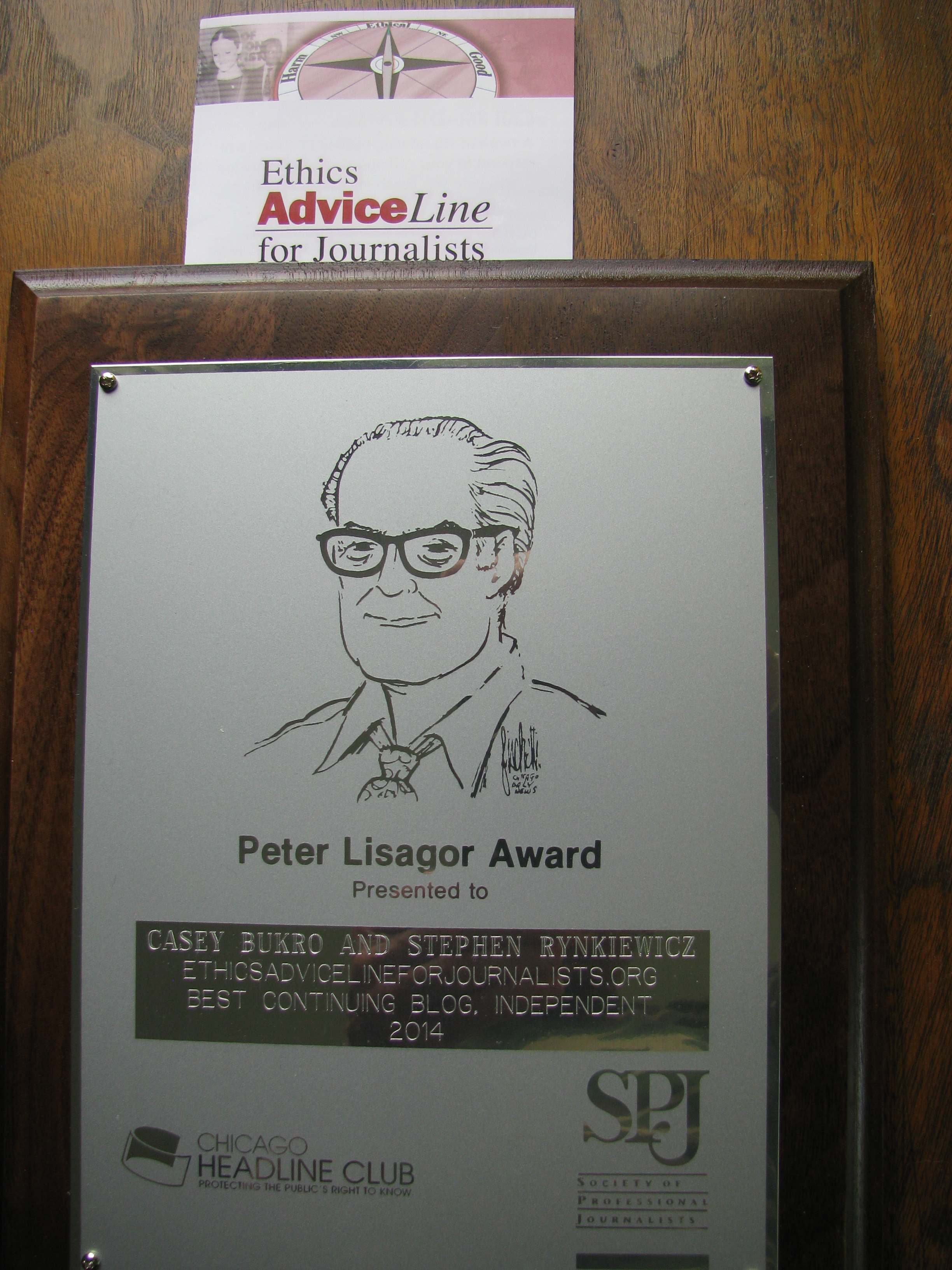
Dilemmas and Difficult Choices

mybestwriter.com image

By Nancy J. Matchett

Professionals wrestling with ethical issues often describe themselves as facing dilemmas. But in many situations, what they may really be facing is another kind of ethically difficult choice.

In a genuine ethical dilemma, two or more principles are pitted head to head. No one involved seriously doubts that each principle is relevant and ought not to be thwarted. But the details of the situation make it impossible to uphold any one of the principles without sacrificing one of the others.

In a difficult ethical choice, by contrast, all of the principles line up on one side, yet the person still struggles to figure out precisely what course of action to take. This may be partly due to intellectual challenges: the relevant principles can be tricky to apply, and the person may lack knowledge of important facts. But difficult choices are primarily the result of emotional or motivational conflicts. In the most extreme form, a person may have very few doubts about what ethics requires, yet still desire to do something else.

The difference here is a difference in structure. In a dilemma, you are forced to violate at least one ethical principle, so the challenge is to decide which violation you can live with. In a difficult choice, there is a course of action that does not violate any ethical principle, and yet that action is difficult for you to motivate yourself to do. So the challenge is to get your desires to align more closely with what ethics requires.

Are professional journalists typically faced with ethical dilemmas? This is unlikely with respect to the four principles encouraged by the SPJ Code (Seek Truth and Report It, Minimize Harm, Act Independently, and Be Accountable and Transparent). Of these, the first two are most likely to conflict, but so long as all sources are credible and facts have been carefully checked, it should be possible to report truth in a way that at least minimizes harm. Somewhat more difficult is determining which truths are so important that they ought to be reported. Reasonable people may disagree about how to answer this question, but discussion with fellow professionals will often help to clear things up. And even where disagreement persists, this has the structure of a difficult choice. No one doubts that all principles can be satisfied.

Of course, speaking truth to power is not an easy thing to do, even when doing so is clearly supported by the public’s need to know. So motivational obstacles can also get in the way of good decision-making. A small town journalist with good friends on the city council may be reluctant to report a misuse of public funds. It is not that he doesn’t understand his professional obligation to report the truth. He just doesn’t want to cause trouble for his friends.

This is why it can be useful to resist the temptation to classify every ethical issue as a dilemma. When facing a genuine dilemma you are forced, by the circumstances, to do something unethical. But wishing you could find some way out of a situation in which ethical principles themselves conflict is very different from being nervous or unhappy about the potential repercussions of doing something that is fully supported by all of those principles. Accurately identifying the latter situation as a difficult choice makes it easier to notice — and hence to avoid — the temptation to engage in unprofessional forms of rationalization. That doesn’t necessarily make the required action any easier to actually do, but getting clearer about why it is ethically justified might at least help to strengthen your resolve.

Ethical dilemmas are more likely to arise when professional principles conflict with more personal values. Here too, the SPJ Code can be useful, since being scrupulous about avoiding conflicts of interest and fully transparent in decision-making can mitigate the likelihood that such conflicts occur. But journalists who are careful about all of this may still find that issues occasionally come up. As the recent case of Dave McKinney shows, it can be very difficult to draw a bright line between personal and professional life. And the requirement to act independently can make it difficult to live up to some other kinds of ethical commitments.

Whether this sort of personal/professional conflict counts as a genuine dilemma is subject to considerable philosophical dispute. The Ancient Greeks tended to treat dilemmas as pervasive, but modern ethics have mainly tried to explain them away. One strategy is to treat all ethical considerations as falling under a single moral principle (this is the approach taken by utilitarianism); another is to develop sophisticated tests to rank and prioritize among principles which might otherwise appear to conflict (this is the approach taken by deontology). If you are able to deploy one of these strategies successfully, then what may at first look like a professional vs. personal dilemma will turn out to be a difficult choice in the end. Still, many contemporary ethicists side with the Greeks in thinking such strategies will not always work.

If you are facing a genuine dilemma it is not obvious, from the point of view of ethics, what you should do. But here again, it can be helpful to see the situation for what it is. After all, even if every option requires you to sacrifice at least one ethical principle, each option enables you to uphold at least one principle too. In addition to alleviating potentially devastating forms of shame and guilt, reflecting on the structure of the situation can enhance your ability to avoid similar situations in the future. And if nothing else, being forced to grab one horn of a genuine dilemma can help you discover which values you hold most dear.

******************************************

The Ethics AdviceLine for Journalists was founded in 2001 by the Chicago Headline Club (Chicago professional chapter of the Society of Professional Journalists) and Loyola University Chicago Center for Ethics and Social Justice. It partnered with the Medill School of Journalism at Northwestern University in 2013. It is a free service.

Professional journalists are invited to contact the Ethics AdviceLine for Journalists for guidance on ethics. Call 866-DILEMMA or ethicsadvicelineforjournalists.org.


The Steve Kroft Affair


By Casey Bukro

We here at Ethics AdviceLine for Journalists sometimes clash over what is ethical or not.

The Steve Kroft affair is the latest example.

The veteran “60 Minutes” correspondent admits he had a three-year fling with a New York City lawyer, though both are married.

“I had an extramarital affair that was a serious lapse of personal judgment and extremely hurtful to my wife and family, and for that I have nothing but regret,” Kroft said in a statement to the New York Post. Both the Post and the National Enquirer published salacious text messages between Kroft and his lover, proving once again that anything on the internet is not private.

A CBS spokesperson said “It’s a private matter.”

Soon after the scandal broke, an AdviceLine colleague wrote: “Are personal values/ matters the same as professional matters? Should I teach my students that I don’t care what they do in their personal lives as long as they make good ethical choices in their professional ones? Personally, this Kroft story does not interest me. His professional work does.”

Kroft is one of the most high-profile journalists in America. He has been a CBS newsman for 31 years, 26 of them as a correspondent with “60 Minutes,” which specializes in asking the high and mighty tough questions about their personal lives, their entanglements, their dalliances and the quality of their professional judgment.

Here’s what I say to my AdviceLine colleague: What people do in their personal lives reflects on their credibility and integrity. I don’t think you can separate personal and work lives that easily.

By your reasoning, we should have ignored Bill Clinton’s affair with Monica Lewinsky, as we did with JFK and his affairs. Looking back on JFK, journalists are criticized now for turning a blind eye to his dalliances. Now we’re more inclined to think about accountability.

Kroft is a very public figure by virtue of his role on “60 Minutes.” Part of his job is exposing the conduct of public officials. I would buy your argument if he were not a public figure. That is why, in ethics, we draw the distinction between public and private individuals.

Also, there is the issue of blackmail. Anyone involved in something he or she does not want the public to know is subject to the possibility of blackmail and manipulation.

Tell your students that they have to be smart enough to recognize that ethical values apply to all facets of people’s lives, especially to public figures, and that they, themselves, become public figures when they become very visible journalists. Think Woodward and Bernstein.

That’s why, these days, we encourage publishers and editors to avoid becoming involved in civic organizations, a practice that once was common, and to a degree still is. There is the public perception that if a publisher is an official on the board of a civic organization, he will favor that organization and give it favorable publicity. He also is seen likely to keep bad information about the organization out of the news.

The Society of Professional Journalists code of ethics warns journalists to avoid conflicts or interest, real or perceived.

All of this is in the realm of accountability, an issue we take more seriously these days. People with ethics issues should not be pointing fingers at others with ethics issues. “60 Minutes” sets very high standards and its correspondents should measure up to them.

Personally, I always thought my role as a journalist meant that I was forbidden from doing things others could do. When I covered finance, I avoided buying stock in companies I covered. I did not join organizations I covered. I did not take part in political campaigns.

You can argue that any American citizen is entitled to do those things, and you would be right. But I always believed that anything I did should be above reproach. Being a journalist was paramount. It is an honor, a privilege and a duty to be smart enough to avoid any activity that could tarnish my reputation, and the reputation of the journalism organization I worked for.

Too often, the public complains that the media gleefully write about the transgressions of politicians and others, while keeping silent about the transgressions of journalists. The “old boy” syndrome. They say we cover up for each other. It’s a double standard. We should report on the transgressions of journalists as vigorously as we do about the transgressions of others. It’s only fair.

Comments are welcome.

Rape, Cosby and UVA

A story in Rolling Stone featured the alleged gang rape of a University of Virginia student, launching calls for reform and more attention to the issue of sexual assaults on campus. Recent reporting by the Washington Post, however, has raised doubts about the veracity of the story.
Fraternity house named in alleged rapes (Ryan M. Kelly, The Daily Progress/AP file)

How aggressively did journalists pursue the facts?

By Casey Bukro

Rape became big news with allegations against Comedian Bill Cosby and an explosive Rolling Stone story describing a gang rape of a co-ed at a fraternity house on the University of Virginia campus, for which editors later apologized for “discrepancies.”

Both rape stories raised questions about how journalism works in America and whether it can be trusted.

Where were the editors while these stories were being covered? Tough editors ask tough questions, and demand answers from their own reporters about how they got the story and whether it’s supported by hard investigation.

Media are accused of failing to dig into serial rape accusations over decades against Cosby, who was seen as a popular father figure as he was portrayed on his television show.

About 20 women have accused Cosby of drugging them, and often raping them. But he has not answered to what he calls “innuendos.” Some of the accusers have been challenged. Cosby’s most recent comment is that his wife is dealing well with the controversy.

Pushing back, Cosby’s lawyer accuses a reporter of deception, and his wife, Camille, contends the media failed to take a close look at her husband’s accusers.

The Rolling Stone gang rape story by Sabrina Rubin Erdely is based on a single source, a woman identified only as “Jackie,” who claimed she was lured to a 2012 fraternity party by a man named “Drew,” and raped by seven men. The Washington Post described the story.

Good reporting usually involves getting all sides of the story. Erdely admitted that she made a deal with Jackie that no attempt would be made to find and interview anyone else involved in the alleged rape, or knew about it.  And her editors allowed her to get away with a violation of a basic tenet of good reporting – getting multiple sources to verify the accuracy of the story

The editors allowed this unusual dispensation from careful reporting because the story was “sensitive.” Yes, rape is a sensitive issue, but not a reason to suspend professional standards in reporting. Sensitive stories require more careful reporting, not less.

The Society of Professional Journalists code of ethics urges caution in reporting sex crimes.

The story was widely reported and put a spotlight on campus rape. Then came questions about its accuracy. The accused fraternity had no party on the night the rape allegedly happened, and issued a statement saying that sexual assault was not “part of our pledging or initiation process.” It appeared to be fabricated and continues to be called into question from many sources.

Media followed the story as a lesson in journalism and ethics. A defamation suit against Rolling Stone is a possibility.

Rolling Stone’s managing editor, Will Dana, issued a statement:  “In the face of new information, there now appear to be discrepancies in Jackie’s account, and we have come to the conclusion that our trust in her was misplaced.”

Other media noticed the discrepancies. Pittsburgh Post-Gazette Columnist Jack Kelly calls the story “an unforgivable breach of journalism ethics” and thinks the fraternity house should sue Erdely and Rolling Stone for libel.

Rolling Stone editors believed Jackie was credible, according to Leslie Loftis in the Columbia Journalism Review,  because of a bias – a willingness to believe Jackie because “everyone knows that there is an epidemic of rape on campuses around the country….”

It’s what you know, or want to believe, that can set a trap.

The editors at the Washington Post wanted to believe one of their bright and upcoming reporters, Janet Cooke. She wrote “Jimmy’s World,” a story about an 8-year-old heroin addict in a family of addicts. Narcotics addiction was a big issue in 1980.

That story was so good, it won a Pulitzer Prize in 1981.

Then came the questions. A Washington Post editor asked Cooke to get in a car and go with him to identify where Jimmy lived. They drove around and could find no Jimmy. Cooke eventually admitted she invented Jimmy.

Cooke said the Post’s high-pressure newsroom corrupted her judgement. She said she had heard about somebody like Jimmy. She decided to write the story, based on anonymous sources, to satisfy her editors, she said.

The Post’s ombudsman wrote a long critique on the “Jimmy’s World” story, and found that the editors bore heavy responsibility, adding that “everybody who touched this journalistic felony was wrong.”

Good editors are supposed to do the hard work of keeping stories honest.

“Don’t tell me what you think, chum. Tell me what you know!” said a fabled, crusty editor at the former City News Bureau of Chicago, once called the Devils Island of Journalism. He grilled his reporters as vigorously as he expected his reporters to grill their sources.

3 Ethical Pressure Points for Journalists on Twitter

Twitter shades of gray

Shades of gray: Rumor, intent and context in reporting on social media

By David Craig

This post is a condensed version of an article I wrote on the website Mediamorals.org.

For many journalists and news organizations, Twitter has shifted in a few years from being an oddity and add-on to a key tool for gathering and reporting news.

The thinking about ethics and best practices in journalistic use of Twitter has sharpened and evolved since the platform’s early days. But the ethical challenges persist, and the boundaries of best practices are difficult to nail down. Here, I will look at three continuing ethical pressure points for journalists using Twitter.

Handling unverified information

The continuous flow and immediate spread of information on social networks make this part of journalists’ work, which has always been challenging, more difficult. The consequences of incorrect information – whether about individuals, companies or governments – can be devastating and global. And with journalists occupying only a small space in the larger network of information flow, the pressure to pass on and amplify information prematurely becomes much greater.

My interactions with journalists, tracking of Twitter discussion, and reading suggest that journalists’ understanding of best practices with unverified information sits on a continuum from not tweeting until verified to acknowledging on Twitter while simultaneously checking. (For contrasting perspectives, see this AdviceLine post.)

The notion of reporting information in the process of being verified is in line with what City University of New York journalism professor and blogger Jeff Jarvis calls “process journalism,” which emphasizes being transparent about what one does and does not know, rather than waiting for a final finished product – which he argues is never perfect itself. I think the key challenge with this approach – and the lingering question for journalists – is how to be transparent in the midst of the larger network flow while maintaining truthfulness and minimizing harm.

What is the proper balance among these principles? Transparency alone doesn’t guarantee truthful information. Focus on minimizing harm alone can keep reports out of the public eye, even though members of the public might be able to help corroborate or dismiss them in an open network. Paying attention to the importance of the truth that is being reported alongside the extent of the harm that may result – a common balance in journalism ethics – helps in sorting out whether to transparently acknowledge unverified information on Twitter.

Beyond this, it’s important to use all available resources to verify content. As BBC News social media editor Chris Hamilton has told me, that means making the most of both technical tools such as Google Earth and reverse-image searches to check content shared through tweets and other means. But it also means using critical thinking to look for evidence of falsity and ask questions of human sources.

Navigating boundaries between personal and professional identities

The dual and overlapping uses of social media for personal and professional purposes create ambiguity about the identity of journalists using Twitter and other social platforms. One can signal intentions to some extent with a Twitter profile listing professional affiliations alongside some personal information, but not everyone will see the profile or the larger context of the kinds of things being tweeted.

I don’t think it’s necessary or helpful to agonize over whether journalists should offer routine tidbits about their personal lives in the same feeds they use for their journalism. As some journalists argue, doing that just shows they are human like their audiences. This may serve to increase rather than diminish their credibility. The bigger issue becomes how to handle opinion, especially opinion associated with what one is writing about.

Kelly Fincham, a professor at Hofstra University on Long Island, New York, studied a number of major news organizations’ social media policies for a chapter in Ethics for Digital Journalists, a book I co-edited. She found that although there were “some small signs” that “opposition to transparency about viewpoints is weakening,” overall the guidelines still warn against stating opinions on social media.

In the guidelines she studied, Fincham found that there has been a substantial shift since early days, from the expectation of separate Twitter profiles for personal and professional activity to a consensus that journalists should have single accounts. But single accounts do leave open the possibility that different people coming from one’s personal or professional worlds will assume different things about the intent of the account holder.

There is no foolproof way to navigate the challenges that come from the ambiguity of professional versus personal on Twitter. In ethical terms it’s important to be transparent by signaling the scope of the social world represented by including both professional and personal elements in the profile, or only professional elements if the focus will really be limited to those.

Providing context and narrative structure

From my own use of Twitter, I have seen how difficult it is to include structure and context. The character length limit makes it challenging to provide context for the meaning and significance of individual words. Other challenges involve connecting multiple tweets in a coherent way, especially given that many people get thousands of tweets a day and move in and out of the platform. It’s almost guaranteed that some followers will miss some tweets. From an ethical standpoint, this means that the truth users take away from these messages is fragmented and often missing some of the intended pieces.

Journalists have had several years of Twitter use to gain experience looking for ways to provide context and a coherent narrative. Jonathan Hewett, in another chapter in Ethics for Digital Journalists, notes the simple approach of numbering each segment of a series of related comments, in ways such as “1/3,” “2/3,” etc. (if the number is known). Parallel wording can also help, as he noted in an example of multiple tweets introduced by “Survivor of boat sinking:” or, in subsequent tweets, simply “Survivor.” He said BBC journalist Dominic Casciani has been trying “signposting” of tweets – “alerting users at the start of the day to what he’ll be covering later, for example, or providing a reminder of key points to add context and/or to help those who have not been following the story.”

Twitter hashtags also can help to provide context by keeping related tweets connected with one another.

On a larger scale, Storify has enabled journalists and others to combine tweets and other social posts in a single document and, if desired, add explanatory sentences of introduction and connection. But the tweets can end up in different contexts than the originals did by being selected for inclusion when related tweets were not.

All of these approaches using Twitter and related tools provide means to meet the ethical goal of truth telling to the greatest extent possible within the format.


Cosby: When The Media Watchdogs Bark, Or Not


By Casey Bukro

The serial rape allegations against Comedian Bill Cosby have reached the stage where people are asking why the media failed to report them when they happened.

It’s complicated and messy, in part because Cosby denies the allegations and calls them “innuendos” from the distant past which he will not dignify with a response.

The public often blames the media for hounding celebrities, sometimes to the point of ruining their reputations. Other times, the media are accused of promoting popular celebrities to the point of being a cheering section.

Both true.

It could be argued that Cosby got the cheering section treatment for decades. But now that’s changing and causes observers to wonder if media watchdogs failed, professionally and ethically.

Especially troubling are media reports that, in exchange for an exclusive interview, Cosby made a deal with the National Enquirer to delay a story about a new rape accusation while the civil suit in another rape case was going on. That strikes to the heart of media responsibility to report the facts, and whether the media did that in Cosby’s case.

The Columbia Journalism Review  says the press is responsible for ignoring Cosby rape allegations, pointing out that People Magazine published an article in 2006 about five women who accused him of rape.

About 20 women have accused Cosby of assaults, most dating to the 1970s and 1980s.

From a wider perspective, rape is one of those issues where the media tend to reflect societal attitudes, which includes the issue of privacy for both public and private figures. And all of that is changing fast. Media always had a responsibility to lead public opinion, not just follow it.

Not so long ago reporters ignored the private peccadillos of powerful figures in the belief that what they did in private was their business, not the public’s. Their silence was called “a gentleman’s agreement.”

Think President John F. Kennedy and President Dwight D. Eisenhower.

Kennedy was a known cavorter, but the White House press corps ignored it, in part to stay in the president’s good graces.

Rumor had it that Eisenhower had an affair with his war-time chauffeur, Kay Summersby, who confirmed it in 1975 in a memoir titled “Past Forgetting: My Love Affair with Dwight D. Eisenhower,” before she died. The rumors stayed mostly under wraps until the memoir appeared.

But rape is far more complicated. In the past, police departments sometimes minimized it as a he said/she said sort of thing. Women were sometimes twice victimized by rape and then accused of bringing it upon themselves. Sometimes they were ashamed to talk about it, especially when alcohol was involved.

It is a topic coming out of the shadows as women are more inclined to talk about it, and the media more inclined to report on it partly as a result of that openness and changing social views. That comes at a time when other sensitive issues, such as gay rights and abortion, are discussed more openly.

The Cosby accusations  stretch over decades, enough time to show how differently the issue is treated, then and now.

The case against Cosby snowballed recently after supermodel Janice Dickinson publicly accused the entertainer of drugging then raping her in 1982 when she met with him, hoping he would help advance her career. Dickinson is one of about 20 women who tell similar stories, one of whom was 15 years old at the time.

Nostalgia is another time-related thing.

Entertainment is a fantasy, just as Cosby as Cliff Huxtable was a fantasy. But it was a fantasy that the public desperately wanted to believe, wrote Vox.com’s Amanda Taub. They wanted to keep happy childhood memories of the Cosby show.