Category Archives: Videos

Mizzou Students and Faculty Flunk Press Freedom Test

Heated: Activists at the University of Missouri were caught on camera forcing photographer Tim Tai (left) off the public quad on Monday, during their celebrations over the resignation of President Tim Wolfe

Photographer Tim Tai explains First Amendment

By Casey Bukro

Amid the chaos of student and faculty protests over racial tensions at the University of Missouri, student photographers Tim Tai and Mark Schierbecker stood out as young men who understood their First Amendment rights to photograph and videotape the historic event in a public place.

Sadly, Tai and Schierbecker were badgered, harassed and bullied by students and faculty while trying to do their jobs.

Schierbecker videotaped Tai as he was harangued, surrounded and pushed by a crowd of students and older individuals who held their hands in front of his camera and would not allow him to move forward.

“We will just block you,” says one. “You need to go.”

Others chanted, “hey, hey, ho, ho. Reporters have got to go.”

Another says, “You gotta go, bro. You lost this battle, bro. Just back up.”

To his credit, Tai stood his ground and explained patiently, “The First Amendment protects your right to be here and mine.” He added, “I’ve got a job to do.”

Continue reading Mizzou Students and Faculty Flunk Press Freedom Test

Killing the Messenger, Live: Journalists Killed on Video

By Casey Bukro

Killing the messenger takes new meaning when you see it live, in living color, as happened in the deaths of a Virginia television news reporter and her cameraman.

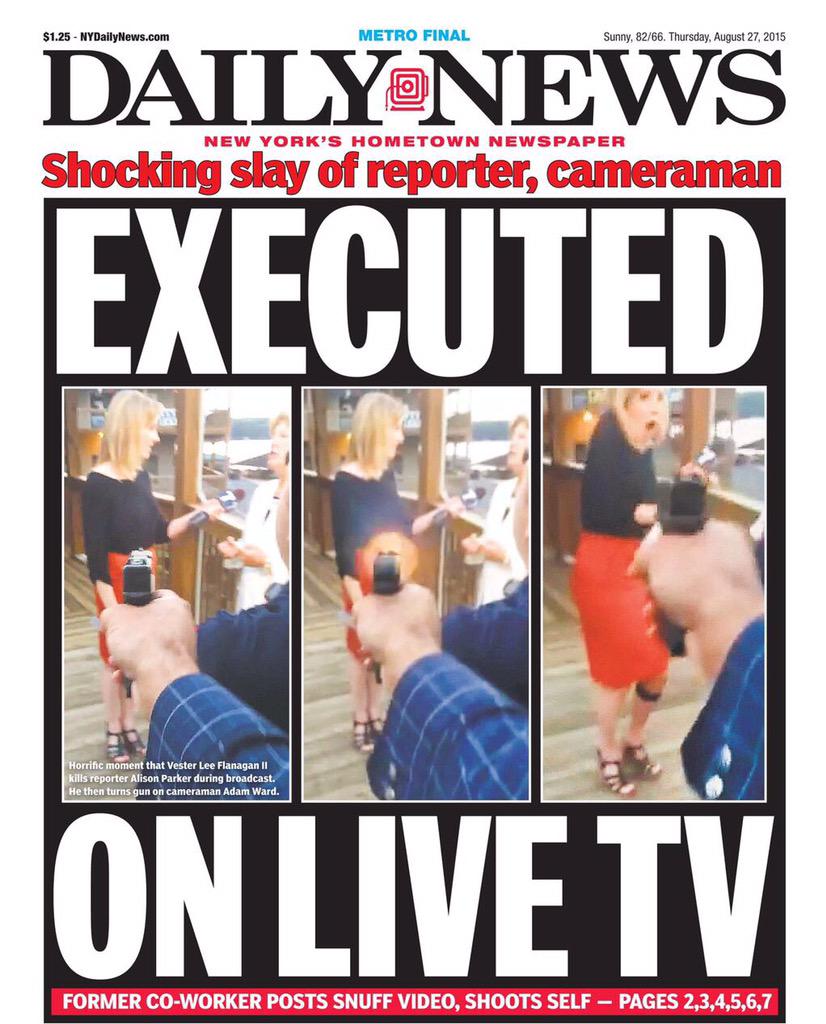
WDBJ correspondent Alison Parker was conducting an on-air interview in a Moneta, Va., shopping center when she and the photographer, Adam Ward, were shot and killed by a disgruntled former colleague who also videotaped the attack and put it on social media.

The New York Daily News gave the murders front-page display, in very graphic detail than some TV outlets shunned.

Embedded image permalink

Killings on video are increasingly common these days. Journalists are among those targeted now, becoming victims and not just reporters of  events. Parker and Ward’s names are now added to a list that included James Foley and Daniel Pearl.

Tech-savvy killers use social media and the internet these days to show their crimes.

The Islamic State group released a video in 2014 showing Foley, clad in an orange gown, kneeling on the ground next to a man dressed in black holding a knife. Foley makes a short statement and then is decapitated.

In 2002, Pearl, a correspondent for The Wall Street Journal, disappeared while on assignment in Karachi, Pakistan. Video shown around the world via the Internet showed Arab extremists cutting his throat, then decapitating the reporter.

In this world of social media, terrorists don’t need reporters to tell their message. Terrorists can do that themselves now, and one way of doing that is killing reporters.

Continue reading Killing the Messenger, Live: Journalists Killed on Video

Ethics of Using Internet Video of Police Conduct

WBEZ video
WBEZ reposted video it credited to YouTube user King-Dubb.


From the Ethics AdviceLine for Journalists archives

By Casey Bukro

Back in 2011, Chicago radio reporter Steve Edwards was covering gang violence and Chicago police for WBEZ when a video surfaced, showing youths menacing a suspect in the back seat of an open police squad car.

Was it ethical to use that video on a WBEZ broadcast?

That’s what Edwards wanted to know when he called the Ethics AdviceLine for Journalists. The video shows two Chicago police officers standing at the parked blue-and-white SUV with the doors open in Chicago’s violence-prone Humboldt Park area. A group of shouting young men, some possibly minors, taunt a suspect cowering in the back seat and trying to cover his face.

Someone tells the photographer, possibly a gang member, “get a close-up.” The photographer posted the video on YouTube and quickly took it down.

Edwards told AdviceLine that WBEZ had been investigating allegations that Chicago police had a history of subjecting gang members to harm by picking them up, then dropping them off in “enemy” gang territory.

The Chicago Police Department told Edwards that it got a complaint about the incident and released this statement:

“The conduct that is alleged does not reflect the behavior and core values of the men and women of the Chicago Police Department nor our commitment to serve the community in a professional manner.” The department said its internal investigations divisions began an investigation.

In 2013, the Chicago Police Department announced that it had dismissed the two police officers involved in the incident, saying the charges included “unlawfully restraining a youth, transporting him without a valid police purpose to the turf of a gang that would threaten him and making a false statement about the incident to an Internal Affairs detective.”
Continue reading Ethics of Using Internet Video of Police Conduct