Category Archives: Fairness

An Ombudsman’s Dilemma

By Casey Bukro

See how the Toledo Blade’s ombudsman handles a reader’s complaint that the newspaper’s president and general manager also serves as chairman of the University of Toledo’s board of trustees.

The reader calls that a conflict of interest. The ombudsman says it’s not because the paper’s president operates on the business side of the newspaper, not the news side.

The reader correctly wondered how the newspaper can independently cover university activities when its president is head of the university’s board, especially when the university is in the process of selecting a new president.

AdviceLine periodically gets complaints about cases like this where top news officials serve on local civic organizations. The defense often is that the media official is performing a civic duty.

The Blade’s ombudsman cites the Society of Professional Journalists code of ethics in his president’s defense, but does not mention that the code warns against conflicts of interest, “real or perceived.”

Notice that in the Toledo case the reader is not convinced that the president’s involvement with the university is innocent and free of potential duplicity. That’s probably a typical reaction.

Civic organizations usually invite media officials to serve on their boards in hopes of publicity. The public knows that.

Given the threat to media credibility, this long-time practice should be abandoned. It’s from another era, before the changes now transforming journalism.

Especially lately, AdviceLine is getting more complaints from reporters about publishers and editors dictating news coverage favoring advertisers, in the pursuit of revenue.

In the real world, the argument that publishers or other top media managers operate strictly on the business side and do not influence the news side is a bit misleading. The boss, after all, is the boss, and he or she knows it. That can lead to a few “suggestions” from the top.

But it’s always interesting to see how an ombudsman defends the actions of his boss. You can decide how convincing he was.

Three Ethics Takeaways From ONA Conference

Alberto Cairo
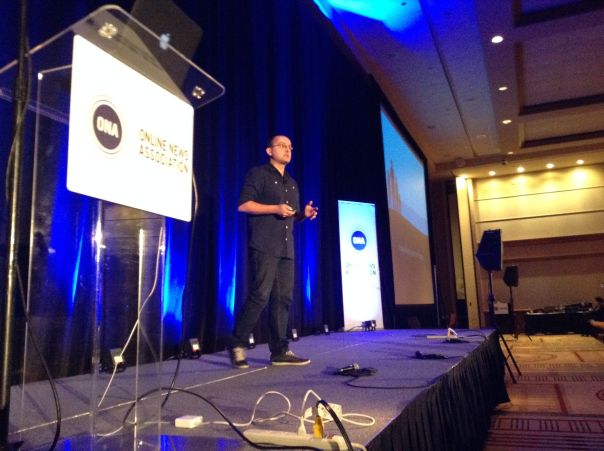
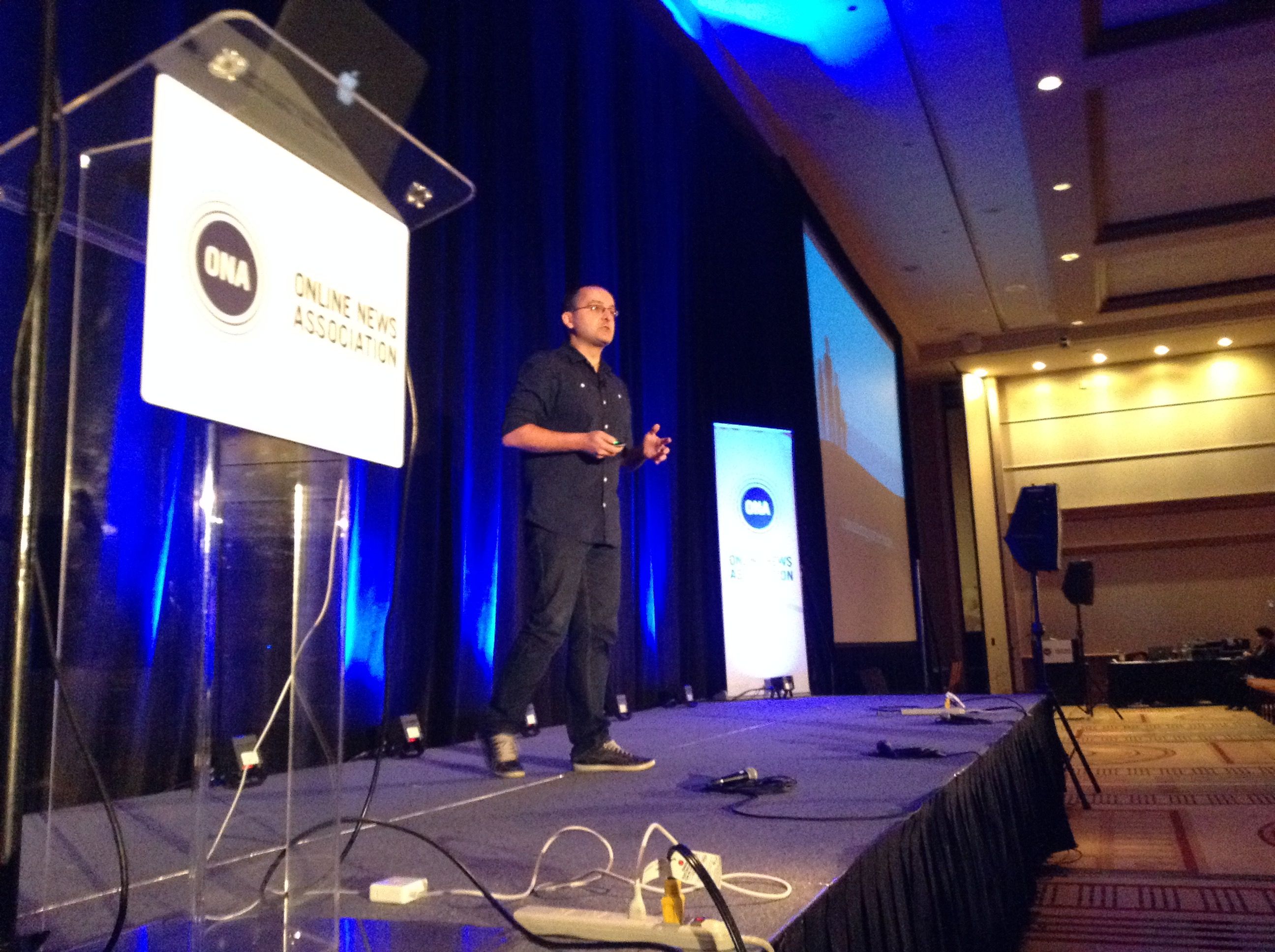
Alberto Cairo of the University of Miami says ethics have not kept pace with data visualization techniques. (Stephen Rynkiewicz photo)

By David Craig

The Online News Association annual conference, which I attended September 24-27 in Chicago, always provides great updates on trends and issues in digital journalism. But it’s also a great place to hear about ethical challenges, both new and continuing.

Ethical issues were the focus of three sessions, including a challenge session in which audience members had to react quickly to ethical scenarios on topics such as use of user-generated content. But ethics also came up in sessions that were primarily about other topics.

Here are three ethics takeaways from the conference:

1. Content that disappears will create new ethical challenges. Amy Webb, founder of Webbmedia Group, delivered her annual talk on “10 Tech Trends for Journalists.” One of them was “ephemeral content,” an increasingly popular kind of social media communication.

Webb said Snapchat, an app developed to share photos that’s popular with young people, provided a way to send private content that users might not want to stay around, but “it’s also a way to clear up our cluttered social streams.” She said other companies are providing messaging services with content that disappears, appears anonymously or is even encrypted. She predicted that most messaging apps will have some kind of means of making content ephemeral in the next 24 months.

Ephemeral content is relevant to journalism because some news organizations including The Washington Post are experimenting with it. But Webb pointed to an ethical difficulty: “Ephemeral content can be used for publishing news. But it can’t be corrected, because no record is left.”

This kind of communication raises questions of accountability for the accuracy of content because once it’s gone, there’s no way to amend a false message or even verify what the message said.

“Talk internally about the implications,” Webb suggested to news organizations.

Even for journalists who don’t use this kind of content, the discussion points to ongoing questions about what it means to ethically handle incorrect content in social media messages.

2. Algorithms shape the truth that people learn about the world and point to new ethical obligations for journalists. Kelly McBride, vice president for academic programs at the Poynter Institute for Media Studies, and Nick Diakopoulos, a journalism professor at the University of Maryland and an expert in computational journalism, presented a session titled “Algorithms are the New Gatekeepers.”

McBride said algorithms, because they shape how news is distributed and to whom, have a powerful influence on what gets attention in the marketplace of ideas. As one of the presentation slides showed, they also affect a huge number of other areas of life including search rankings, online recommendations, advertising and relationships.

Diakopoulos talked about the power of algorithms in influencing the information we receive because of their ability to prioritize, classify, associate and filter it. He argued that the power they carry suggests new responsibilities – and opportunities – for journalists in reporting because they can help hold algorithms accountable. Stories might address issues including discrimination, mistakes that deny service, censorship, illegal activity or false predictions.

This kind of reporting isn’t easy. He pointed to several possible approaches to “auditing” algorithms – reviews of computer code, surveys of users about their experience, analysis of input and output, having users report data and (with ethical problems he acknowledged) impersonating users with programs.

Despite the difficulties, the social and economic impact of algorithms make it important for journalists to try new ways of reporting.

3. The power and availability of data visualization tools call for increasing attention to the ethics of visualization messages. Alberto Cairo, a professor at the University of Miami who teaches on informational graphics and data visualization, gave a session called “The Journalist, the Artist and the Engineer: The Ethics of Data Visualization.”

Cairo argued that the core goal of journalism ethics is to improve the public’s understanding of issues “relevant for their conducting good lives” while minimizing any potential harm. He said tools to create interactive charts, maps and other informational graphics are becoming more popular and widely available but that ethics is not keeping pace. He said that helping the public understand what good, ethical visualizations look like can help to better society and avoid the impact of misleading messages.

Even though great data visualizations are beautiful as well as functional, Cairo said, they must hold to a high standard of truthfulness that doesn’t oversimplify or distort the information being represented. Using the example of a graphic from the National Cable Television Association, he talked about going from showing things that are true but may leave out important information to showing a picture that’s more complicated but also truer and more accurate.

Cairo urged the audience not to hide complexity from the public or point to patterns that really aren’t there. In doing so, he is rightly pointing to a standard of care in visualization that is as high as the standards used in good investigative writing.
Bashir’s Legal But Unethical Comments

By Lee Anne Peck

Occasionally, when outraged news consumers want to vent about a professional media organization and/or its staff, Ethics AdviceLine for Journalists will receive calls from these disgruntled citizens.

Our line, however, helps journalists with ethical dilemmas they face; we do not take complaints from callers who want us to get someone reprimanded or fired.  We do advise these callers to contact the news organization with which they have an issue and voice their concerns. (See the SPJ code of ethics which states: “Encourage the public to voice grievances against the news media.”)

Such was the case after MSNBC political talk show host Martin Bashir’s commentary Friday, Nov. 15. I returned to Colorado from a trip to South America the weekend after his diatribe about Sarah Palin; I was clueless to the outrage Bashir had caused, but three callers to the AdviceLine wanted his head.

Bashir, formerly a host of ABC’s Nightline program, took Palin to task for her comments about the U.S. debt to China and slavery. On air, Bashir told the story of plantation owner Thomas Thistlewood, who had a slave “flogged and pickled, then made … another slave shit in his mouth.”

“When Mrs. Palin invokes slavery,” Bashir said during his commentary, “she doesn’t just prove her rank ignorance, she confirms that if anyone truly qualified for a dose of discipline from Thomas Thistlewood, then she would be the outstanding candidate.”

Let’s consider the SPJ code of ethics. What does this code say about behavior such as Bashir’s? The guidelines are often too cut and dry for specific situations, of course. However, we could start with these principles from the code. Journalists should:

  • Examine their own cultural values and avoid imposing those values on others.
  • Avoid stereotyping by race, gender, age, religion, ethnicity, geography, sexual orientation, disability, physical appearance or social status.
  • Support the open exchange of views, even views they find repugnant.
  • Distinguish between advocacy and news reporting. Analysis and commentary should be labeled and not misrepresent fact or context.

Did Bashir have the right to speak the way he did about Palin? Sure—First Amendment rights. Was it ethical for Bashir to say those things about her? Probably not. Just because it was legal for him to say those things doesn’t make it right for him to say what he did merely because of the “golden rule.” The public made that very clear.

He apologized on air the next Monday, but that wasn’t good enough. On Dec. 4 he resigned.

Pitfalls of Identifying Bystanders as Bombers

By Casey Bukro

Stupidity is not a crime, and ethical lapses usually will not land you in jail.

But they have consequences, as the New York Post learned when two men sued the tabloid newspaper for showing them in a front-page photo at the height of the search for Boston Marathon Bombing suspects, with a “Bag Men” headline.

CNN reported that the men, 16 and 24-years old, accused the Post of libel, negligent infliction of emotional distress and invasion of privacy for showing them standing next to each other in the April 18 edition. Also displayed in large letters on the photo were the words: “Feds seek these two pictured at Boston Marathon.” The photo appeared three days after the Boston bombing, making it appear that the FBI were searching for them. One of them wore a backpack.

Post editor Col Allan said the Post did not identify the men as “suspects.”

Huffington Post reported outrage at the use of the photo, with some calling it “a new low” and “appalling.”

Later that day, authorities released photos of Boston bombing suspects Tamerlan and Dzhokhar Tsarnaev.

NBCNEWS.com reported that the two innocent men were stunned to see themselves pictured on the front page of the tabloid and one of them suffered a panic attack.

Minimize harm, advises the Society of Professional Journalists code of ethics. And be judicious, it says, about naming criminal suspects before they are charged. Though the two men were not  named by the Post, it’s an apt comparison when showing their faces.

The New York Post photo is considered an example in a series of errors and false reports that were rampant during the frenzy of trying to learn motives for the bombing, and who did it.

Crowd sourcing, it turned out, was not as valuable as its supporters might have supposed. Authorities essentially told the public they were not interested in the flood of iPhone photos that were offered of people and things considered suspicious. Instead, authorities zeroed in on the Tsarnaev brothers by using highly sophisticated identification technology.

There’s one more questionable thing about that New York Post photo, and that’s the use of the words “Bag Men.” You don’t have to be from Chicago or New York to know “bag man” is slang for a person who collects money for racketeers, or a mob errand boy.

It was bad enough that two innocent men were linked falsely with the Boston bombing. It got worse when they were tainted with language that implied criminal activity. Words hurt. They also can get you sued.